
In the muscle car world, the build sheet is almost a religion. A folded piece of factory paper found under a seat spring can add tens of thousands of dollars to a car. Luxury classics have their own version of this, and while the documents look different, the principle is identical: paper that proves what a car is turns a good story into a verified fact, and the market pays for the difference. Build sheet and provenance culture in classic luxury cars is less about a single tucked-away form and more about assembling a file that can withstand scrutiny.
Market & Values
6 min read
Documentation and Build-Sheet Culture in Luxury Classics
How build records, chassis-to-body matches, and ownership history define a classic luxury car's value, and how to spot faked paperwork.
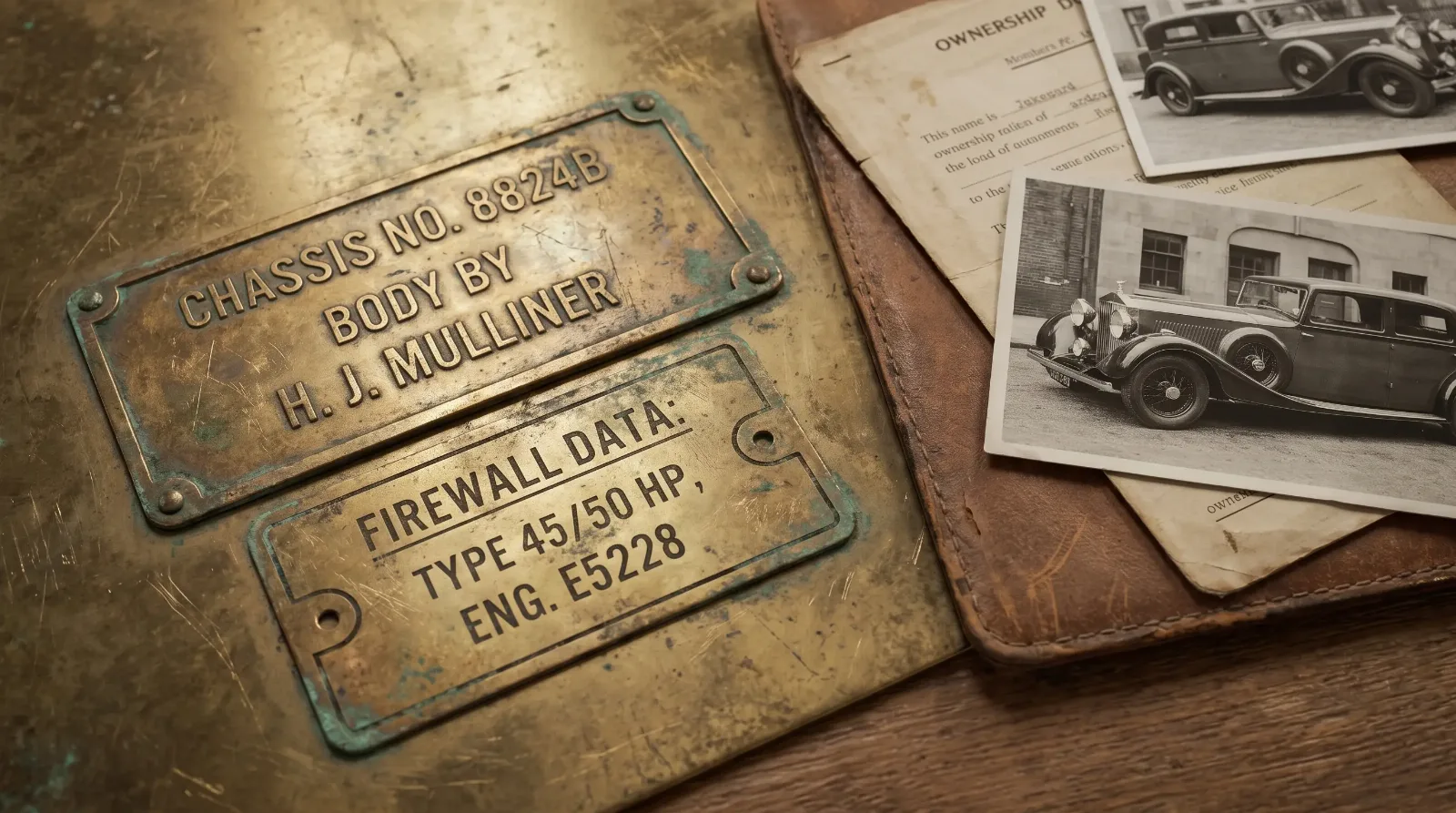
I appraise cars where the only difference between two similar examples is the thickness of the history folder, and that difference is routinely six figures at the top of the market and a meaningful percentage everywhere below it. Documentation is not paperwork you get around to later. It is part of the asset.
What counts as documentation in the luxury world
Pre-war and post-war luxury cars rarely have a single Detroit-style build sheet, so the documentation is a collection rather than one page. The strongest files include the factory or coachbuilder build records, which for marques like Rolls-Royce, Packard, or Duesenberg often survive through the clubs or factory archives. Add the chassis and body records that tie a specific body to a specific chassis number, period photographs, ownership history, old registration and title documents, and the receipts and records from any major restoration.
For coachbuilt cars, matching the body to the chassis is the central question, because bodies were sometimes moved, rebuilt, or replaced over ninety years. A file that closes that question is worth real money. If you are new to how these cars are bought and kept, the collecting and restoring guide covers where documentation fits in the ownership process.
Why documentation moves value
The reason is straightforward. At these prices, the buyer's biggest fear is not condition, which an inspection can assess. It is authenticity, which an inspection cannot fully resolve. A file that answers the authenticity question removes the fear, and a buyer who is not afraid pays more and negotiates less. That is the entire mechanism.
| Document | What it proves | Value impact |
|---|---|---|
| Factory / coachbuilder build record | Original spec, body, first owner | High |
| Chassis-to-body match record | The body belongs on this chassis | High (critical for coachbuilt) |
| Continuous ownership history | No unexplained gaps or swaps | Medium to high |
| Period photographs | Original configuration and finishes | Medium |
| Restoration records & receipts | Quality and scope of work done | Medium |
The exact premium varies by marque and by how much the market cares about that particular car, so treat these as directional. The direction, though, is never wrong: more verifiable paper means a stronger, more liquid sale.
Liquidity is the part owners underestimate. A documented car does not just sell for more, it sells at all when the market is quiet. In a soft season, buyers get cautious and gravitate to the cars where the risk is already resolved. A car with a complete file finds its buyer while the mystery cars sit unsold at optimistic numbers. I have watched two similar cars go to the same auction weekend, and the one with the folder hammered while the one with the story was bought in. The paper was the whole difference.
There is also a compounding effect over time. Documentation gathers weight the longer a car keeps it, because each new owner who preserves the file adds a verified link to the chain. A car that has carried its records through several owners is far more convincing than one whose history appeared suddenly before a sale. Continuity itself becomes evidence, and it is the one thing a seller cannot manufacture at the last minute.
"A number two car with a thin paper trail is not a number two car when the check clears. It is a number three with a good story, and any honest appraisal has to say so. The folder is not supporting evidence. On these cars, it is half the value."
David Mercer
The risks in the paperwork
Documentation cuts both ways, because paper can be wrong or faked. Restamped chassis numbers, reproduced build records, and photographs that do not actually show the car in front of you are all part of this market. Treat the file with the same skepticism you would apply to the metal. Cross-check the chassis number against the club or factory registry rather than trusting a printed sheet on its own. Look for internal consistency, because a genuine history hangs together and a fabricated one usually has a gap or a contradiction if you read it carefully.
The safest move is to have a marque expert or the club registrar review the file before you buy. They have seen the forgeries and know which records can be independently confirmed. A car whose documentation checks out against an outside source is worth far more than a car whose file simply looks impressive.
Building a file that protects your car
If you own one of these cars, treat its history as an asset you can grow. Keep every receipt from restoration work, photograph the car during any disassembly, and record what was replaced and what is original. Register the car with its marque club and get its records into the registry. Preserve the old titles and correspondence rather than discarding them, because a document that seems trivial today can close an authenticity question in twenty years.
Documentation also feeds directly into how you approach a restoration, because the decision to keep original parts or replace them is really a decision about the car's future paper trail. That trade-off, between originality and the work a car needs, is the subject of the next: Frame-Off vs Driver-Quality Restoration piece. Get the file right first, and every other decision about the car gets easier.
Related Reading
Have a
Classic Car
for Sale?
Reach thousands of serious classic car collectors across the US.
Sell It Here →
Are You a Classic Car Dealer?
List your full inventory and connect with targeted classic car buyers.
Join as a Dealer →

About the author
David Mercer
Classic car market analyst with two decades of experience tracking collector car valuations, auction results, and investment trends.

Comments
Be the first to comment on this article.