Every restorer who has chased period-correct trim for a late-1920s car eventually runs into the same wall: the plating looks slightly different depending on the exact production year, and it is not always obvious why. The answer is a materials shift that happened quietly across the decade, one that most owners at the time probably never noticed happening but that changed how these cars aged and how they get restored today. This is the 1920s chrome trim story, and the factory records on it are more specific than most people expect.
Nickel plating's long run
Through the brass era and into the early 1920s, exterior brightwork on American cars was almost universally nickel-plated brass or steel. Nickel gave a bright, warm finish that took a good shine, but it had two real problems. It tarnished relatively quickly when exposed to weather and road salt, and it required regular polishing to keep that shine, which meant an owner spent real time maintaining trim that looked dull within a season if neglected.
Manufacturers accepted this trade-off because there was not yet a better option in mass production. Nickel plating processes were well understood and reasonably cheap to run at scale by the early 1920s, and the look had become the expected standard. A radiator shell, headlamp bezels, door handles, windshield frame, all of it typically wore nickel through most of the decade's early years.
Chromium arrives, and changes the calculation
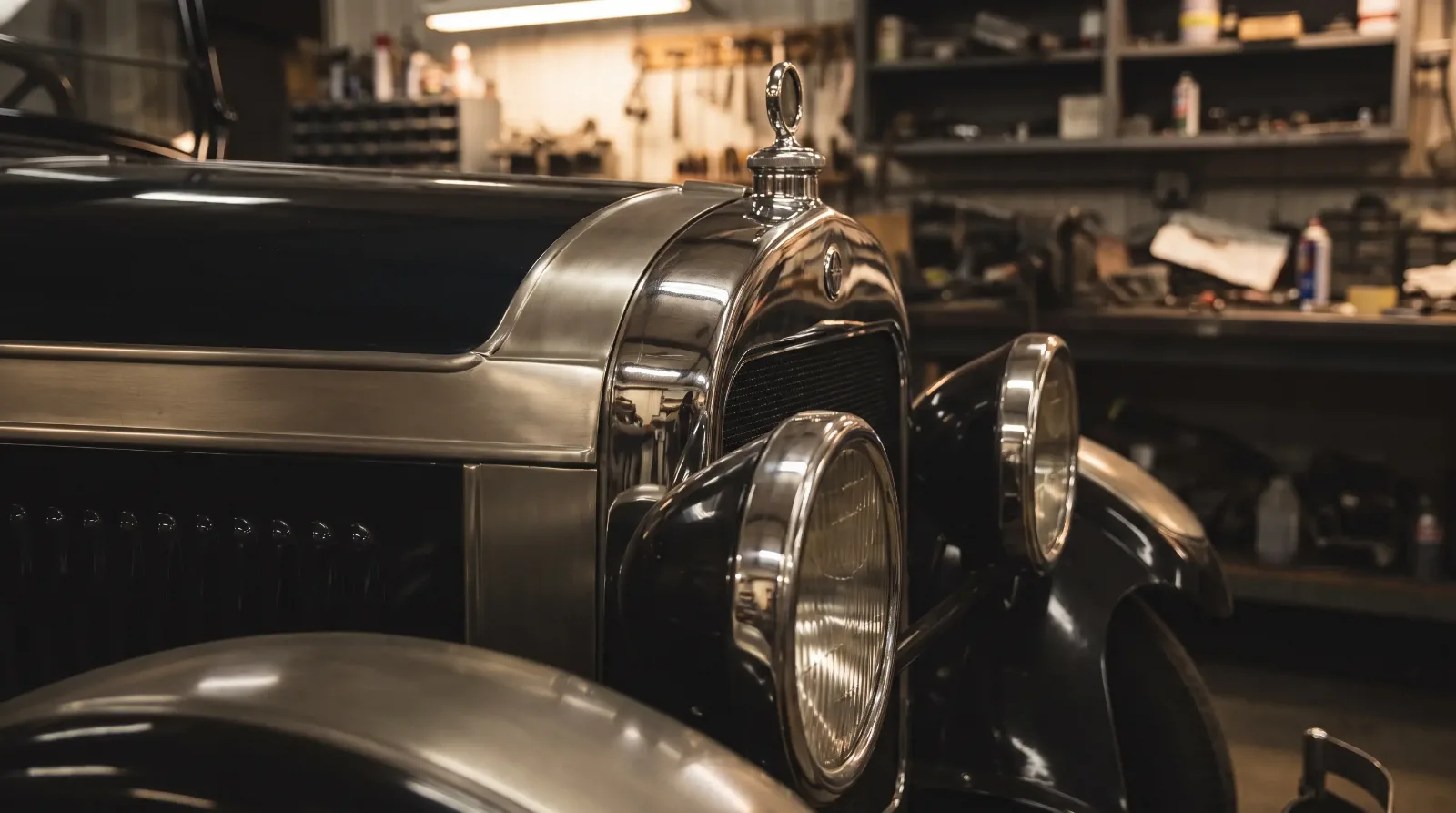
Chromium plating had been experimented with in industrial applications since around the turn of the century, but the commercially practical process for a durable chrome layer over a nickel undercoat was only worked out in 1924, when researchers at Columbia University developed and patented the method, and specialty platers began advertising chrome-finished sample parts through 1925 and 1926. The advantage was significant once automakers picked it up. Chrome held its shine far longer than nickel alone, resisted tarnish and corrosion better, and gave a harder, brighter, slightly bluer-white finish that photographed and showed better on a dealer's lot.
Adoption by the automakers themselves came a bit later than the plating technology itself. Oldsmobile is generally credited as the first manufacturer to switch from nickel to chromium on production cars, converting radiator shells, bumpers, door handles, and window cranks starting in March 1927 after advertising the change the preceding months. Studebaker followed that same year, announcing in October 1927 that chromium would replace nickel across its future production. Other makers moved at their own pace after that, and the changeover was not universal. Ford's Model A did not get chrome-plated radiator shells and bumpers until the 1930 model year, having run nickel trim through the Model A's earlier production. By the very end of the decade and into the early 1930s, chrome had become the industry standard, and by the time the streamline era arrived, nickel trim on a new car was essentially gone.
| Period | Typical trim finish |
|---|---|
| Early-to-mid 1920s | Nickel-plated brass or steel, industry-wide |
| 1927 | Oldsmobile and Studebaker lead the switch to chrome-over-nickel |
| Late 1920s, roughly 1928-1929 | Chrome-over-nickel spreading across most makers |
| Early 1930s | Chrome-over-nickel as the default; some makers, including Ford's Model A, held nickel into 1929 |
Why the shift matters to a restorer
Getting the trim finish right on a restoration is not just an aesthetic detail, it is a correctness question that judges at concours events and knowledgeable buyers both pay attention to. A car from 1924 with chrome trim is wearing the wrong finish for its year, full stop, and it will read as incorrect to anyone who knows the timeline even if the car is otherwise beautifully done. Conversely, a 1929 model still wearing straight nickel where the factory would have specified chrome is equally off.
The practical complication is that the transition years are genuinely murky, because manufacturers phased chrome in model by model and sometimes trim piece by trim piece rather than switching everything over on a single date. A 1926 or 1927 car might correctly wear chrome on some pieces and nickel on others, depending on the specific parts supplier and when that component was redesigned. This is exactly the kind of detail worth checking against original factory documentation or a marque-specific parts book rather than assuming based on the model year alone.
"I've had owners insist their car should be all chrome because that is what they associate with a classic car, and then we pull the factory parts records and find out their exact build date falls right in the middle of the changeover, with some pieces still speced in nickel. The paperwork settles the argument every time, and it usually surprises people how specific the factory actually was about it."
— Tom Ramirez
The suppliers behind the shift
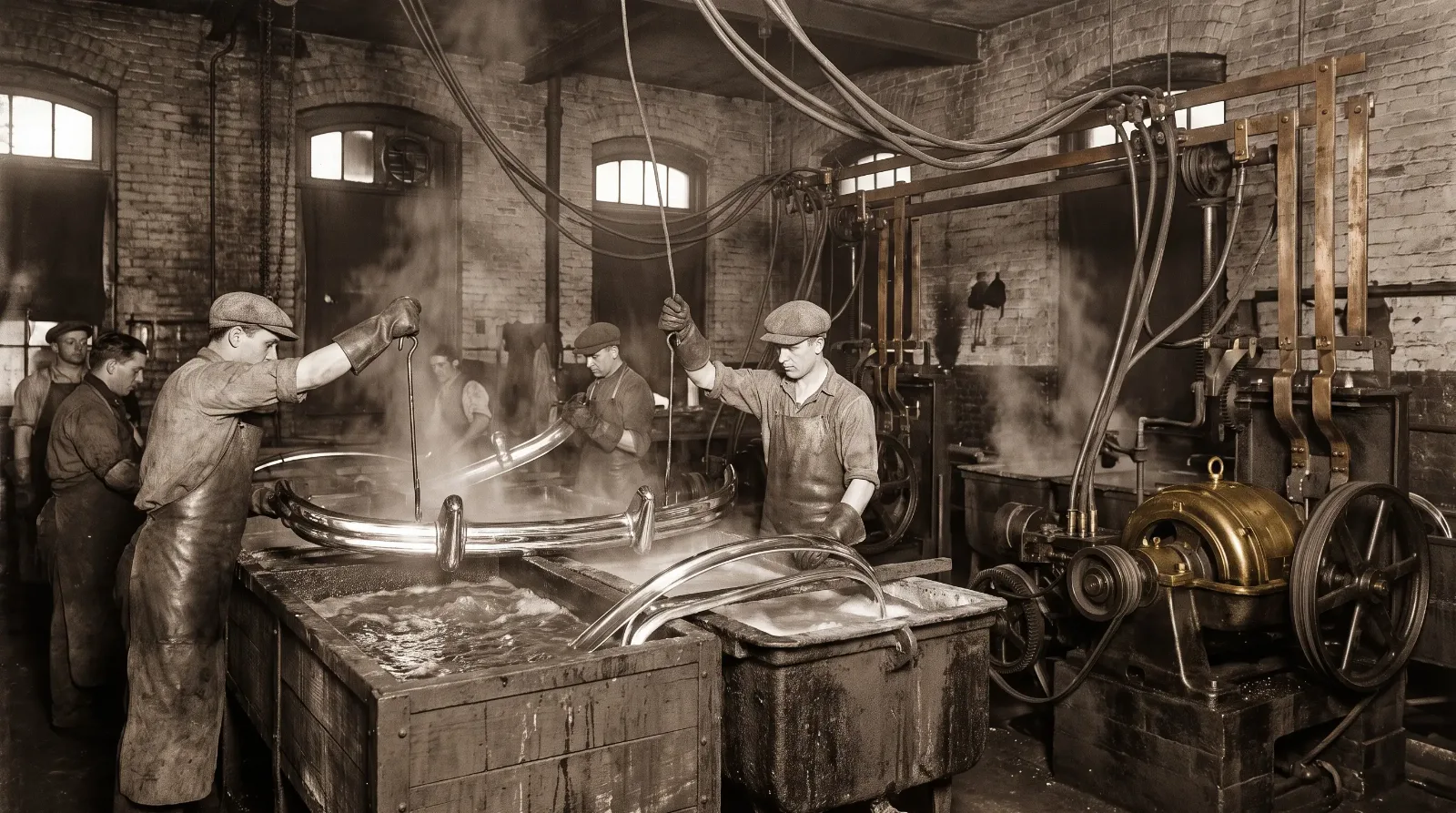
The changeover was not something any single automaker drove on its own. Independent plating and trim suppliers, companies that sold finished bright metal parts to multiple manufacturers at once, were the ones actually working out the industrial chemistry of durable chromium plating and then pitching it to the automakers as an upgrade. Once one major supplier had a reliable chrome-over-nickel process worth selling, it spread across several manufacturers in a short window, since none of the automakers wanted to be caught still offering the visibly duller nickel finish once a competitor's showroom cars were gleaming with the new plating.
That supplier-driven pattern is why the changeover dates can vary even between two manufacturers that otherwise built very similar cars in the same price class. A company that had a supply relationship with an early adopter of chrome plating might switch over a year or two ahead of a rival still sourcing trim the old way, which is one more reason the transition years resist a single clean cutoff date and reward the kind of parts-book research that serious restorers end up doing anyway.
Caring for what you have
Whether your car wears nickel or chrome, the maintenance approach differs. Nickel needs more frequent attention, a dedicated nickel polish rather than a chrome polish, and a gentler touch since the underlying metal is softer and more easily scratched through repeated buffing. Chrome tolerates more regular polishing without wearing through as fast, but once it does wear through to bare metal or the nickel undercoat, the fix is a full replate rather than a quick touch-up.
Either way, the trim on these cars is a small detail that carries real weight for anyone trying to keep a car honest to its year. It is also one more marker of how fast the automobile industry was still moving in the 1920s, changing materials and processes year over year even on details as small as a door handle. The same restless pace that pushed trim from nickel to chrome was pushing performance too, and that story shows up clearest on the track, where the next installment picks up.