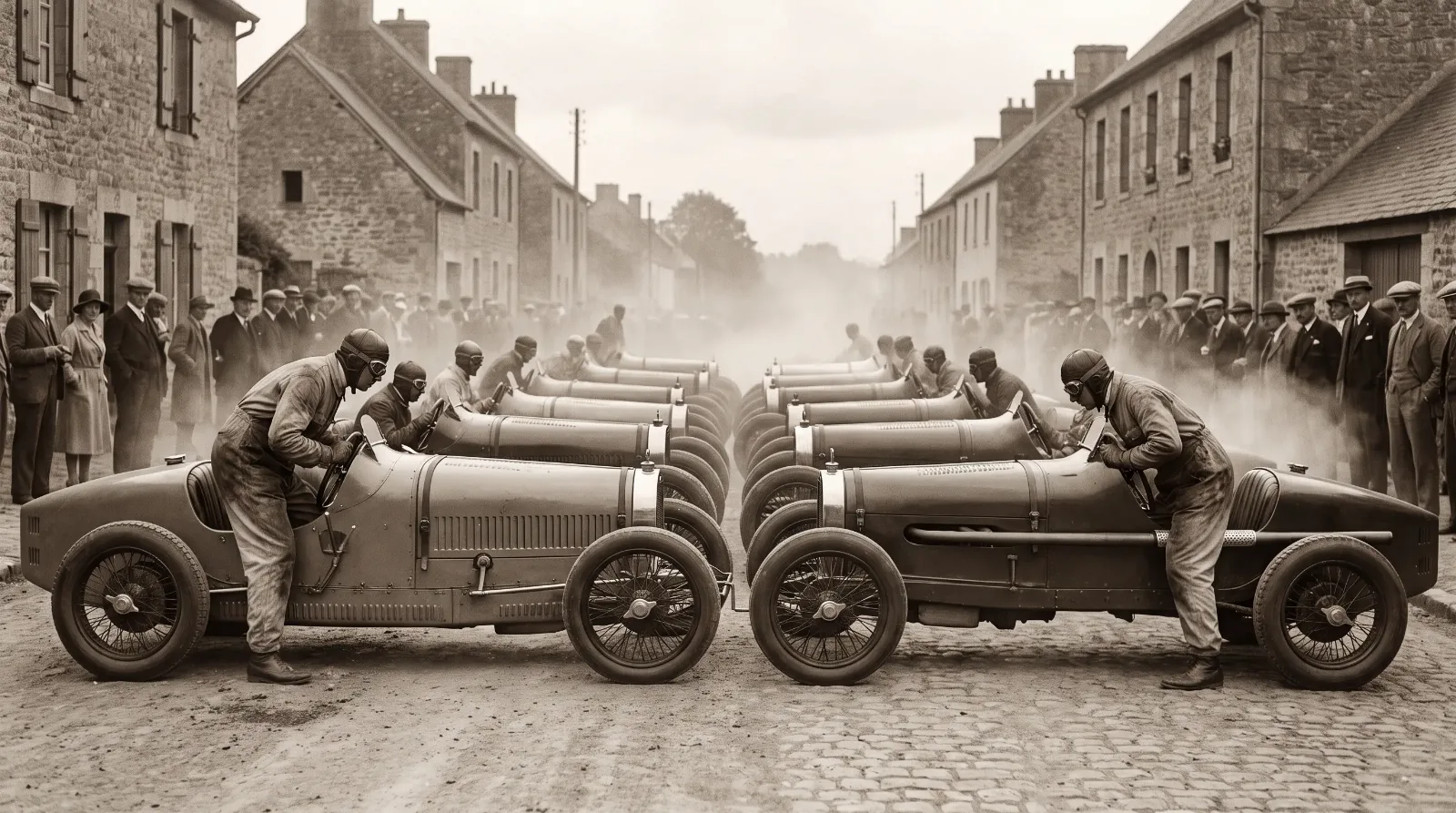
There is a photograph that circulates among racing historians of the start line at Monza in the early 1920s, dozens of low, narrow machines lined up nose to nose, drivers sitting bolt upright with no roll bar, no seatbelt, and often no helmet worth the name. What those men were about to do at well over 100 miles an hour on roads never built for that kind of speed is the real subject of the 1920s race cars guide, and it is a wilder story than most people realize.
Grand Prix racing finds its modern shape
Organized road racing existed before the 1920s, but the decade is when Grand Prix racing settled into something recognizable as the sport we know today. The Automobile Club de France had been running its Grand Prix since 1906, but the war years scattered the calendar, and it was the 1920s that rebuilt it into a genuine international circuit, with races in France, Italy, Belgium, and beyond drawing factory teams from across Europe.
The Indianapolis 500 was already running in America on the same basic timeline, and while the two racing worlds developed somewhat separately, both were pushing the same fundamental problem: how fast can an engine and a chassis be pushed before something fails catastrophically, in an era when metallurgy, tire technology, and driver protection were all still catching up to raw horsepower.
The machines that dominated
Bugatti built its reputation in this exact decade, and the Type 35, introduced in 1924, is arguably the most successful Grand Prix car of all time by sheer race win count. Ettore Bugatti's design combined a lightweight chassis with cast aluminum wheels, a genuine innovation at the time, and a straight-eight engine that balanced power with reliability better than most of its rivals. The Type 35 and its variants reportedly won more than 2,000 races between 1924 and 1930, an almost absurd number for a single design.
Alfa Romeo pushed the technical envelope from the other direction, developing supercharged engines that chased outright speed even at the cost of reliability, a trade-off that produced some spectacular wins and some spectacular failures in the same season. Delage and Sunbeam from France and Britain rounded out the top tier, each bringing engineering approaches that reflected genuinely different philosophies about where speed should come from, whether that meant lighter weight, more displacement, or forced induction.
| Manufacturer | Signature 1920s race car | Known for |
|---|---|---|
| Bugatti | Type 35 | Lightweight chassis, cast alloy wheels |
| Alfa Romeo | P2 | Supercharging, raw speed |
| Delage | 15-S-8 | Straight-eight refinement |
| Sunbeam | Grand Prix models | British engineering, land speed record ties |
Racing without a safety net
What strikes anyone reading race reports from this decade is how little separated the driver from disaster. Cars had no roll protection, drivers wore soft leather helmets that did almost nothing structurally, and the tracks themselves were often public roads closed for the day rather than purpose-built circuits with proper runoff areas. A mechanical failure at speed, a blown tire, a snapped axle, a seized engine, could and did kill drivers with regularity that would be unthinkable in modern motorsport.
That danger was not incidental to the sport's appeal, it was central to it. Crowds turned out by the tens of thousands to watch men risk their lives against machines that were, by any honest measure, barely under control at their limit. The drivers who won consistently, men like Louis Wagner and Robert Benoist, earned a kind of fame that had less to do with technical skill alone and more to do with a willingness to sit at the edge of catastrophe for a hundred laps at a time.
"You have to understand what these drivers were actually risking. There was no crash structure, no fire suit worth the name, no medical helicopter waiting. A man got in that car knowing the odds were real, and he raced anyway, because the alternative was not racing at all, and that wasn't a life these men were willing to accept."
— Patrick Walsh
The rules kept changing underneath the teams
Part of what makes 1920s Grand Prix history so chaotic to follow is how often the governing formula changed. Organizers experimented constantly with engine displacement limits, minimum car weight, and race distance, sometimes from one season to the next, in an attempt to keep speeds manageable and costs from spiraling completely out of control for the manufacturers footing the bill. A car built to dominate one season's formula could find itself obsolete or ineligible the next, which forced constant redesign work and meant no single car, not even the dominant Bugatti Type 35, could simply be built once and raced unchanged for years.
That instability frustrated manufacturers at the time, several of whom periodically threatened to pull out of Grand Prix racing altogether over the cost of chasing a moving target. But it also had the effect of accelerating development across the whole field, since every rule change forced engineers back to the drawing board rather than letting anyone coast on last year's success. The sport that emerged by the end of the decade was faster, more sophisticated, and considerably more organized than the one that had restarted after the war, even if none of the teams involved would have described the process as smooth while they were living through it.
What this era left the sport
The technical lessons from 1920s Grand Prix racing traveled directly into road cars over the following decades. Supercharging, worked out under race conditions by Alfa Romeo and others, eventually filtered down into performance road cars. Lightweight chassis construction, proven first on the track, shaped how sports cars were built for the next generation. Even the basic idea that a car company's racing success could sell road cars to ordinary buyers, a marketing logic that still drives motorsport sponsorship today, took its modern form in this decade.
The drivers and machines of 1920s Grand Prix racing rarely get the same attention as the era's luxury cars or the mass-market Fords rolling off the same decade's assembly lines, but they were doing something just as important, proving what an engine and a chassis could survive under the worst conditions anyone could throw at them. That knowledge did not stay on the track. It found its way into every fast car that came after. If the story of how the automobile put ordinary Americans on the road interests you as much as the racing did, the next story picks up exactly there.