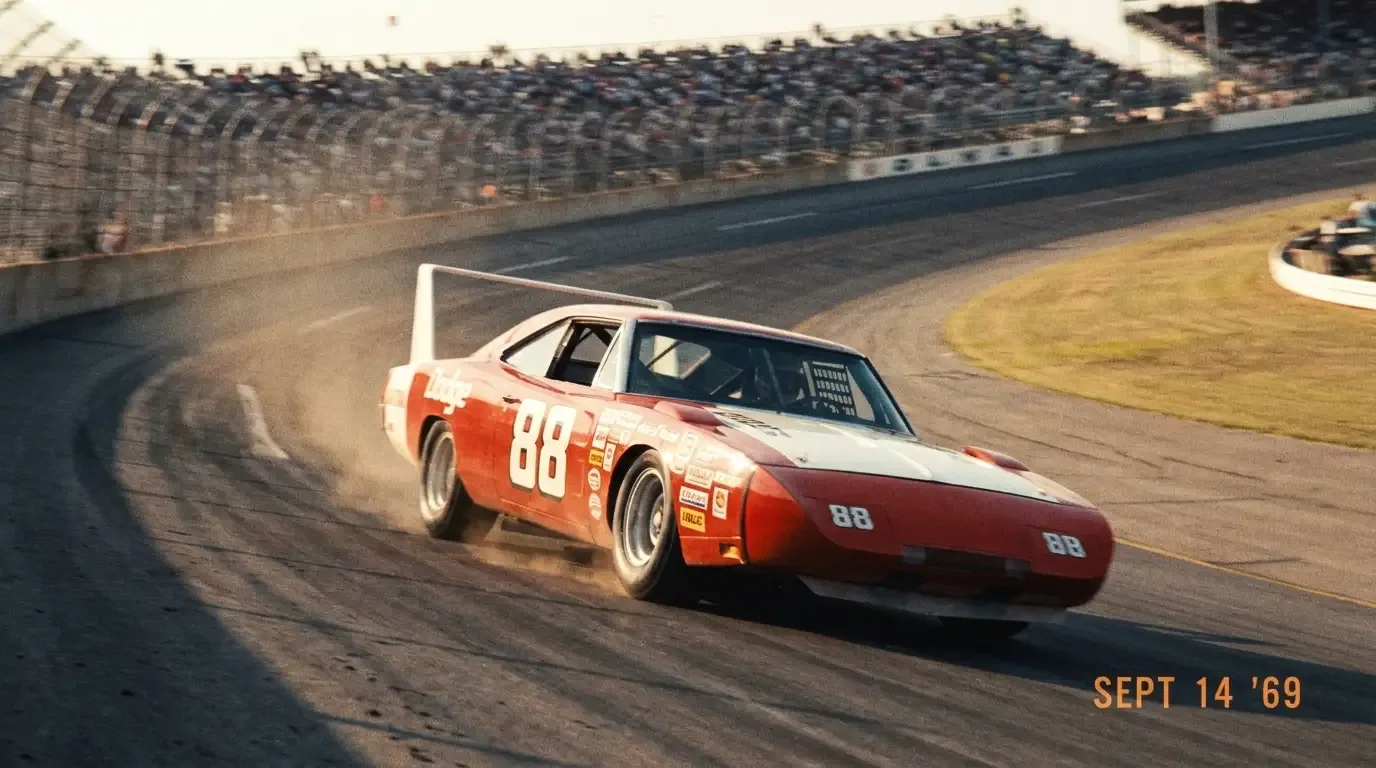
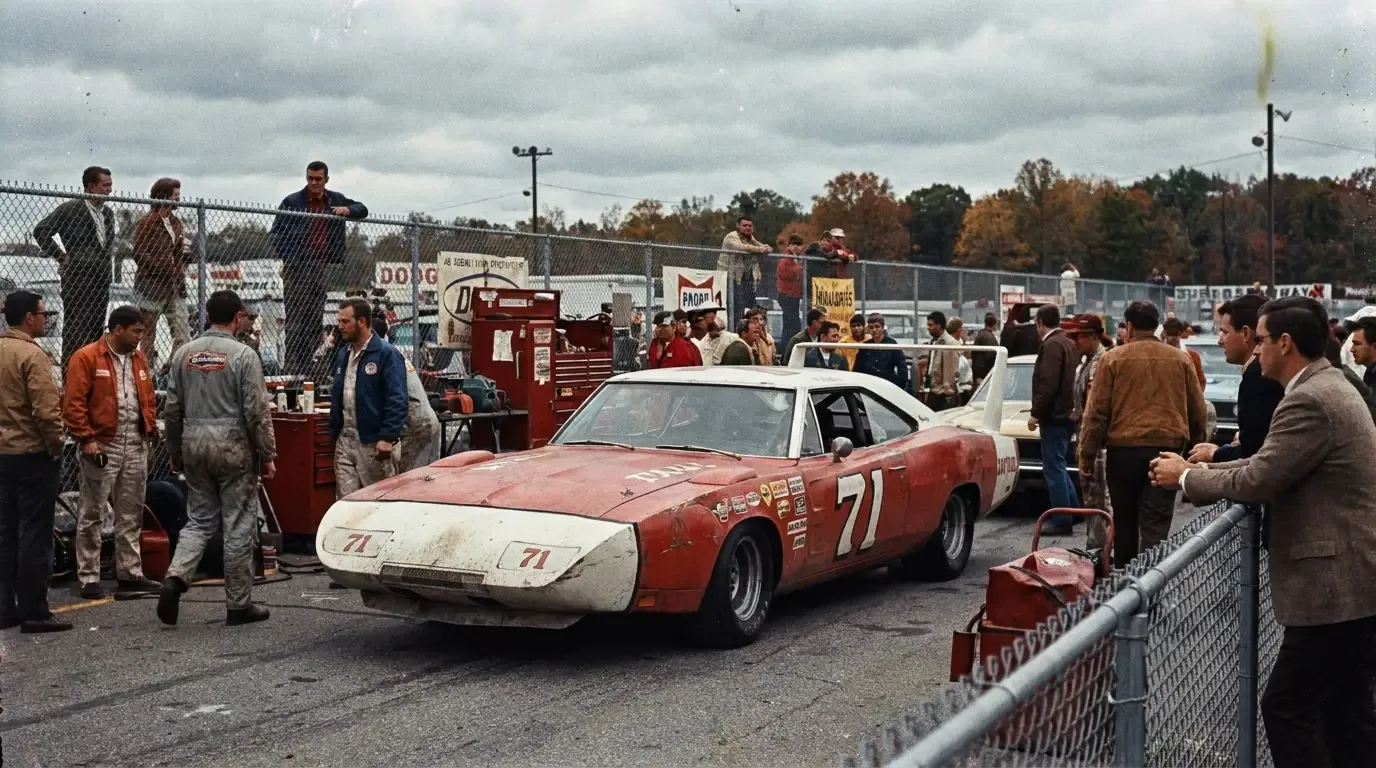
Talk to anyone who was standing in the garage area at Talladega in the fall of 1969 and they will tell you the same thing: the Charger Daytona did not look like it belonged to the same species as the rest of the Dodge lineup. The nose ran nearly two feet longer than a standard Charger. The tail carried a wing that stood taller than the roofline. People walked around it before the race just to look, the way you would look at something that had wandered onto the lot from somewhere else entirely.
The car existed because Dodge had run out of patience. Through 1968 the Charger's fastback body, gorgeous as it was on the street, punched a hole in the air on the superspeedways that no amount of horsepower could fully overcome. Ford's Torino Talladega and Mercury's Cyclone Spoiler were built low and slick specifically to beat it, and they were winning. Dodge had already tried a milder answer in the Charger 500 that came first, but it did not go far enough, so Chrysler engineers went back to the wind tunnel and came out with something that looked less like a facelift and more like a different car wearing a Charger's skin.
A street car built to satisfy a rulebook
NASCAR in 1969 required manufacturers to build and sell a minimum number of a model to the public before it could race, homologation in the strict sense. That number sat around 500 units for that season, small compared to a regular production run but real enough that dealers had to move actual cars to actual buyers. Dodge built the Daytona at its Charger assembly point, then trucked the shells to Creative Industries in Detroit for the nose cone, the wing, and the flush rear glass to be installed by hand. It was not an assembly line job in the usual sense. It was closer to a small batch of specials wearing Dodge badges.
Roughly 503 Daytonas left the plant for public sale, plus a small additional batch built for Canada, and that number matters more than it looks. It is the difference between a factory experiment and a legal, homologated race car. Chrysler was not building a concept. It was building the minimum viable street version of a car engineered for one purpose, holding a line at well over 190 mph on a banked oval, and every buyer who wrote a check for one got a piece of that engineering whether they ever saw a racetrack or not.
"The guy I talked to at Carlisle had owned his car since 1974. Drove it there every single year, even the time the water pump let go outside Harrisburg."
— Patrick Walsh
What made it different from every Charger before it
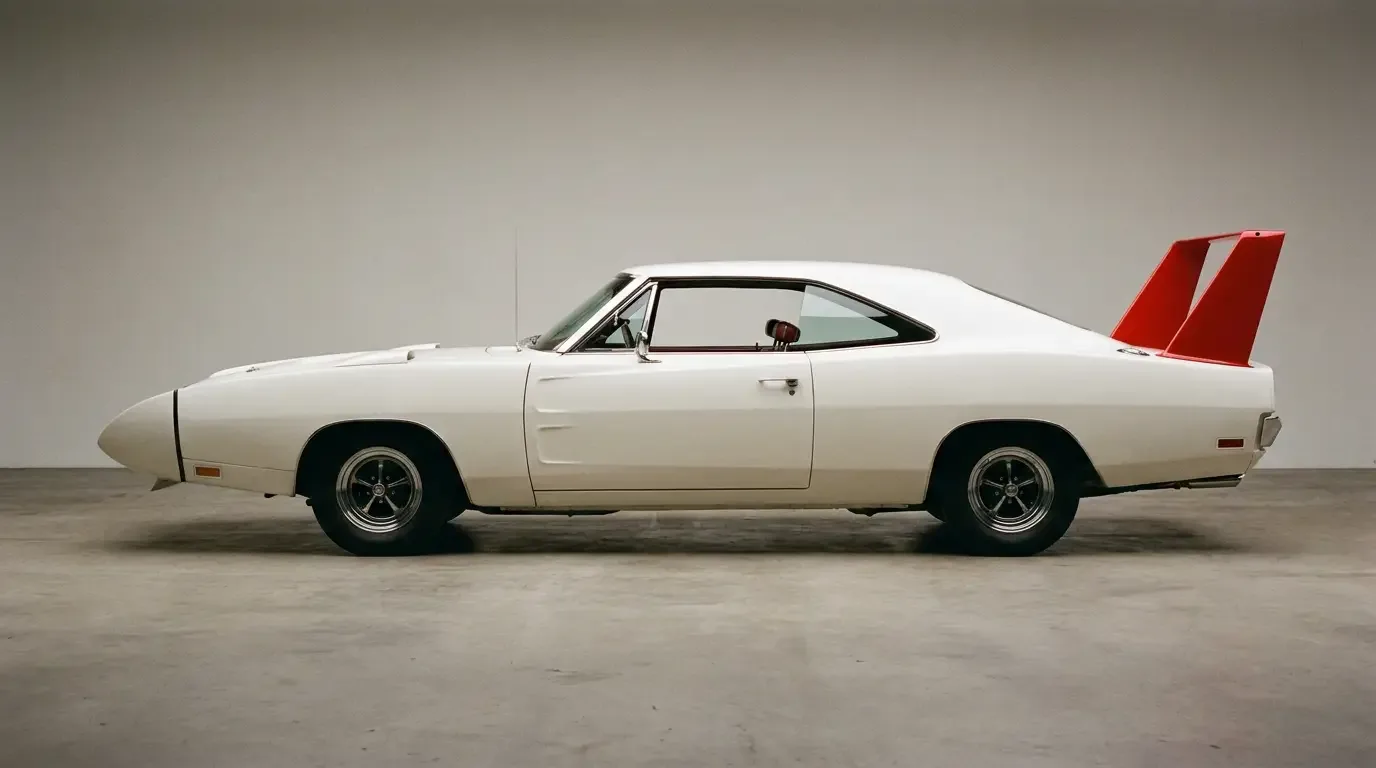
The changes were not cosmetic tweaks bolted onto an existing shape. The nose extended the front of the car by about 18 inches, a steel and fiberglass cone that eliminated the drag-inducing grille opening of the standard Charger and replaced it with a smooth, pointed profile. Flip-up headlights hid inside the nose at speed and dropped down for street use, a detail that made the car look almost predatory with the lights closed. At the back, the wing sat on tall struts that put its surfaces up out of the turbulent air rolling off the roofline, high enough that engineers could tune the downforce without the wing fighting the wake coming off the C-pillars.
Underneath, the Daytona shared its running gear with the rest of the B-body Charger lineup. Buyers could order the 440 Magnum or the 426 Hemi, the same engines available in an R/T, backed by either a TorqueFlite automatic or a four-speed manual. Nothing about the drivetrain was exotic. The whole point of the car was that the speed came from the shape, not from some hidden engine trick, and that is part of what makes it interesting today. It is a muscle car whose party piece is aerodynamics rather than displacement.
The wing height was not an accident of style
A common assumption is that the wing sits high because someone wanted the car to look dramatic. The real reason is more practical. Wind tunnel testing showed that air coming off the Charger's roof and rear window created a low pressure, turbulent zone directly behind the car at speed. A wing mounted low, flush with the trunk lid the way a spoiler usually sits, would have been sitting inside that dead air and doing very little useful work. Raising it up on struts put the wing surfaces into clean airflow where they could generate real downforce instead of fighting turbulence. You can read a fuller breakdown of the geometry in the Charger's full history, but the short version is that every inch of height on those struts was earned in a wind tunnel, not sketched by a stylist.
How the public reacted to a car that looked like nothing else
Reaction on the street was mixed in a way that is easy to forget now that the Daytona commands serious money at auction. Some buyers loved the aggression of the shape. Others thought it was strange looking, a Charger wearing a costume, and dealers reportedly had trouble moving all of the units at full price. That hesitation is part of why surviving Daytonas are relatively rare today, production was already small and the cars that did not sell quickly sometimes sat on lots before being discounted. The ones that survive tend to have a longer, more interesting ownership history than a typical R/T from the same years, in part because owners knew from day one that they had something unusual.
| Spec | 1969 Charger Daytona |
|---|---|
| Nose extension | Approximately 18 inches over standard Charger |
| Wing height | About 23 inches above the deck lid |
| Engines offered | 440 Magnum, 426 Hemi (70 Hemi cars) |
| Estimated production | 503 U.S. street cars (plus ~40 for Canada) |
| Top speed achieved | Over 200 mph at Talladega (Buddy Baker, March 1970) |
Why the story does not end with the street car
The homologation requirement meant the street Daytona was never really the point, it was the ticket that let the race version onto the track. That race story, the runs at Talladega and the records that followed, is really where the car earns its reputation, and it deserves its own telling rather than a paragraph tacked onto the end of this one. For that side of the story, the dodge charger daytona stands as the fuller account of what happened once these cars hit the high banks. What matters here is that none of it would have been legal without roughly five hundred ordinary buyers signing paperwork at Dodge dealers in late 1968 and early 1969, most of whom had no idea they were financing a NASCAR arms race.
For anyone chasing one today, condition and documentation carry more weight than usual because the aero parts, the nose cone especially, are fragile, expensive to source, and easy to fake with reproduction pieces that do not match factory tooling marks. A car with its original nose, wing, and build sheet is a different animal from a clone wearing the shape without the paperwork. Readers looking at Dodge Chargers for sale today will find plenty of Daytona tributes and only a handful of the genuine article, and the price gap between the two tells you everything about how the market has come to value the real ones. To see how this one winged season fits into the larger arc of the model, it is worth reading the Charger's full history from the 1966 debut onward.
Sources and notes
- Wikipedia - Dodge Charger Daytona - confirmed the 503 U.S. street-car production run, the 23-inch wing, the 426 Hemi/440 Magnum options, and Buddy Baker's first 200 mph run at Talladega on March 24, 1970.
- Wikipedia - Dodge Charger (B-body) - confirmed the 18-inch nose, the Creative Industries hand-assembly of the aero parts, and the Charger 500 as the predecessor program.
- Wikipedia - Ford Torino Talladega - confirmed Ford's and Mercury's aero cars that the Daytona was built to beat.
- Wikipedia - Buddy Baker - confirmed the March 24, 1970 closed-course run in the Chrysler Engineering No. 88 Daytona.
- Wikipedia - Talladega Superspeedway - confirmed the track opened in September 1969 and hosted Baker's 200.449 mph run, and that the Daytona debuted there.