
Picture a Chevrolet showroom in the fall of 1986, the new model year cars lined up under fluorescent light, and one of them with its roof folded away behind the seats. For anyone who had grown up wanting a Camaro with the wind in it, that car had been missing for a very long time. The 1987 Camaro convertible was the first open Camaro Chevrolet had sold since 1969, and it arrived through a side door: a specialist firm cutting the roofs off finished coupes. This is the story of that return, how it was done, how few were built in the first year, and why it mattered more than its numbers suggest.
Car Features
7 min read
The 1987 Camaro Convertible Returns
After 18 years without one, the 1987 Camaro convertible came back through ASC conversions of T-top coupes. Only 1,007 were built that first year.
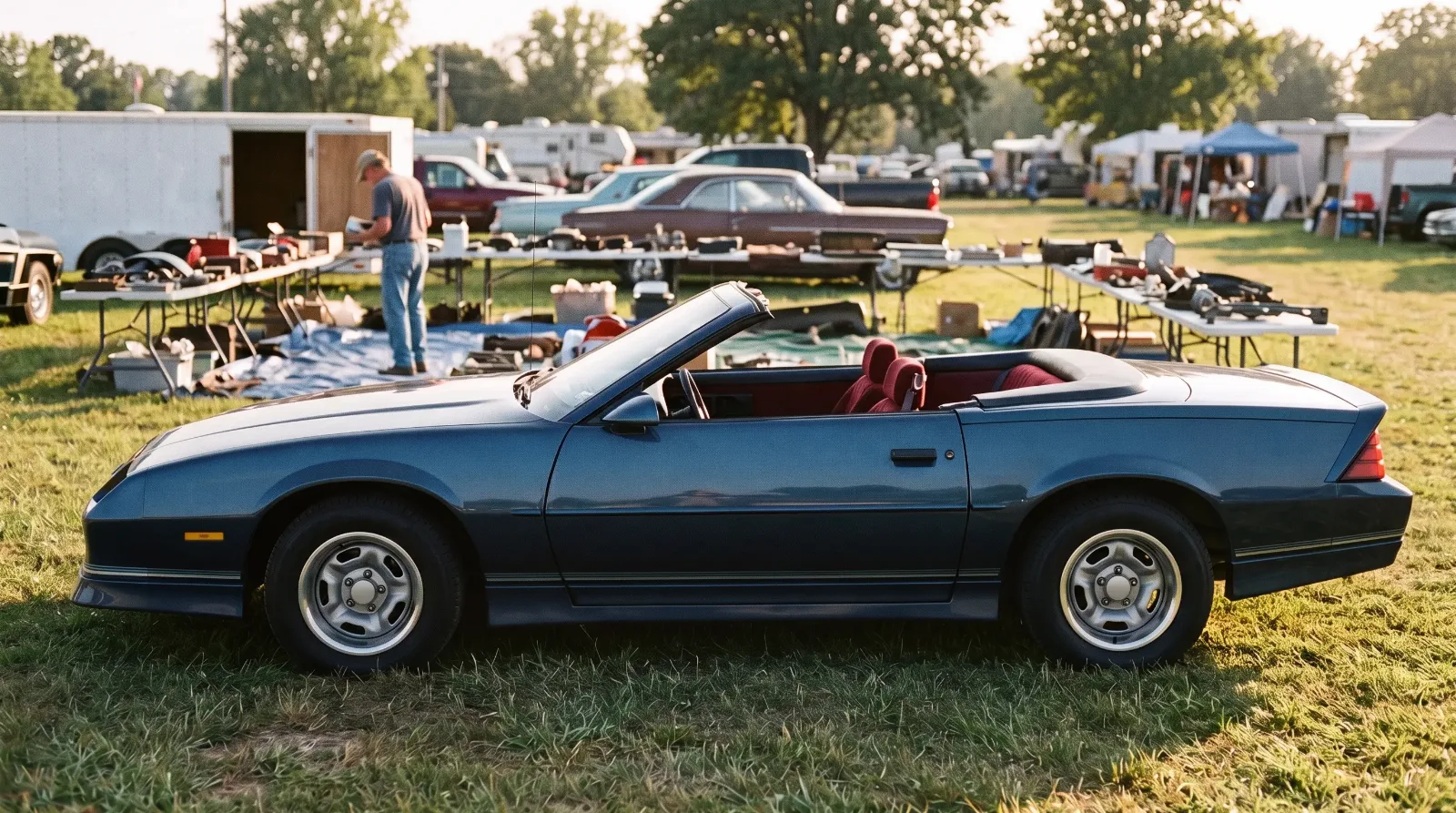
Eighteen years without a top to fold
The last factory Camaro convertibles left the line in the 1969 model year. Some of them went out in style: 3,675 Z11 pace car replica convertibles were built that year, white with orange houndstooth inside, the car that had come to stand for summer in a Chevrolet dealership. Then the door closed.
The second-generation Camaro, from 1970 to 1981, was a coupe and only a coupe for all twelve of its years. It is the only Camaro generation that never offered a convertible. The likely reason was money rather than taste. The Firebird shared the platform but used its own sheetmetal, down to different doors, and tooling an open car for both divisions looked too expensive to justify. Owners who wanted sky got T-tops from 1978, two tinted glass panels that lifted out and rode in the trunk. It was a compromise, and everyone knew it.
When the third generation arrived for 1982, it was a hatchback with a huge glass rear window, and again there was no convertible. T-tops stayed on the order form. That detail turned out to matter, because T-top cars carried extra structural bracing to make up for the missing roof section. Five years later, that bracing became the starting point for something else. If you want the whole arc of the third generation first, there is more on that here.
How ASC built the 1987 Camaro convertible
Chevrolet did not build the 1987 Camaro convertible on its own assembly line. It sent the job out. American Sunroof Company, known everywhere as ASC, took T-top coupes and converted them into convertibles, removing the roof structure, adding reinforcement and fitting the folding top. The braced T-top body was the logical donor, already stiffened to live without a full steel roof.
ASC had rehearsed the idea before the official program began. Late in the 1986 model year it built 82 IROC-Z convertibles for a consortium of dealers, an aftermarket arrangement rather than a catalog option. Those cars proved there were buyers willing to pay for an open Camaro. For 1987 the conversion became a factory program, sold through Chevrolet dealers and priced roughly $4,000 to $4,400 above the equivalent coupe.
That premium was steep for the time, and it bought something closer to a coachbuilt car than a mass-produced one. The convertible was not a line item that a plant could switch on in an afternoon. Every one passed through a second set of hands after the coupe was finished.
Motor Trend tested an IROC-Z convertible for its November 1986 issue and predicted it would become one of the most desirable cars of the decade. A bold call for a car that had barely reached showrooms. It was also the kind of sentence that tends to follow a car around for the rest of its life.
1,007 cars and the engines they got
Chevrolet built 137,760 Camaros for the 1987 model year. Only 1,007 of them were convertibles, well under one percent of the total. Of those, 263 were based on the Sport Coupe, the entry-level car, and 744 were Z28 or IROC-Z convertibles. Old Cars Weekly, citing the Camaro White Book, says only a small share of those 744 were IROC-Zs; no exact split has been published.
| Model year | Convertible version | Built |
|---|---|---|
| 1986 | ASC IROC-Z, dealer consortium program | 82 |
| 1987 | Sport Coupe convertible | 263 |
| 1987 | Z28 and IROC-Z convertible | 744 |
| 1988 | Base convertible | 1,859 |
| 1988 | IROC-Z convertible | 3,761 |
The big news under Camaro hoods that year was the 5.7-liter L98 tuned port engine, rated at 225 hp and 330 lb-ft. It did not reach the convertible. The 350 went only into IROC-Z coupes, and only with the automatic transmission. Convertible buyers who wanted the most power available got the 305 with tuned port injection, rated at 190 hp with the automatic or 215 hp with the five-speed manual. For a car meant for slow evenings with the top down, nobody seemed to mind much.
Every one of the 1,007 had a V8. The Sport Coupe convertible went the other way, offering the open air of the IROC-Z without the stiff suspension or the price. The Berlinetta, with its space-age instrument panel (covered here), was gone for 1987, replaced by the LT, so the Sport Coupe was the gentler road into an open Camaro.
"Eighteen years is long enough for a whole generation to learn to drive. The 1987 convertible gave those kids the car their parents remembered, and it gave the parents a reason to walk back into the showroom."
Nora Beckett
A season of good news in a hard year
The 1987 model year was not a cheerful one for the Camaro's people. The Norwood plant in Ohio, which had built Camaros since 1967, was being shut down. The final car down that line, a red IROC-Z, came off on August 26, 1987, a day the workers called Black Wednesday, and about 4,200 jobs went with it. That story, and why GM made the decision, belongs to the Norwood closing.
Against that backdrop, the convertible was a small, bright thing. Production totals for the year were down from 1986. The car was getting older, the Mustang was selling hard, and the brand needed reasons to be talked about. A Camaro with its top down, in a dealership window, was exactly that kind of reason. It asked little of Chevrolet's own plants, since ASC carried the conversion work. And it reminded people that the Camaro could still be a pleasure car as well as a stoplight car.
The first year also explains why the 1987 Camaro convertible sits apart among third-gen collectors. Low numbers, a single year with the ASC program in its debut form, and the absence of the 350 give it a profile that later convertibles do not share. One in roughly every 137 Camaros built that year was an open car. Find a documented one today and you are holding a small piece of a moment.
What came after the first open year
The convertible did not stay rare for long. For 1988, with Norwood closed and all Camaros built at Van Nuys, convertible output jumped. Chevrolet built 1,859 base convertibles and 3,761 IROC-Z convertibles that year, more than five times the 1987 total. The open Camaro had found its audience. It stayed in the lineup through the rest of the third generation, and when the fourth-generation car arrived, the convertible came back for 1994 built on the main assembly line in Quebec rather than through a conversion shop.
That change says something about 1987. The first convertible was an experiment, carried out by an outside company on cars Chevrolet had already finished, sold at a premium to see who would bite. People bit. By the time the next generation came, the convertible was simply part of the plan, no longer a question to be tested.
For buyers today, the practical lesson is to read the paperwork. A 1987 car with ASC conversion documentation and a clear story of its original trim is worth chasing, and an IROC-Z convertible is a different proposition from a Sport Coupe convertible. Ask about the top mechanism, the condition of the body areas ASC reinforced, and whether the car still has its original engine. If you are starting the search, begin with the Camaro convertibles for sale and look closely at the details.
The top folds down the same way it did in that showroom in 1986. The quiet comes all at once.
Sources and notes
- Old Cars Weekly: the 82 ASC IROC-Z convertibles of 1986
- GM EFI: guide to the third-gen Camaro (ASC conversions, 1987 split, premium)
- Wikipedia: Chevrolet Camaro (third generation)
- Chevy Hardcore: third-gen Camaro engines
- Conceptcarz: 1988 Camaro production by model
- WVXU: Norwood, the last Camaro and Black Wednesday
Related Reading
Have a
Chevrolet Camaro
for Sale?
Reach thousands of serious classic car collectors across the US.
Sell It Here →
Selling a classic? Here's how: compare the places to sell classic cars
Are You a Classic Car Dealer?
List your full inventory and connect with targeted classic car buyers.
Join as a Dealer →

About the author
Nora Beckett
Automotive features writer and photographer who tells the human stories behind the cars, from show fields to cross-country road trips.
Related Listings - Chevrolet Camaro
Comments
Be the first to comment on this article.