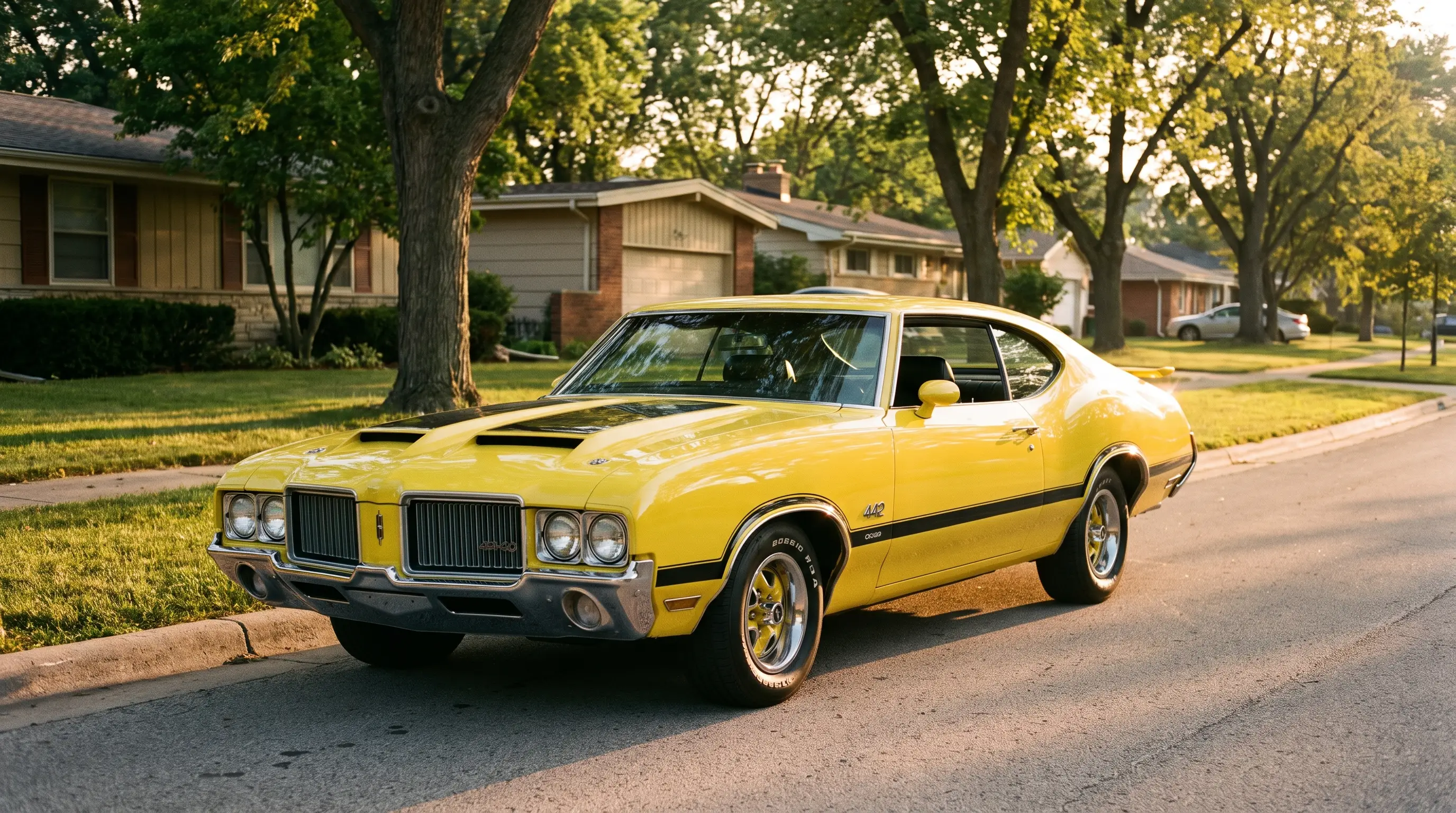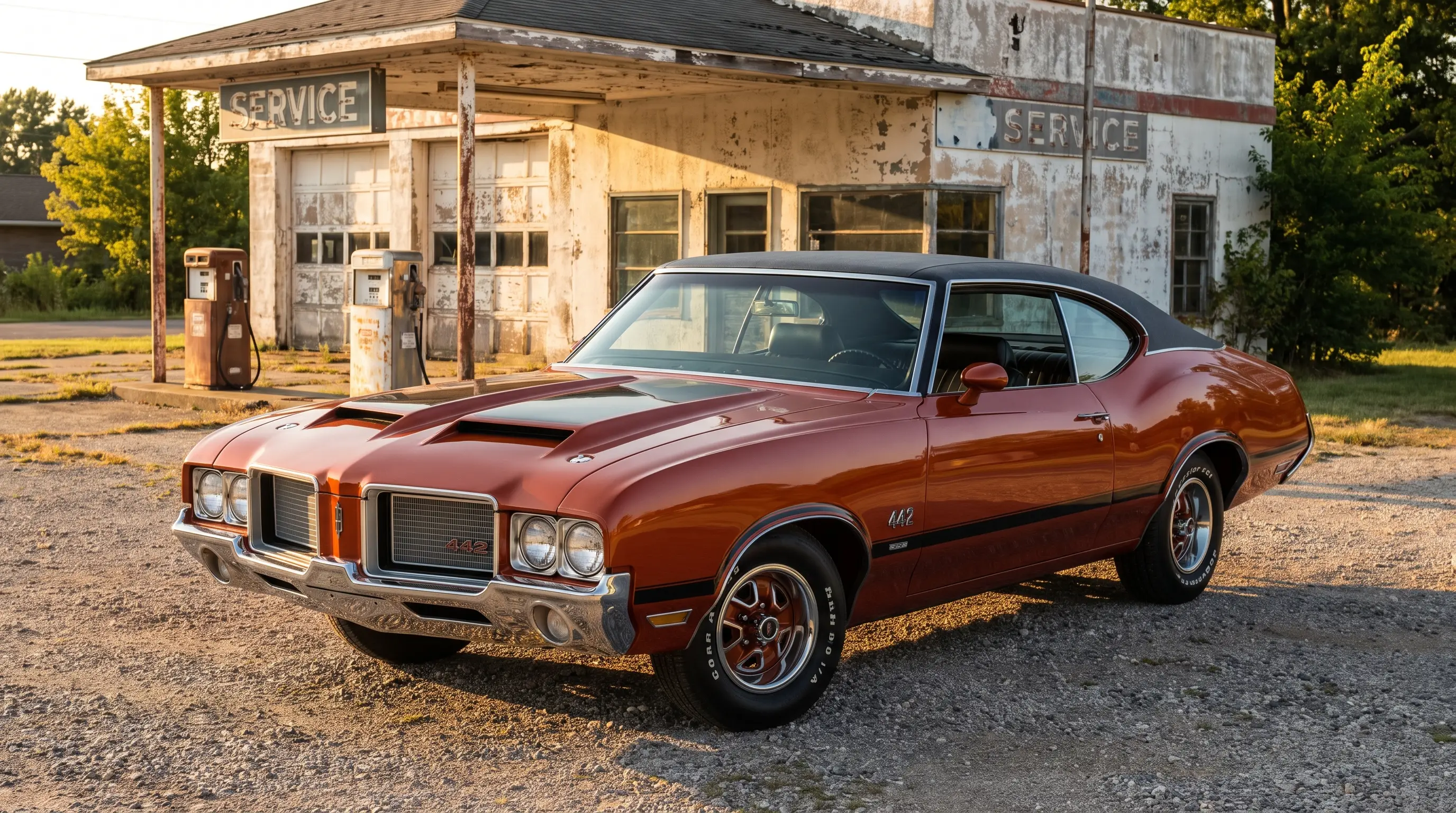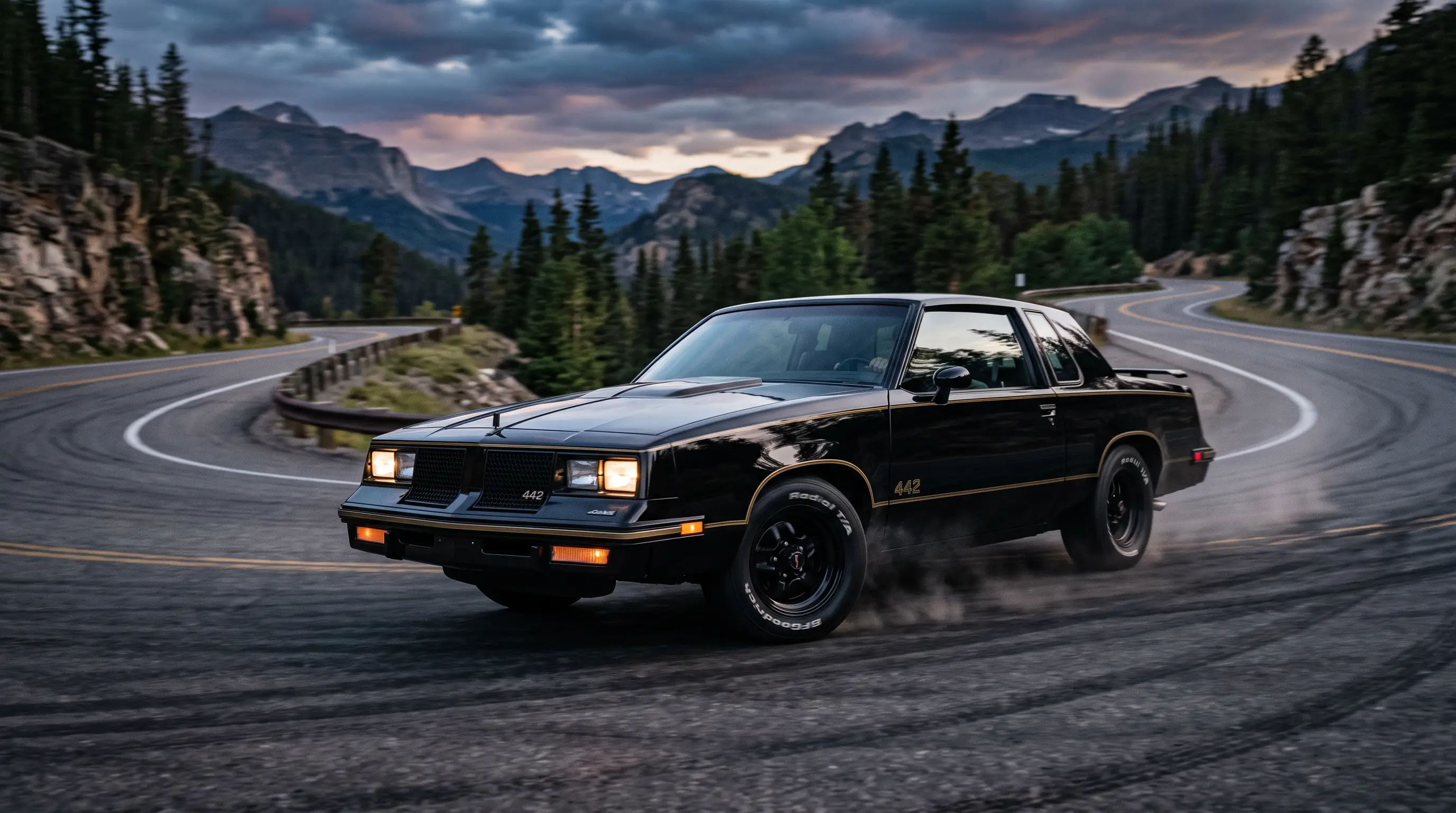
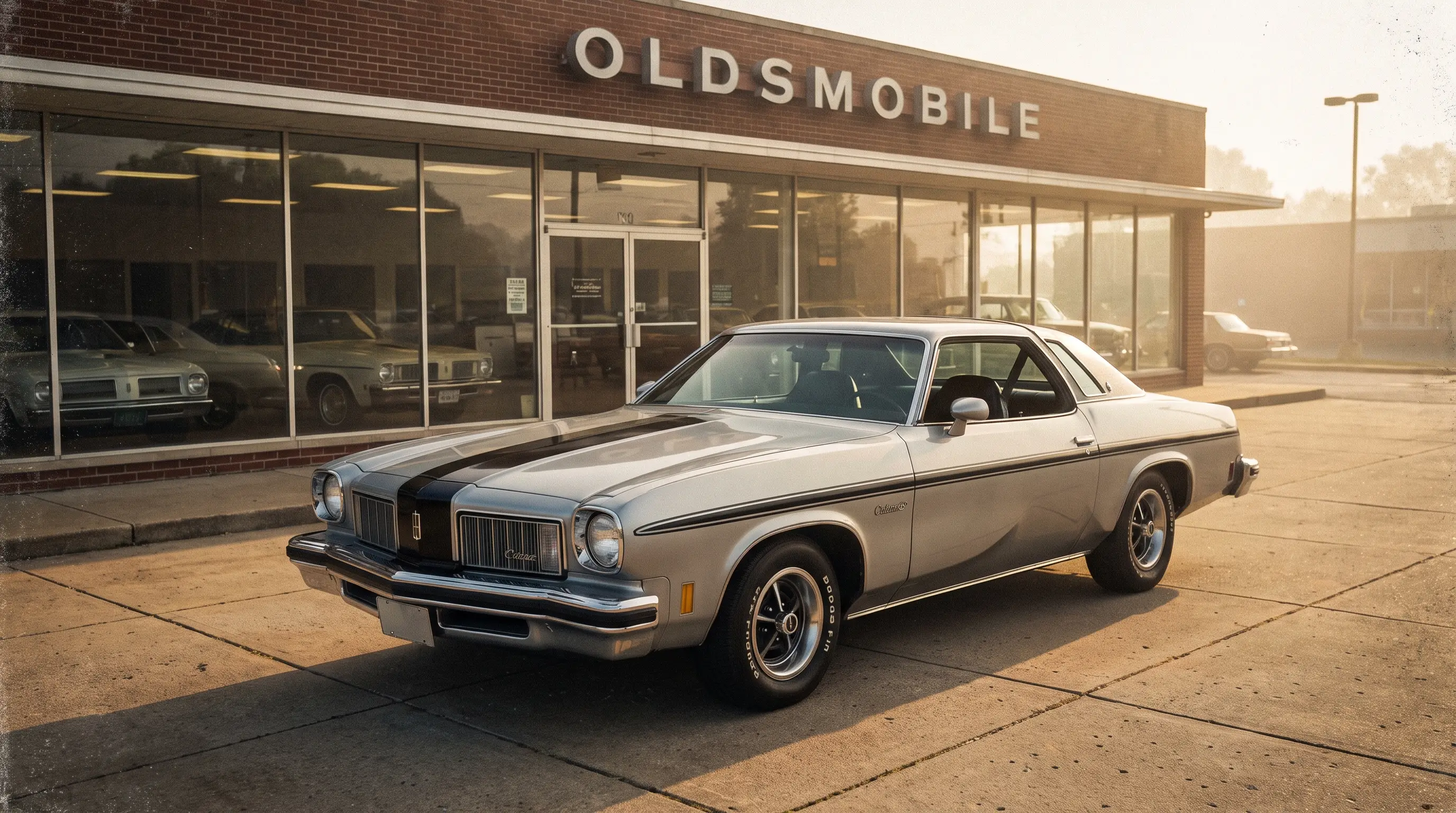
The Colonnade 442 never gets the parking spot next to the '70 W-30 at a show. It sits off to the side, usually with a "for sale" sign in the window instead of a trophy on the hood. That is a mistake. The 1973 to 1977 Cutlass 442 is the car that kept the badge alive through the roughest stretch American performance ever had, and it did it on a body style, the colonnade, that gets blamed for a lot it did not actually do wrong.
What "colonnade" actually means and why 442 wore it
GM's colonnade body style ran 1973 through 1977 on the midsize A-body cars, and it replaced the pillarless hardtop roofline with a fixed B-pillar, framed windows, and (on coupes) a formal rear quarter window. The name comes from that pillar, styled to look like a row of columns rather than a bare structural post. Insurance companies and new rollover standards pushed GM toward it, not styling committees looking for a fresh look. The Cutlass Supreme coupe wearing this body became, for a few years, the best-selling car in America, full stop, not just in its class.
The 442 package rode on top of that Cutlass Supreme or Cutlass S coupe. It was an option package again by this point, not a standalone model, the same way it had shifted after 1971. Buyers checked a box for handling gear, a specific engine, and badges. That is a smaller story than the muscle car era 442, and I get why people skip past it. But smaller does not mean nothing.
The engines and numbers, 1973 to 1977
The W-30 designation carried into 1973 and part of 1974 on the colonnade body, still backed by a 455 cubic inch V8. Power was down from the pre-emissions years, and Oldsmobile itself stopped chasing the old gross horsepower figures once the industry moved to net ratings. The 1973 W-30, which required the 4-speed manual and came with no automatic option that year, is rated at 270 horsepower net (the automatic-only base 455 that year made 250 net), a real drop from the 1970 W-30's advertised 370 gross. That comparison gets thrown around as proof the whole era was worthless. It is not a fair read. Net and gross numbers measure different things, and the drop looks worse on paper than it drove on the street.
After the 455 disappeared from the lineup (Oldsmobile pulled it following the 1976 model year for the Cutlass line), the 442 package leaned on smaller displacement V8s, including 350 and eventually 260 cubic inch engines depending on the model year and emissions package. By 1977 the 442 option was mostly a handling and appearance package layered onto a Cutlass Supreme with modest V8 power underneath. Nobody is claiming that's a muscle car. It is a well-built, good-handling midsize coupe wearing a badge with history behind it.
Colonnade 442, year by year snapshot
| Model year | Body | Top engine offered with 442 | Notes |
|---|---|---|---|
| 1973 | Colonnade coupe | 455 W-30 | Last year of the true W-30 big block package |
| 1974 | Colonnade coupe | 455 (W-30 fading out) | Catalytic converter era begins, compression drops further |
| 1975 | Colonnade coupe | 455 | W-30 badge largely gone, appearance/handling focus grows |
| 1976 | Colonnade coupe | 455 (final year) | Last 455 available in a Cutlass |
| 1977 | Colonnade coupe | 403 (350 also offered) | 442 now a handling/trim package; 403 replaced the 455 as the top V8 |
Why the colonnade years get overlooked
People compare these cars to the wrong yardstick. Set a 1975 442 next to a 1970 442 and the '75 loses every time on paper. Set that same 1975 car next to anything else a family could buy new that year with a bucket seat and a rally wheel, and it holds up fine. This is a survival story, not a decline story. Oldsmobile kept the badge working through fuel shortages, new safety rules, and an entire industry pulling horsepower out of everything it built. Plenty of other performance nameplates from that era just quietly disappeared instead.
I've had customers bring in a colonnade 442 apologizing for it before I even open the hood, like they need to explain why it isn't a '70. Stop that. It's a real car with a real drivetrain and factory handling parts that actually do something on a back road. Judge it on what it is.
What to look for today, and what these cars cost to own
Body panels and interior trim are not the problem on a colonnade 442. Millions of A-body coupes were built across this run, and the parts network built up around the Cutlass Supreme covers most of what a 442 needs, right down to badges and stripe kits. The real issues are rust in the rear quarters and lower doors, sagging trim on the vinyl-top cars, and buyers who assume every 442-badged colonnade car came with a 455. It didn't, especially by 1976 and 1977. Get the build sheet or at minimum decode the cowl tag before you pay a premium for a "big block" 442 from this era.
Prices reflect the era's reputation. A clean, documented 1973 or 1974 455 W-30 colonnade 442 still brings real money, but nowhere near what a 1970 W-30 commands, and a 1977 350-powered 442 sells more like a nice period Cutlass Supreme than a muscle car. That gap is the opportunity. You can own genuine factory 442 history, with a title that says 442, for a fraction of the money the early cars ask.
"Nobody walks into my shop asking me to apologize for a 1975 Cutlass. Owners do that to themselves. The car doesn't need the apology, it needs an oil change and somebody who respects what it actually is."
— Mike Sullivan
Where the colonnade 442 fits in the bigger story
Every generation of the 442 answered a different question Oldsmobile was facing that year. The colonnade cars answered the hardest one: how do you keep a performance badge alive when the performance itself is being legislated and taxed out of existence? Read the 442 story for the full arc from 1964 through the badge's final years, and see a companion piece on the G-body cars that picked the badge back up in the mid-1980s after a gap. Together they show a nameplate that bent without breaking, twice.
Buy a colonnade 442 for what it is: a well-documented, honestly built midsize coupe with real handling upgrades and a badge that earned its name a decade earlier and never fully let go of it. That's not a consolation prize. That's a car with a story worth owning.
Sources and notes
- Oldsmobile 442 - Wikipedia
- 1973 Oldsmobile 442 Rocket 455 V8 L77 4-speed Specs - Automobile Catalog
- Curbside Classic: 1977 Oldsmobile 4-4-2 - Curbside Classic
- W-30 455 V8: 1974 Oldsmobile 442 - Barn Finds
- The Oldsmobile 442's survival through the '70s - Fast Lane Only
- Olds FAQ - 442 - ClassicOldsmobile.com