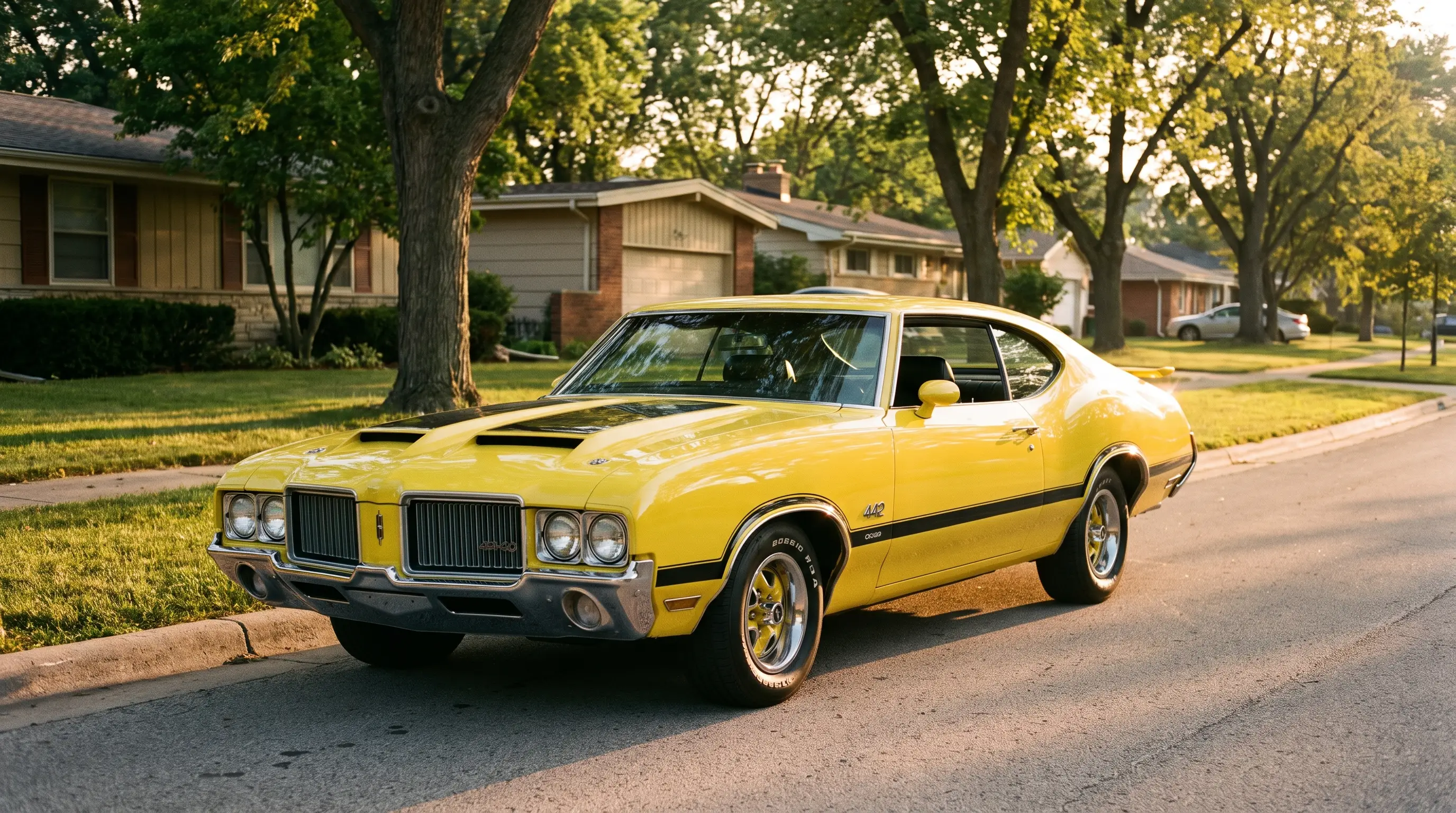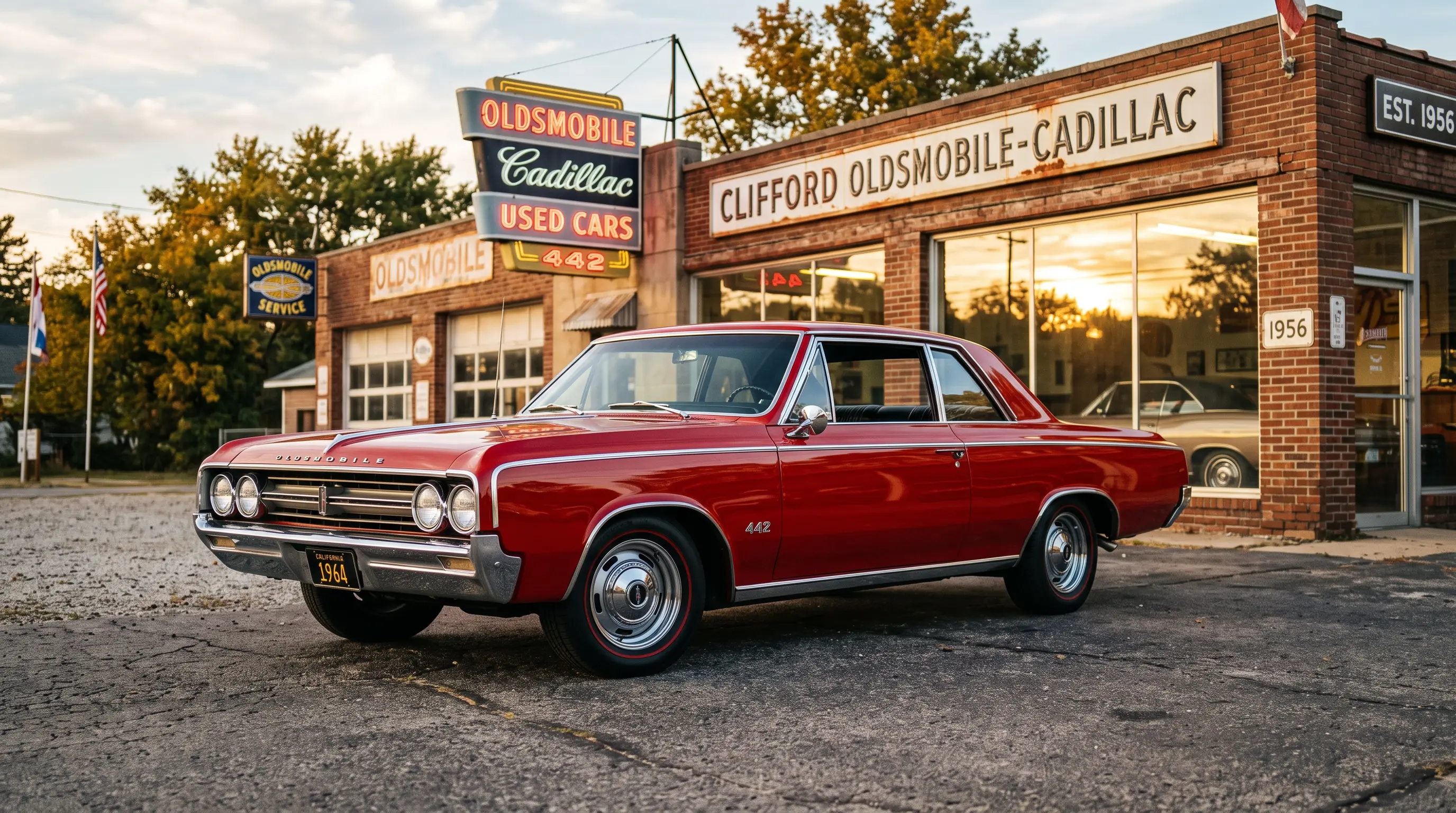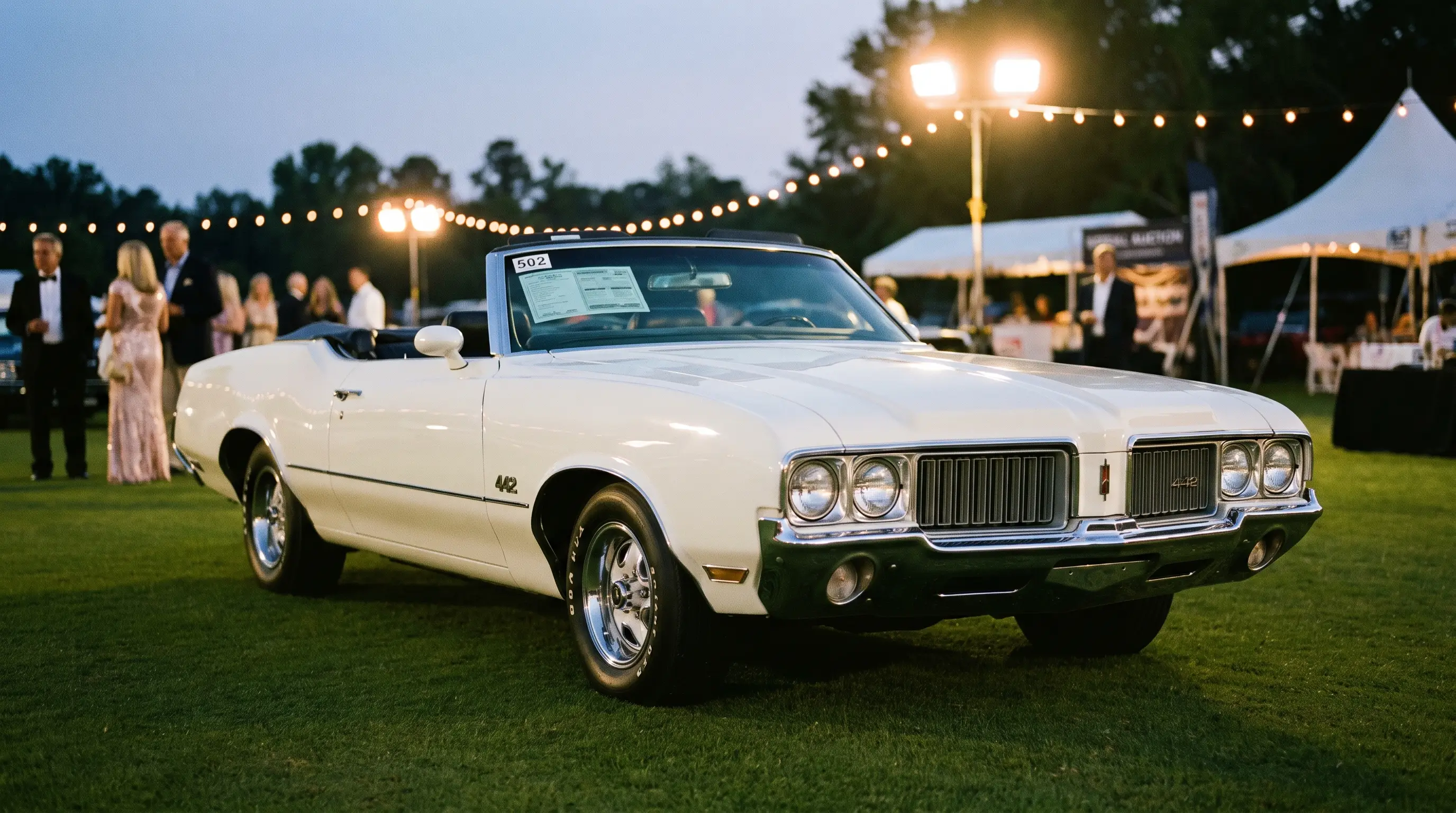
Ask ten guys at a car show what "442" stands for and you will get ten confident, slightly different answers. That is because Oldsmobile itself changed the definition twice in four years, and nobody at the factory bothered sending out a memo. The badge on the fender never changed. What it stood for did. If you want the full origin story, how the 442 earned its name covers the corporate politics behind it. Here I just want to nail down what those three numbers actually meant, year by year, without the folklore.
The 1964 answer: four, four, two
In 1964 the meaning was simple and it was engineering, not marketing. The 442 package on the F-85 and Cutlass was option code B09, and the digits described three specific pieces of hardware: a 4-barrel carburetor, a 4-speed manual transmission, and dual (2) exhaust outlets. That is it. No hidden meaning, no committee-approved slogan. A guy in engineering needed a way to differentiate the performance package from the base car on the order sheet, and three numbers did the job faster than a name would have.
The catch that trips up a lot of newer collectors: for 1964 the wide-ratio Muncie 4-speed was actually the only transmission you could get with the 442 package. The two-speed Jetaway automatic could not handle the high-revving engine, so Oldsmobile did not offer it. A 3-speed manual did not join the 442 options list until 1965, when it became the standard gearbox alongside the 4-speed and a two-speed automatic. So the 1964 car actually matched its own name on the transmission count, more by necessity than plan.
Why the definition had to change by 1965
Here is where it gets interesting. For 1965, Oldsmobile bumped the engine from 330 cubic inches to 400 cubic inches. Suddenly "4-4-2" as four-barrel, four-speed, dual exhaust did not line up with what buyers actually cared about, which was the size of the engine under the hood. Factory literature started leaning on a second explanation: 400 cubic inches, 4-barrel carburetor, dual exhaust. Same badge, same three numbers, different math entirely.
I have had customers argue with me in my own shop about which explanation is "correct." Both are correct, depending on the model year you are standing next to. That is not a cop-out. Oldsmobile's own dealer materials shifted the story once the displacement changed, and nobody at the factory seemed bothered by the contradiction. Cars got badged and sold either way.
Tri-Power, W-30, and the numbers getting messier
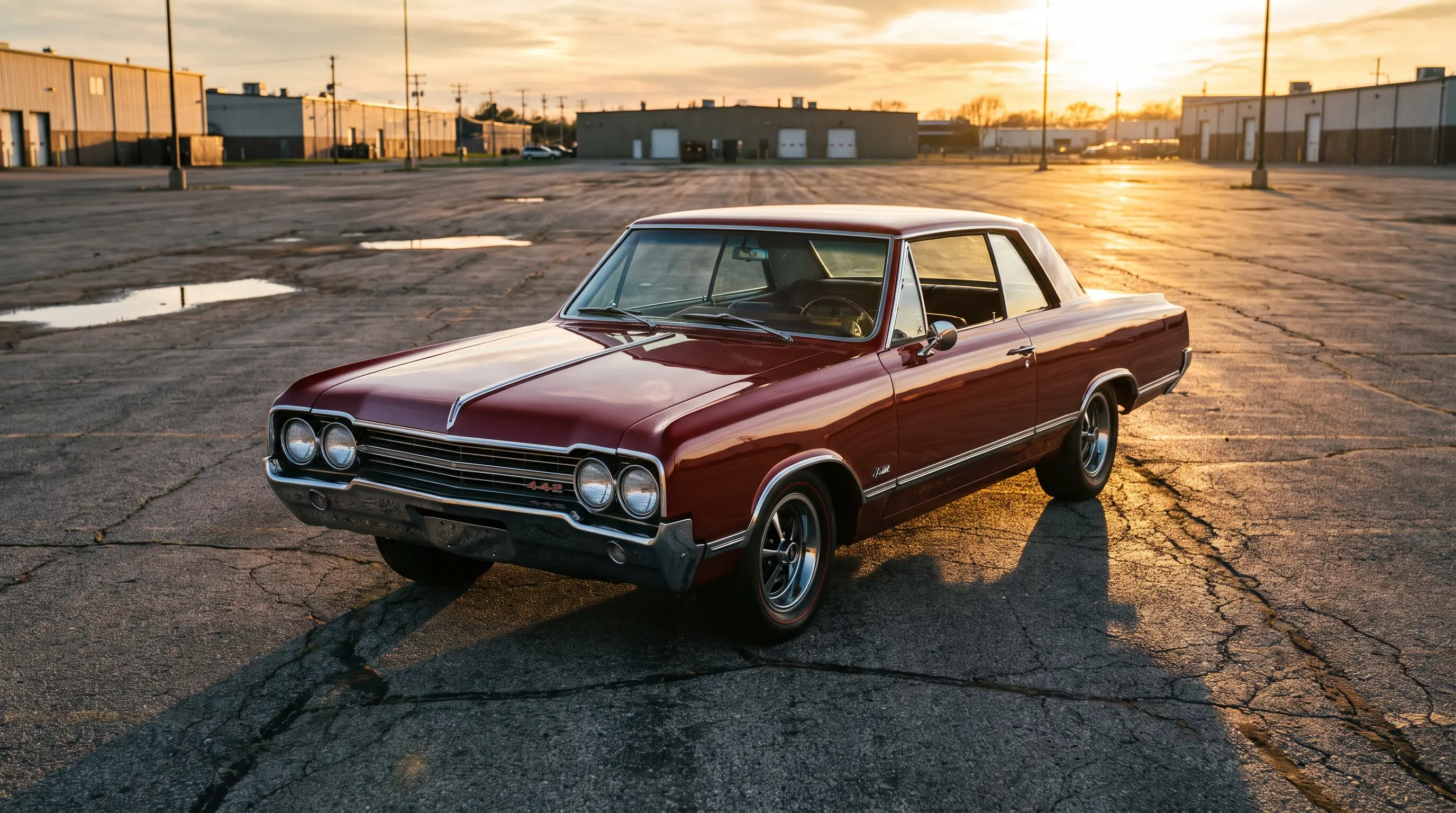
Then 1966 threw a wrench into things with the L69 Tri-Power option, three two-barrel carburetors instead of one four-barrel, rated at 360 gross horsepower, the same claimed figure as Pontiac's Tri-Power 389. For that one year a chunk of 442s on the road technically did not have a four-barrel carburetor at all, which broke even the second version of the acronym. GM's corporate ban on multiple carburetion for intermediates ended the Tri-Power option after 1966, so it never returned for 1967, and the single four-barrel became the standard story again. The W-30 forced-air package, introduced in 1966, added its own layer of confusion because buyers assumed the "W" meant something related to the 442 name. It did not. It was a separate RPO code for the induction system.
None of this is a knock on the car. It is a reminder that model-year details matter more with a 442 than with almost any other muscle car nameplate, because the one thing everybody assumes is fixed, the name itself, is the one thing that was not.
| Model years | 442 meaning as marketed | Engine |
|---|---|---|
| 1964 | 4-barrel carb, 4-speed manual, dual exhaust | 330 cubic inch V8 |
| 1965 | 400 cubic inch, 4-barrel carb, dual exhaust | 400 cubic inch V8 |
| 1966-1967 | 400 cubic inch, dual exhaust (carb count variable) | 400 cubic inch V8, Tri-Power optional |
| 1968 onward | Badge became a standalone series name | 400 cubic inch V8, later 455 |
When 442 stopped being an acronym at all
By 1968 Oldsmobile made 442 its own series, separate from the Cutlass and F-85 option sheet. Once that happened, the acronym argument became mostly academic. It was a model name the same way Chevelle or Charger was a model name. Buyers in period were not cross-referencing carburetor barrels against the fender badge. They knew a 442 was the fast Olds, full stop, and that reputation is what carried the name for the rest of the muscle car era. If you want to see how that transition played out on the ground, the next story in this set walks through that first full model year in detail.
My advice to anyone buying a 442 today: do not get hung up on defending one version of the acronym as the "real" one. Ask what year the car is, look up what the badge meant that specific year, and check the car against those specifics. Chasing the wrong definition is how people end up arguing with a seller over something Oldsmobile itself never settled.
"I've had guys tell me my own car's badge is wrong because it doesn't match the definition they memorized. Half the time they're using the wrong model year's explanation. Oldsmobile changed the meaning before most of these cars even had ten thousand miles on them."
— Mike Sullivan
What actually matters when you are checking a car
Forget the trivia contest. When you are under the hood of a 442, verify what is actually bolted to the block against the build sheet or Protect-O-Plate for that specific car, whatever year it is. A four-barrel carb on a 1964 car should have a 4-speed behind it and dual exhaust running to the back, since that was the only gearbox offered that year. A 1966 car might legitimately have three carburetors instead of one. None of that makes a car more or less of a real 442. It just means the name was flexible enough to survive three different engineering answers and still mean the same thing to buyers: fast, factory, and worth a second look on the lot.
Sources and notes
- Oldsmobile 442 - Wikipedia
- Middle-of-the-Road Muscle: The Oldsmobile Cutlass and 442 - Ate Up With Motor
- Middle-of-the-Road Muscle: The Oldsmobile Cutlass and 442, Part 3 - Ate Up With Motor
- 1966 Oldsmobile 442 - Muscle Car Facts
- 1966 Oldsmobile 442 Profile - Sports Car Market
- Muscle Cars You Should Know: The Oldsmobile 442 - Street Muscle