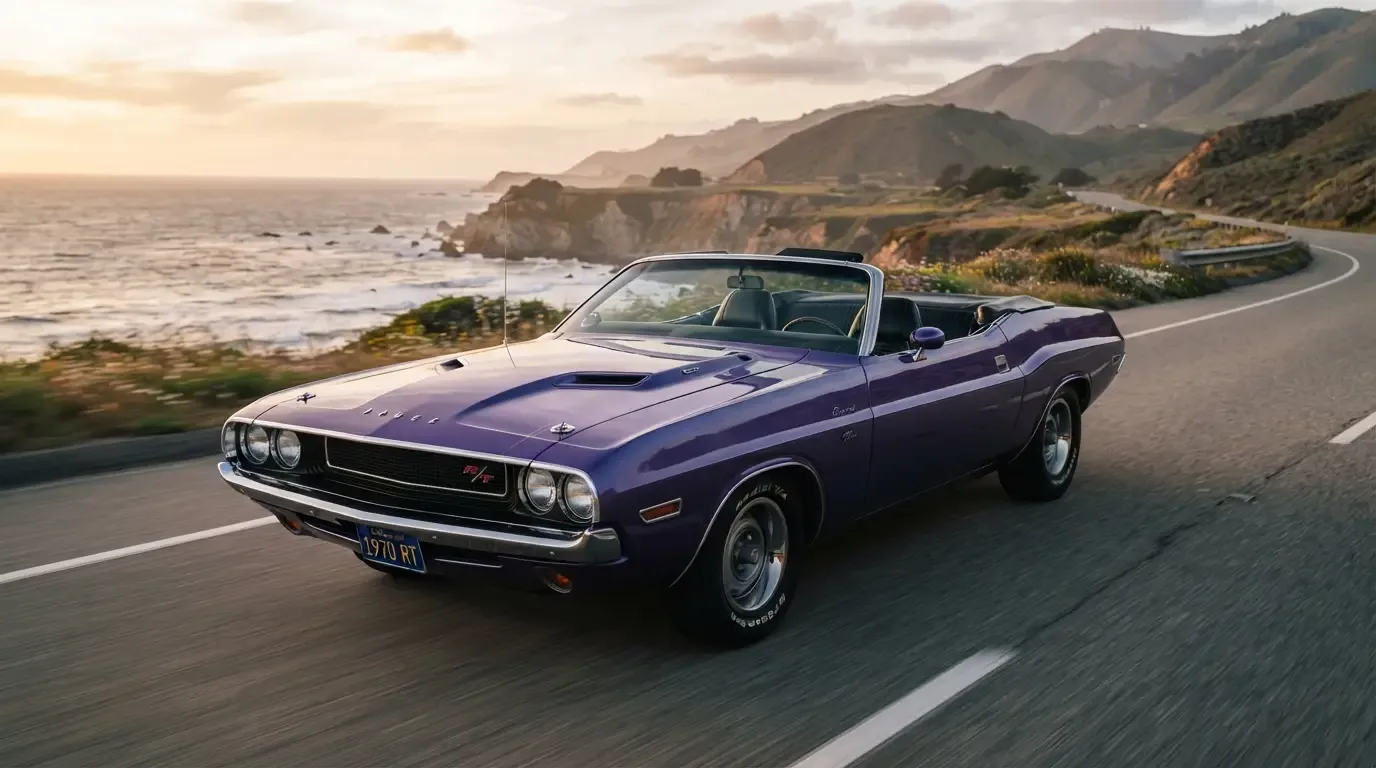
Among every body style Dodge offered that year, the 1970 challenger convertible occupies a unique spot in the story, built in far smaller numbers than the hardtop or coupe and carrying a level of engineering complexity the closed cars never needed. Removing a fixed roof from a unibody platform is never a small change. It meant additional structural reinforcement, a power top mechanism, and a price premium that pushed the convertible toward buyers who wanted the Challenger experience with the top down more than they wanted the lowest possible price of entry into the model.
Why convertibles cost Dodge more to build
A hardtop or coupe Challenger relies partly on its roof structure for overall body rigidity, a benefit convertibles simply do not have. Dodge engineers compensated with additional reinforcement in the rocker panels, floor pan, and cowl area, adding weight and cost that a buyer never saw directly but that showed up in the convertible's higher base price compared to an equivalent hardtop. This reinforcement was necessary to keep the body from flexing excessively over rough pavement, a problem that plagued many earlier convertibles built without adequate structural compensation.
The power top mechanism itself added further cost and complexity, with hydraulic or electric motors, linkages, and a folding frame that needed to stow cleanly behind the rear seat without compromising trunk space too severely. All of this meant a convertible Challenger simply cost Dodge more to engineer and build than a hardtop, a cost passed along to the buyer at the point of sale.
Available trims and engine options
Dodge offered the convertible body style primarily on the base Challenger and R/T trims, giving buyers access to the same range of engines available on the closed cars, from the standard six-cylinder up through the big-block R/T options including the 440 Magnum and, in limited numbers, the 426 Hemi. A convertible R/T with a genuine Hemi represents one of the rarest possible combinations from the entire 1970 model year, since it stacks the lower overall convertible production numbers on top of the already scarce Hemi engine option.
Dodge built somewhere in the neighborhood of 900 to 1,000 R/T convertibles for 1970 across all engine choices, and only about nine of those left the factory with a 426 Hemi under the hood. Because convertible production ran so much lower than the hardtop across every trim level, surviving examples in original, unmodified condition are correspondingly harder to locate today, and that scarcity shows up clearly whenever one comes to auction.
The convertible's place in Dodge's 1970 lineup
Dodge marketed the convertible as the lifestyle image car within the Challenger range, leaning on its open-top appeal in advertising aimed at younger buyers who wanted the visual statement of a drop-top pony car as much as raw performance. For full context on how the convertible fit alongside the coupe, hardtop, and every other body style Dodge offered that year, our 1970 dodge challenger retrospective covers the complete lineup in depth.
Despite the marketing push, convertible sales never approached hardtop volume, a pattern consistent across nearly every manufacturer in the segment by 1970 as buyer preference gradually shifted toward fixed-roof performance cars. Rising insurance costs and a general cultural shift away from open-top motoring through the early 1970s only accelerated that trend industry-wide, making the 1970 model year convertibles something of a high point before the body style faded from the Challenger lineup entirely within just a few years.
| Convertible detail | Note |
|---|---|
| Available trims | Base, R/T |
| Structural changes | Reinforced rocker panels, floor pan, cowl |
| Rarest combination | R/T convertible with 426 Hemi |
| Production trend | Far lower volume than hardtop across all trims |
"Convertibles get treated like a footnote in a lot of Challenger histories, but the engineering behind keeping a unibody car rigid with no roof is genuinely underappreciated. Dodge did real work to make the drop-top feel solid, not just visually appealing."
- Tom Ramirez
Why the convertible matters to today's collectors
Scarcity alone would make the 1970 convertible interesting to collectors, but the combination of scarcity and genuine engineering distinction from the hardtop gives it a stronger case than rarity numbers alone might suggest. A well-documented convertible, particularly in a desirable engine and color combination, tends to draw serious attention whenever one changes hands. For a look at how overall production numbers broke down across body styles and trims that year, a related story digs into those figures directly. And for buyers hoping to find one of these increasingly scarce drop-tops for themselves, there are Challengers for sale now worth reviewing.
What stands out most about the 1970 convertible in hindsight is how briefly this window lasted. Within just a handful of years the convertible Challenger disappeared from the lineup entirely as market conditions shifted, making the 1970 examples a genuine snapshot of a body style that Dodge would not offer again on this generation of the car.
Top mechanism and interior details specific to the convertible
Beyond the structural work, the convertible's power top itself was a genuine engineering exercise. The folding frame needed to stow compactly enough behind the rear seat to leave usable trunk space, while the vinyl or cloth top material had to withstand years of sun exposure and folding cycles without cracking or tearing prematurely. Dodge offered the top in a small selection of colors to complement the exterior paint choices, and getting an original color-matched top on a surviving car today is its own small research project for anyone chasing an accurate restoration, since replacement tops from the aftermarket do not always match factory shades precisely.
Interior appointments on convertible models generally mirrored whatever trim the buyer selected, base or R/T, though the rear seat area was reshaped slightly to accommodate the folded top mechanism, a compromise that reduced rear legroom modestly compared to the hardtop and coupe. Buyers accepted that tradeoff for the open-air experience, and the compromise never seemed to dampen enthusiasm for the body style even as sales numbers told a more modest story than the marketing campaigns suggested they might.
Restoration challenges unique to convertibles
Restoring a 1970 convertible today presents challenges the hardtop and coupe simply do not share. Sourcing a correct top assembly, verifying original color and material, and addressing decades of accumulated rust in the reinforced rocker and floor areas all add complexity and cost beyond what a comparable hardtop restoration requires. Water intrusion around an aging top boot is a common culprit behind hidden floor pan corrosion, and thorough inspection of these areas before purchase is essential given how much harder convertible-specific structural parts are to source compared to shared components used across the entire Challenger lineup. These added complications are part of why a convertible in genuinely sound, well-documented condition tends to command such a premium over a project car needing this kind of specialized structural work.