
I have stood at the back of enough auction tents to know the exact moment a Challenger R/T is going to blow past its estimate. The paddles go quiet for a second, then two bidders lock onto each other and stop looking at anything else in the room. It happened at a Scottsdale sale with a Hemi convertible a few years back, and it happens, on a smaller scale, at regional auctions every season. The results of these challenger rt auction moments tell you more about real market value than any price guide ever will.
Car Features
7 min read
Challenger R/T Auction Highlights
Headline challenger rt auction results almost always belong to documented, matching-numbers cars, and the gap between those and undocumented cars is enormous.
What the headline numbers actually represent
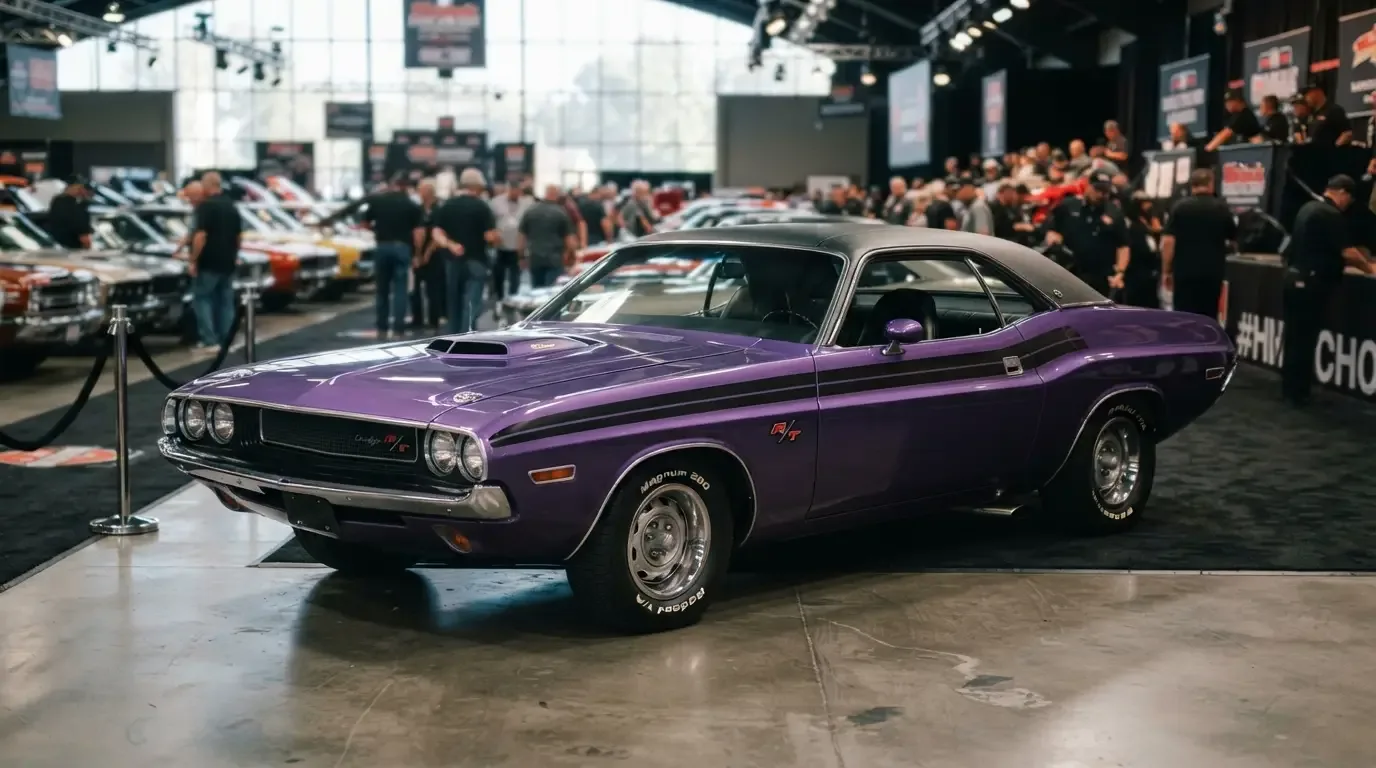
When a major auction house reports a seven-figure sale on a Challenger R/T, it is almost never a standard car. It is a documented, numbers-matching Hemi, often a convertible, often with an unbroken ownership history and factory paperwork that removes every question a serious buyer might have. Those sales make headlines because they are genuinely rare events, not because they represent what a typical R/T sells for.
Mecum has been the house most associated with these headline results. A Plum Crazy 1970 Hemi Challenger R/T convertible, one of just nine built for the U.S. market, brought $1.43 million at Mecum's Phoenix sale, and other documented Hemi convertibles from the same model year have crossed the block in the same seven-figure territory. The "Black Ghost," a real 1970 Hemi Challenger R/T SE with a documented street-racing past, sold for more than a million dollars at Mecum Indianapolis. Those numbers sit far above what a standard 383 or 440 Magnum R/T brings, which is exactly the point.
The broader market for Challenger R/Ts, the 383 and 440 Magnum cars that made up the bulk of production, trades in a much steadier and more accessible range. Those results rarely make it into the auction highlight reels, but they are where most real transactions actually happen, and they are the numbers a typical buyer should be watching.
Why some cars sail past estimate and others do not
I have watched two nearly identical 440 Magnum R/Ts cross the block at the same event with wildly different results. The difference almost always comes down to the same handful of details: original engine versus replacement, matching paint code versus repaint, and whether the car has a paper trail a buyer can independently verify. A car with any question mark in its history tends to sell at or slightly under estimate. A car with no question marks tends to sail past it, sometimes by a wide margin, because bidders trust what they are buying enough to chase it.
Auction houses know this too, which is why catalog descriptions increasingly lean on phrases like "matching numbers confirmed" or "same family ownership since new." Those phrases are not filler. They are the actual product being sold, arguably more than the sheet metal itself.
| Documentation level | Typical result vs. estimate |
|---|---|
| Full matching numbers, verified history | Often exceeds high estimate |
| Partial documentation, some gaps | Trades near or slightly under estimate |
| Little to no documentation | Frequently sells under low estimate or does not meet reserve |
What bidders are really reacting to in the room
Watching bids climb in person is different from reading a result online later. In the room, you can tell within the first thirty seconds whether the crowd believes the car. If the specialist on stage reads off a strong provenance and the crowd nods along, the bidding accelerates fast. If there is hesitation, questions from the floor, a specialist hedging on a detail, the bidding slows and often stalls well short of what a cleaner example would bring. Readers who want where this started, the full production history behind these cars, will understand why so much of an auction result depends on paperwork nobody in the audience can actually see from their seat.
"An auction room does not lie about what it believes. Watch the second bidder, not the first. The second bidder tells you whether the car is real."
- Marcus Feld
How specialists describe cars from the podium
Spend enough time at these sales and you start to notice a pattern in exactly how the auctioneer's specialist frames each car as it crosses the block. A car with no reservations gets specific language, engine and transmission numbers read aloud, ownership chain summarized in a confident sentence or two. A car with any uncertainty gets softer language, phrases like "believed to be" or "represented as," which are doing careful legal work even as they sound like harmless filler to an inexperienced bidder. Learning to hear that distinction is one of the more valuable skills a new auction attendee can pick up, and it usually costs nothing but a few hours of paying close attention.
I tell people new to this hobby to attend at least one major sale purely as a spectator before they ever raise a paddle. Watch how the language shifts between lots. Watch which cars draw a hush in the room and which draw restless side conversations. That atmosphere tells you almost as much about a car's real standing as the printed catalog description does, and it is free information that far too many new bidders skip past on their way to the bidding paddle.
Reserve, no-reserve, and what each signals
Whether a car crosses the block with a reserve in place or as a no-reserve lot changes the psychology of the room in a way that is worth understanding before attending any sale. A no-reserve Challenger R/T tends to draw more aggressive early bidding, because buyers know the car will sell regardless and want to avoid getting shut out entirely. A reserved lot often sees a slower build, bidders testing the waters cautiously until the number clears whatever threshold the consignor has set, sometimes never getting there at all.
Neither structure is inherently better for a seller, but they produce different kinds of results, and comparing a no-reserve sale price directly against a reserved sale price from a different event without accounting for that difference is a common mistake among people trying to build a mental price guide from auction results alone. The structure of the sale itself is part of the data, not a footnote to it.
What this means for a private buyer
Private sales do not have a room full of bidders to police a claim in real time, which means the burden of verification falls entirely on the buyer. The same documentation that makes an auction result climb, matching engine numbers, fender tag accuracy, verified ownership history, is exactly what a private buyer should be demanding before agreeing to a price anywhere near what a comparable car brought at auction. Buyers actively comparing documented examples can look through shop classic Challenger listings and hold every claim to the same standard an auction specialist would.
The lesson from years of watching these results is not complicated. Rarity gets attention. Documentation gets the money. A Challenger R/T that can prove what it claims will always find its ceiling. One that cannot will always sell under it, no matter how good the paint looks under the tent lights. Keep that distinction in mind at the next sale, whether you are bidding or just standing at the back of the tent watching two paddles duel it out.
Sources and notes
- "Black Ghost" 1970 Hemi Challenger R/T SE sale - MoparInsiders
- 10 Most Expensive Hemi-Powered Mopars Ever Sold at Auction - TopSpeed
- 1970 Dodge Challenger R/T Hemi Convertible - Sports Car Market
- 1 of 5 1970 Dodge Challenger R/T Convertible sale - GTspirit
- Mecum Auctions
- Dodge Challenger (first generation) - Wikipedia
Related Reading

About the author
Marcus Feld
Accredited collector-car appraiser who reads the market through hammer prices, condition tiers and risk.
Related Listings - Dodge Challenger

Comments
Be the first to comment on this article.