
My grandfather called it the tail stripe, never by its real name, and it took me years to learn that the rest of the world called it something more playful. The challenger bumblebee stripe wrapped around the back of a Dodge Challenger R/T like a belt cinched around the car's widest point, and it is one of those design details that people who have never sat in a classic muscle car still recognize on sight.
Car Features
7 min read
The Bumblebee Stripe: The R/T's Tail Signature
The tail-wrapping band nicknamed the bumblebee stripe became the visual signature of the Challenger R/T, a nickname the factory never used but everyone kept.
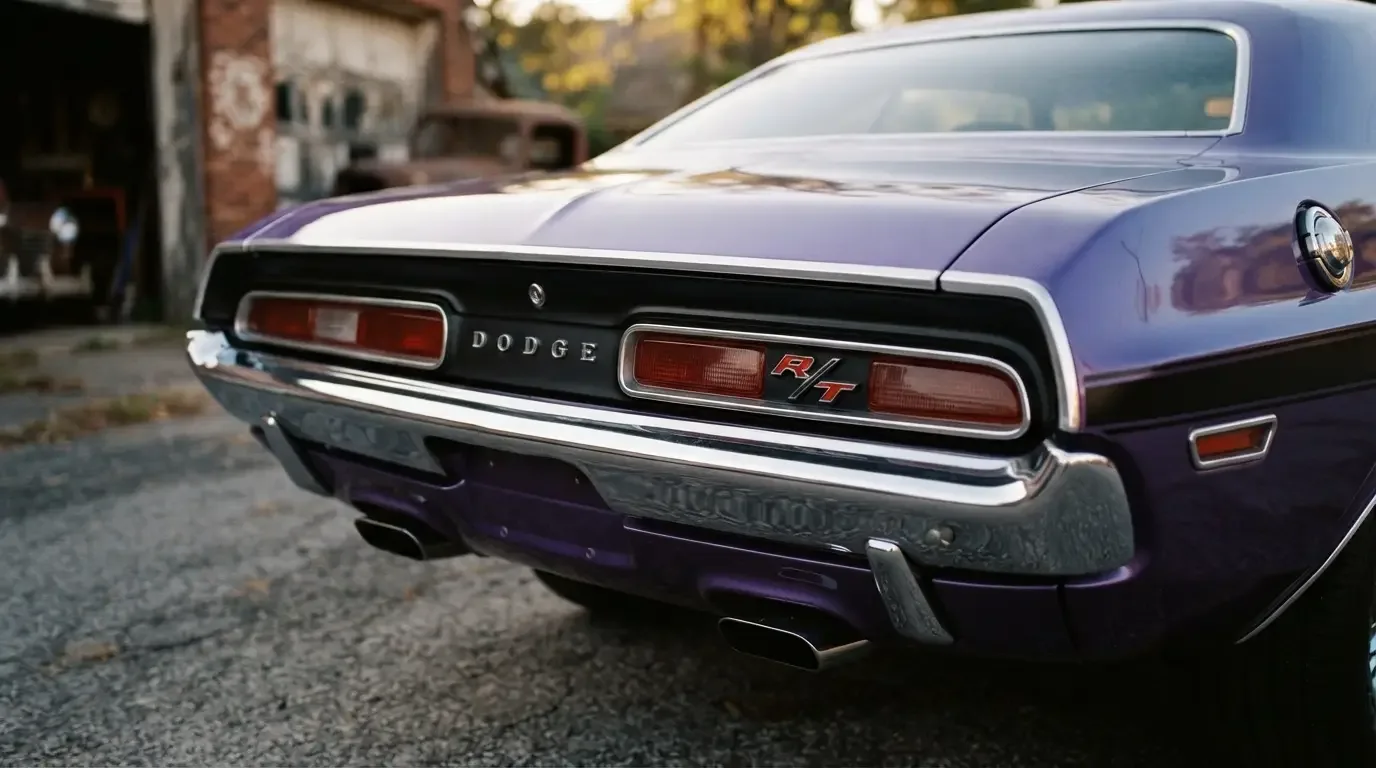
A band with a job to do
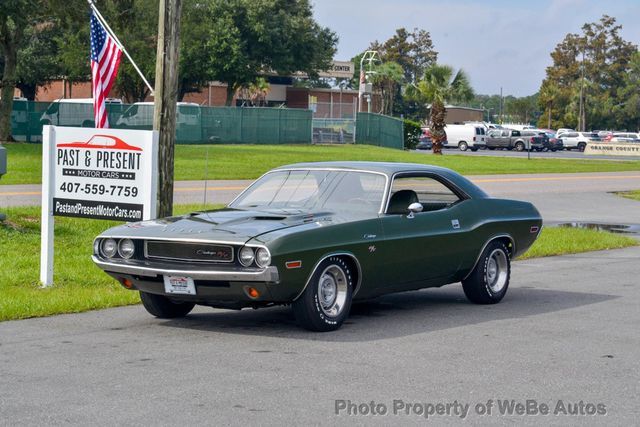
The stripe first appeared on Dodge's performance cars in the late 1960s, and by 1970 it had become closely associated with the Challenger R/T specifically. Unlike a hood stripe that runs the length of the car, the bumblebee wraps the tail end, circling the trunk lid and rear quarters in a wide band, usually finished in black or white depending on the body color underneath it. The effect was deliberate. From behind, at a stoplight or in a rearview mirror, the stripe made the car's width and stance impossible to miss.
Designers were not just decorating. The rear of a Challenger carries a lot of visual weight, wide fenders, a flat deck, quad taillights on many trims, and the stripe organized that weight into a single readable shape. It gave the eye something to follow across a section of the car that otherwise risked looking heavy or plain.
Why the nickname stuck
Nobody at Dodge officially called it the bumblebee stripe in period literature, but the nickname spread anyway, born from the obvious resemblance to the striped abdomen of the insect. It is the kind of name that survives precisely because it is more useful than the formal one. Ask a parts counter for a "tail stripe kit" today and you may get a blank look. Ask for a bumblebee stripe and everyone in the room knows exactly what you mean.
The name has outlived the marketing department that never used it, which says something about how enthusiasts, not manufacturers, often end up writing the lasting vocabulary of a car's identity. That vocabulary gets passed down at car shows and swap meets long after the original brochures are gone.
Getting it right on a restoration
Anyone restoring a Challenger R/T learns quickly that the stripe is less forgiving than it looks. Width, placement, and the exact curve where it meets the body panels all varied slightly depending on model year, and a stripe cut a half inch too wide or positioned a fraction too high changes the entire read of the car's rear end. Reproduction stripe kits exist and most are good, but fitting one correctly still takes patience and a steady hand, particularly around the trunk lid seam where the factory application had to account for the panel gap.
Some owners choose to delete the stripe entirely for a cleaner look, and that choice has its defenders. But most R/T buyers, myself included, see the stripe as inseparable from the car's identity, the visual signature that turns a wide rear end into a statement rather than just sheet metal. Readers curious how this detail fits into the model's broader development can find our complete history of the R/T line, from its first appearance through its final classic-era model year.
"It is such a small piece of tape and paint, in a sense. And yet it is the first thing half the owners I know point to when they describe why they fell for this car."
- Nora Beckett
How the stripe changed year to year
The Challenger R/T's tail treatment was not frozen across its classic-era production run. The exact width, the presence or absence of a thin pinstripe edge, and the way it interacted with the R/T lettering and fuel filler door all shifted slightly from one model year to the next. A stripe correct for one year can look almost right but subtly wrong on a car from another, the kind of detail that a casual observer would never catch but that a judge at a concours event, or a picky buyer doing real diligence, will notice immediately.
This is part of why the stripe is such a useful diagnostic when evaluating an unfamiliar car. A seller who cannot explain why their stripe looks the way it does, or who dismisses questions about the exact edge treatment as unimportant, may not know the car as well as their listing suggests. The stripe is small enough to overlook and specific enough to catch someone out.
The color and material choices behind the look
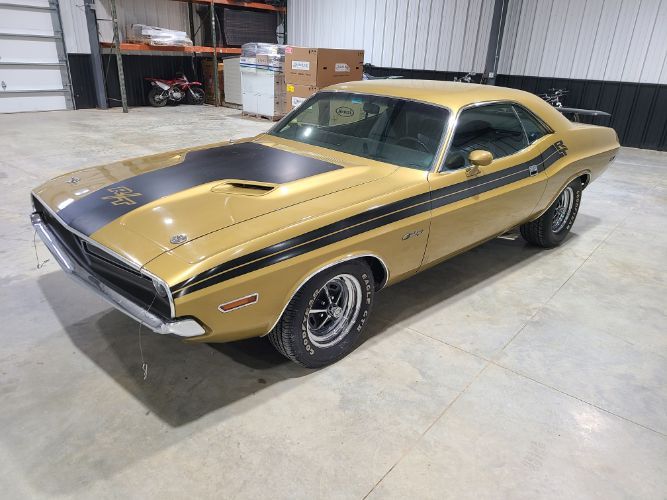
Black and white were the most common choices, but the factory list ran much longer than that on the 1970 Challenger R/T, with buyers able to order the stripe in shades that matched or played against the body color, applied by Dodge as paint rather than a decal, which is part of why the color list could run so long at no extra cost. Reproduction suppliers today generally offer vinyl decal kits, which are considerably easier to apply correctly than trying to mask and paint the stripe by hand, though purists restoring a numbers-matching car sometimes go to greater lengths to match the original application method rather than take the easier path.
Getting the black right is its own small challenge. A stripe that reads as slightly too glossy or slightly too flat against the surrounding paint sheen looks wrong even when the shape and placement are otherwise correct, which is one more reason careful restorers spend real time comparing samples before committing to a specific product.
A detail people notice before the engine
There is something honest about a car whose most memorable feature, for a lot of people, is not the number under the hood but a painted stripe around the tail. It suggests the Challenger R/T was built to be recognized at a glance, not just admired up close by people who already know what they are looking at. Parents who never cared about horsepower figures still remember the stripe from childhood, spotted on a neighbor's driveway or glimpsed at a stoplight decades ago.
That kind of recognition does not fade the way spec sheets do. A generation that has never heard of a 440 Six Pack can still describe the stripe, and that staying power is part of why the detail continues to matter to buyers today, long after the marketing department that never gave it an official name has been forgotten. Anyone who wants to see how the detail looks in person, rather than in old photographs, can browse classic Challenger listings and look for it circling the tail of an R/T still wearing its original band.
It remains, in the end, a small piece of paint doing a large amount of work, and that is about as good a description of good design as I know.
Sources and notes
- Crazy Stripe Combinations of the 1970 Dodge Challenger - ClassicCars.com Journal
- 1970 Dodge Challenger Rear Bumblebee Stripe Paint
- Phoenix Graphix 1970 Challenger R/T Bumble Bee Stripe Kit
- 1970 Dodge Challenger Fact Sheet - Over-Drive Magazine
- Bumble bee stripes discussion - Dodge Challenger Forum
- Dodge Challenger (first generation) - Wikipedia
Related Reading
#muscle car design
#bumblebee stripe
#classic mopar
#dodge challenger
#challenger rt
#restoration detail

About the author
Nora Beckett
Automotive features writer and photographer who tells the human stories behind the cars, from show fields to cross-country road trips.
Related Listings - Dodge Challenger

Comments
Be the first to comment on this article.