
The Magnum name did the selling. The engine did the rest. In the Dodge Challenger R/T, the Magnum badge covered a family of big-block V8s that gave the car its reputation, and most of what people remember about that reputation traces back to two engines: the 383 Magnum and the 440 Magnum. Here is what the numbers actually say about challenger magnum engines, without the marketing gloss.
Car Features
7 min read
The Magnum Engine Family in the Challenger
The 383 and 440 Magnum V8s defined the bulk of Challenger R/T production, and the real difference between them is bigger than the marketing ever admitted.
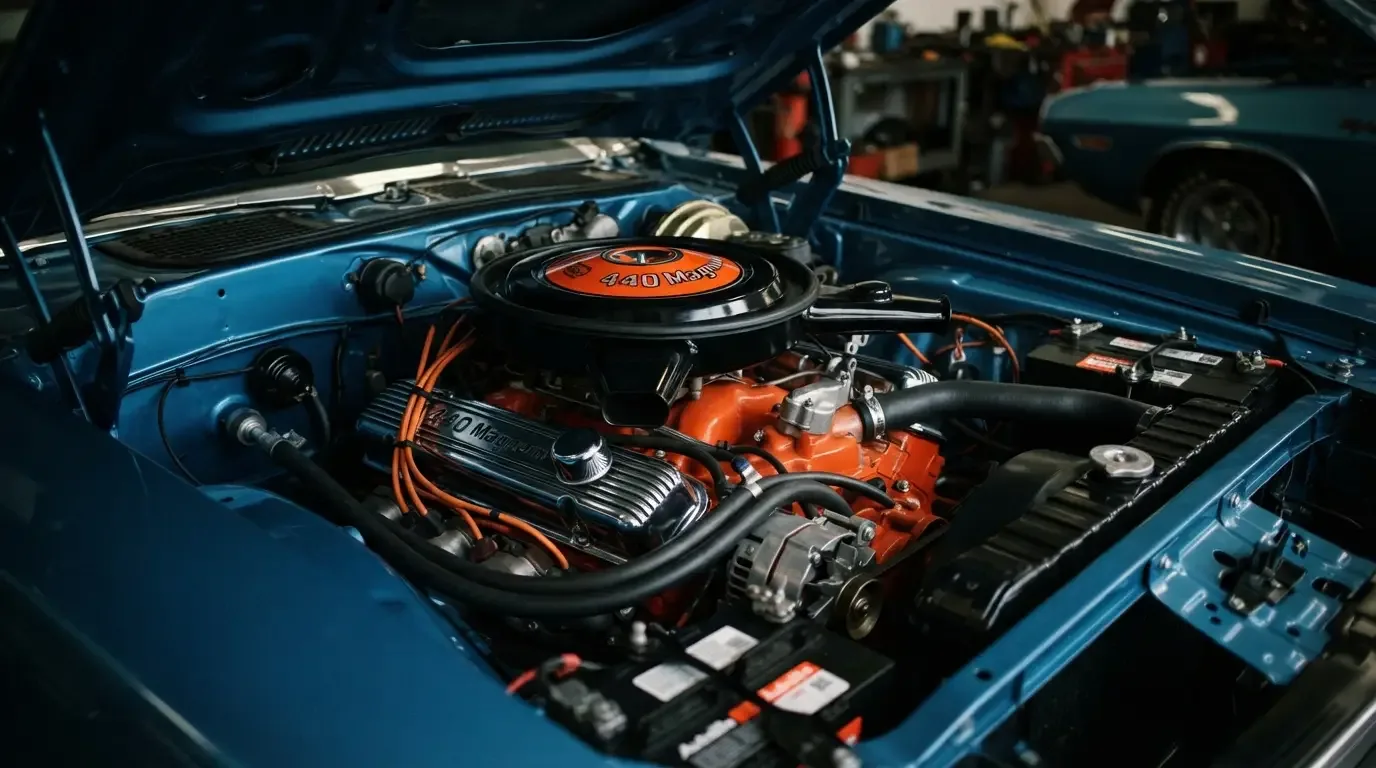
The 383 Magnum, the volume seller
The 383 Magnum was the base V8 for the Challenger R/T package, and it was the engine most R/Ts actually left the factory with. Factory rated around 335 horsepower, it was not the fastest option Dodge offered, but it was the one that made the R/T package affordable enough to actually sell in volume. A four-barrel carburetor, dual exhaust, and a mild cam gave it real presence without pricing out a big chunk of the buying public.
Enthusiasts sometimes talk about the 383 like it is a lesser choice compared to the bigger engines. That framing misses the point. The 383 Magnum is the reason the R/T badge shows up on so many surviving cars today. Without it, the R/T would have been a low-volume specialty package instead of the backbone of Challenger performance sales.
The 440 Magnum, the step up
Move up the order sheet and the 440 Magnum shows up rated around 375 horsepower in standard four-barrel form, a genuine jump in both output and presence under the hood. Buyers who wanted more than the 383 without stepping into Hemi territory landed here, and a lot of them did. The 440 Magnum gave the R/T a wider torque band and a deeper exhaust note, and it remained a strong seller through the model's classic run.
The number moved with the calendar. Dodge advertised the 440 Magnum at 375 gross horsepower for 1970, trimmed to roughly 370 gross horsepower in 1971, and then the figure appears to fall off a cliff for 1972 once the industry switched from gross to net ratings, and Dodge quoted around 280 net horsepower for the detuned, unleaded-fuel version that carried through the model's final Challenger years. Read those numbers side by side and the engine looks like it lost a third of its power in two years. It did not. The measuring stick changed underneath it.
| Engine | Displacement | Approx. factory horsepower |
|---|---|---|
| 383 Magnum | 383 cubic inches | ~335 hp |
| 440 Magnum | 440 cubic inches | ~375 hp |
| 440 Six Pack | 440 cubic inches | ~390 hp |
Six Pack changed the conversation
The 440 Six Pack was not technically branded a Magnum in the same way, but it grew directly out of the Magnum family, taking the same 440 block and feeding it through three two-barrel carburetors instead of one four-barrel. The result pushed output higher again, and it gave buyers a middle ground between the 440 Magnum and the Hemi, without the Hemi's price and complexity. It is the engine collectors point to most often when they talk about the sweet spot in the Challenger's big-block lineup, real performance without the rarity tax the Hemi commands.
The number that matters here is not just horsepower. It is availability. The Six Pack sold in far smaller quantities than the standard 440 Magnum, and that gap in production numbers is exactly why it commands a premium today over an otherwise similar 440 car.
The transmission pairing question
Neither Magnum engine existed in isolation from the transmission bolted behind it, and buyers evaluating a car today should treat the two as a combined package rather than separate line items. Both the 383 and 440 Magnum were available with a heavy-duty automatic or a four-speed manual, and the specific pairing affects both how the car drives and what a documented example is worth. A four-speed 440 Magnum car has a different character entirely from an automatic version, more involved, more work in traffic, and for a certain kind of buyer, meaningfully more desirable for exactly that reason.
Rear axle ratio is the other number that gets ignored too often. A numerically higher ratio sharpens acceleration at the cost of highway cruising manners, and Dodge offered a range of options across both Magnum engines. A car's factory documentation should specify which ratio it left the plant with, and a mismatch between the documented ratio and what is actually under the car is a red flag worth investigating before any serious money changes hands.
What separates the engines in practice
Drive a 383 Magnum car and a 440 Magnum car back to back and the difference is obvious within a block. The 383 pulls hard but runs out of steam sooner. The 440 keeps pulling. Neither is a bad engine. They serve different buyers, then and now. A 383 car is the more livable classic. A 440 car is the one that rewards a heavier foot. Readers who want the fuller dodge challenger rt history behind how these engines fit into the R/T package will find the story is really about trims, not just cubic inches.
"Horsepower numbers get repeated so often people stop checking them. Read the fender tag. The tag does not lie."
- Dan Reeves
Why the Magnum name outlasted the cars themselves
Dodge kept using the Magnum badge on engines for years after the classic Challenger stopped production, which is not an accident. The name had built enough recognition among buyers that it made sense to keep it working even as displacements and platforms changed underneath it. That later history is worth separating from the specific 383 and 440 Magnum engines discussed here. When someone mentions a Magnum V8 today, the model year and application matter enormously, and a casual claim about "a Magnum engine" tells you almost nothing on its own without a displacement and a build sheet to back it up.
For the classic Challenger R/T specifically, the Magnum name is shorthand for a fairly narrow window of history, a handful of years and two primary displacements that defined the car's reputation on the street. Everything since has borrowed the name. The original R/T earned it.
The bottom line on Magnum power
Do not buy a Challenger R/T based on which engine sounds most impressive at a barbecue. Buy based on what the car is actually documented to have, and what condition that engine is in today. A well-maintained 383 Magnum beats a neglected 440 every time it matters, which is every time the key turns. For a related look at how the R/T's performance promise played out on the road, see a related story covering the same ground from a different angle.
The numbers on the Magnum family are not complicated once you strip away the nostalgia. 383 for volume and value. 440 for torque and presence. Six Pack for the buyer who wanted both performance and rarity in one purchase. Shoppers comparing options today can check documented examples among Challengers for sale now and match the fender tag to the claim before paying a premium for any one engine over another.
Do the homework before the handshake, not after. That is the only number that actually protects a buyer once the car is sitting in the driveway.
Sources and notes
Related Reading

About the author
Dan Reeves
Performance engine builder from North Carolina's motorsports corridor, focused on swaps, forced induction and making real, repeatable power.
Related Listings - Dodge Challenger


Comments
Be the first to comment on this article.