
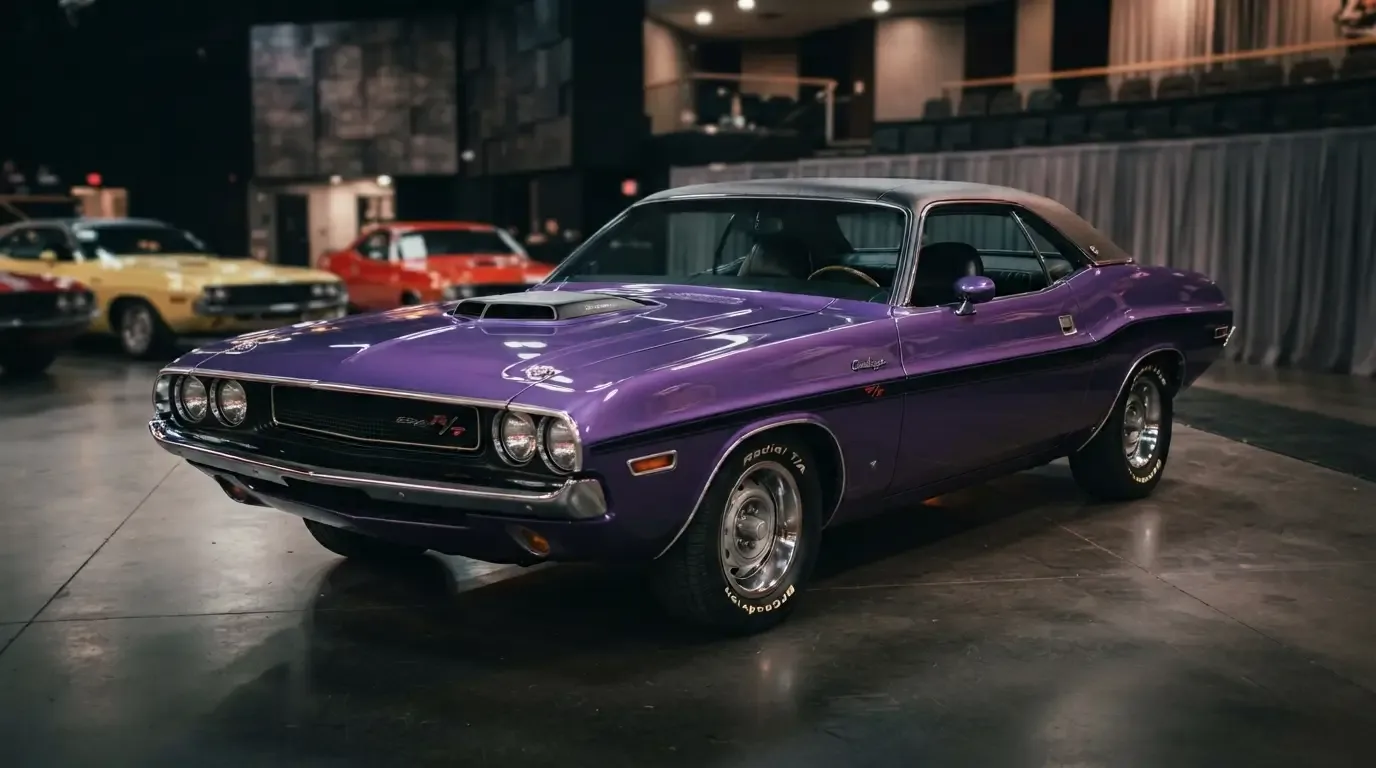
Every appraisal starts the same way for me: three cars, roughly the same year, roughly the same mileage, three very different numbers on the offer sheet. The variable is rarely the engine. It is documentation, condition, and how much of the original car is still the original car. Understanding challenger rt value means understanding that the Dodge Challenger R/T was never one product. It was a range of build combinations, and the market has learned to price that range with real precision.
Car Features
7 min read
Why Challenger R/Ts Command Premiums
Engine, documentation, condition, and originality decide challenger rt value more than badge alone, and the gap between a 383 and a Hemi tells the whole story.
What actually moves the number
Four factors drive a Challenger R/T's price at auction or in a private sale, and I rank them in this order every time. Engine and drivetrain combination first, because a 440 Six Pack or a Hemi car sits in a different bracket than a 383. Documentation second, meaning broadcast sheets, fender tags, and a title history that does not have gaps. Condition third, and I mean honest condition, not detailing. Originality last but not least, because a matching-numbers car with its original sheet metal will always outsell a well-built clone wearing the same badges.
Buyers new to the hobby tend to overweight cosmetics. A fresh paint job photographs well and it is the first thing anyone notices in a listing. But paint is the cheapest thing to fix on a car like this. What cannot be easily fixed is a replaced VIN tag, a re-stamped block, or a title that changed hands three times with no clear record. Those problems do not show up in photos. They show up in the price a serious buyer is willing to pay once the paperwork gets pulled.
The gap between a 383 and a Hemi
The spread here is not subtle. A well-documented 1970 Challenger R/T 383 in good condition sits in a solid mid-range collector bracket, respectable and honestly the better daily proposition. A numbers-matching 426 Hemi R/T convertible from the same year can bring a multiple of that figure at a major auction house, sometimes several multiples, because so few were built and because Hemi cars have become their own separate market with buyers who are not comparison shopping against small-block cars at all.
Only nine 1970 Hemi Challenger convertibles were built for the U.S. market, and documented, numbers-matching examples have brought seven-figure hammer prices at major auctions in recent years, with the best-known sales landing well north of a million dollars and the top result reported around $1.65 million.
That gap is not going away, and it is worth understanding before shopping by badge alone. "R/T" tells you the trim package. It does not tell you the engine, and it does not tell you the value bracket. Read the build sheet before you read the for-sale ad.
| Engine option | Relative rarity | Typical buyer profile |
|---|---|---|
| 318 or 225 six | Common | Entry-level collectors, drivers |
| 383 Magnum | Moderate | Value-focused buyers wanting real R/T presence |
| 440 Six Pack | Scarce | Performance-focused serious collectors |
| 426 Hemi | Rare | Top-tier collectors, museum and investment buyers |
Where the risk actually hides
I have appraised cars that looked flawless and were worth a fraction of the asking price once the numbers were checked, and I have appraised rough-looking survivors that outvalued freshly restored show cars because every stamp matched and the paper trail was complete. The lesson does not change from car to car. A clone can be built to an extremely high standard and still be a clone. Buyers who want the full story on how the R/T was built and optioned will understand why the engine code on the fender tag matters more than almost anything visible from ten feet away.
The downside risk with any muscle car purchase is liquidity. A well-bought, well-documented R/T sells quickly when the time comes. A questionable car with thin paperwork sits, gets relisted, and often sells at a discount to a buyer willing to accept the uncertainty. That is not a moral judgment. It is simply how this market prices risk.
"Condition tells you what you're looking at. Documentation tells you what you're actually buying."
- Marcus Feld
How condition grading actually works in practice
Most appraisers use some version of a letter or number grading scale, and the temptation for a seller is always to round up. A car described as "driver quality" by one seller might be described as "needs everything" by an honest appraiser standing next to it. I have stopped trusting adjectives entirely and started asking for specifics instead. Does the floor pan have any repair sections welded in. Has the frame rail ever been sectioned. Is the trunk drop-off original or replaced. Those answers matter more than whether a seller calls the car excellent or very good, because the words are marketing and the metal is the truth.
Restoration quality matters too, and it is not the same thing as originality. A car can be beautifully restored and still be a lower-value proposition than a rough, honest survivor with its original panels intact, particularly for buyers who care about matching numbers above all else. Conversely, a sloppy restoration on an otherwise correct car drags the number down regardless of how rare the drivetrain is. Buyers need to separate these two questions, originality and restoration quality, rather than folding them into a single vague impression of how nice the car looks.
Regional and seasonal price movement
Challenger R/T prices are not static across the calendar or across the map. Major auction weeks, particularly in Arizona each January, tend to set the tone for private sale expectations for months afterward, for better or worse depending on how that week's results land. A strong result at a headline auction can lift asking prices across private listings almost immediately, sometimes before the underlying demand has actually caught up. That lag is where a patient buyer can find real value, in the weeks after a hot auction week when sellers are anchored to a number the broader market has not fully absorbed yet.
Regional differences matter less than they once did, since serious buyers now shop nationally and transport cars readily, but they have not disappeared entirely. A well-documented R/T in a region with a strong Mopar club presence can sometimes command a modest premium simply because local buyers know exactly what they are looking at and are willing to move quickly on a car with clean paperwork.
A buy or no-buy framework
My rule for a Challenger R/T purchase is simple. If the engine matches the fender tag, if there is a broadcast sheet or reliable paper trail, and if the price reflects the actual condition rather than the seller's optimism, it is a buy. If any one of those three is missing, the price needs to drop enough to compensate for the risk, or I walk. That framework has held up across a decade of appraisals because it separates emotion from arithmetic, and this is a hobby where emotion routinely overpays.
Shoppers ready to apply that same discipline can start by comparing documented examples against asking prices among classic Challenger for sale listings, treating every strong claim about rarity as something to verify rather than something to trust. The car that is honestly what it claims to be is always worth more than the one that only looks the part, and in this market the difference between the two is rarely hidden for long.
Sources and notes
- 1970 Dodge Challenger R/T Hemi Convertible - Sports Car Market
- 10 Most Expensive Hemi-Powered Mopars Ever Sold at Auction - TopSpeed
- "Black Ghost" 1970 Hemi Challenger R/T SE sale - MoparInsiders
- Mecum Auctions
- 1 of 5 1970 Dodge Challenger R/T Convertible sale - GTspirit
- Dodge Challenger (first generation) - Wikipedia
Related Reading

About the author
Marcus Feld
Accredited collector-car appraiser who reads the market through hammer prices, condition tiers and risk.
Related Listings - Dodge Challenger

Comments
Be the first to comment on this article.