
Every serious researcher of the Dodge Challenger runs into the same problem eventually: the production numbers everyone repeats do not always match what the surviving factory paperwork actually says. Challenger R/T production tells a real story about which engines buyers actually chose, but that story only holds up when you trace it back to primary sources rather than repeating figures that have been copied from one article to the next for decades.
Car Features
7 min read
Challenger R/T Production Numbers
Challenger R/T production numbers get repeated so often that the original sources get lost, and the real hierarchy among the 383, 440, Six Pack, and Hemi options rarely matches the myths.
What the factory records actually show
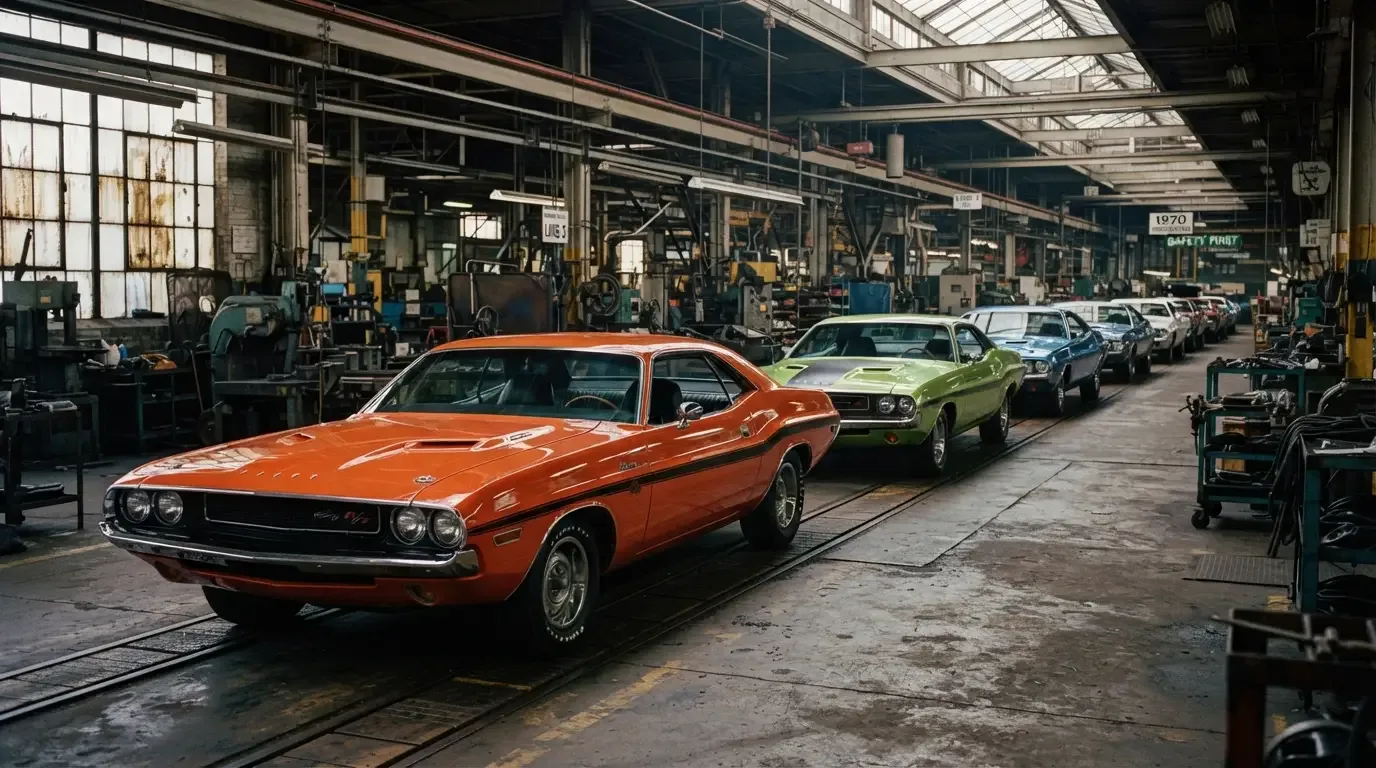
Chrysler's own production breakdowns for the Challenger R/T across 1970 and 1971 show a clear hierarchy among engine choices. For 1970, documented totals show 12,281 of the 18,512 R/Ts built carrying the standard 383 Magnum, roughly 3,840 with the 440 Magnum (2,802 hardtops, 875 R/T SEs, 163 convertibles), roughly 2,035 with the 440 Six Pack, and just 356 with the 426 Hemi. For 1971, total R/T production fell to about 4,892 units, with the Hemi down to 71 cars and the Six Pack to around 250, while the 383 remained the standard engine by far the largest share. The 440 Magnum represents the next largest slice in both years, followed by the 440 Six Pack, with the 426 Hemi trailing far behind as the rarest option by a significant distance.
Correcting misconceptions here matters because casual sources sometimes present the Hemi as though it were a common R/T choice, when the surviving production data says otherwise. Buyers chased the Hemi's reputation, but the sales figures tell a different story about what actually left dealer lots.
Why the totals dropped between 1970 and 1971
Total R/T production fell noticeably from the 1970 debut year to 1971, a pattern that shows up across nearly every engine option rather than concentrated in just one. Rising insurance costs on high-performance cars and tightening emissions regulations both pushed buyers toward less aggressive options, and the R/T package as a whole felt that shift even though it remained available with the same core engine lineup.
This is not a story unique to the Challenger. Nearly every muscle car nameplate from this period saw comparable production declines heading into 1971 and 1972, as the broader market conditions that made high-horsepower cars viable for young buyers began to erode. The Challenger R/T's numbers reflect an industry-wide pattern rather than anything specific to Dodge's marketing or engineering choices.
Common misconceptions this data corrects
A persistent myth in casual Challenger discussion holds that the 440 Six Pack was rarer than the Hemi, when factory production figures show the opposite. The Six Pack, while less common than the plain 440 Magnum, still outproduced the Hemi option by a wide margin in both years, roughly 2,035 Six Pack R/Ts against 356 Hemis in 1970, and roughly 250 Six Pack R/Ts against 71 Hemis in 1971. This matters to collectors because rarity claims drive pricing, and pricing built on an inaccurate premise shortchanges buyers on one side of the transaction or the other.
Another common error treats R/T production as a single steady number across the model's run, when the actual figures show a clear decline year over year. Anyone citing "Challenger R/T production" without specifying a model year is working from an incomplete picture, since 1970 and 1971 numbers differ enough to matter for both historical accuracy and market valuation.
A third error conflates R/T production with total Challenger production, treating the two as though they moved in lockstep. They did not. The base Challenger line, with its six cylinder and small block options, held up better against the era's headwinds than the R/T package did, since a six cylinder commuter car never faced the insurance surcharges that pushed R/T buyers toward more modest choices. Anyone building a percentage-based rarity argument needs to keep those two production pools separate rather than treating the Challenger nameplate as a single undifferentiated total.
| Engine option | Relative production share |
|---|---|
| 383 Magnum | Largest share, standard R/T engine |
| 440 Magnum | Second largest share |
| 440 Six Pack | Smaller share, rarer than 440 Magnum |
| 426 Hemi | Smallest share, rarest R/T engine option |
"Production numbers get repeated so many times in this hobby that people forget to check where the original figure came from. Every time I trace a widely cited number back to its source, I learn something the copies left out."
- Tom Ramirez
Why this matters for anyone researching or buying
Accurate production figures change how a buyer should think about rarity and pricing. A documented 440 Six Pack car, correctly understood as rarer than commonly assumed relative to the plain 440 Magnum but more common than the Hemi, occupies a specific place in the market that generic "rare muscle car" marketing language obscures. Getting the numbers right protects buyers from paying Hemi-adjacent prices for a car that, while genuinely scarce, does not carry the same production rarity.
For the complete picture of how the R/T model developed across its full run, including the engine and trim options discussed here, the whole picture ties this production data into the model's broader history. Readers ready to shop with this context in hand can shop classic Challenger listings and evaluate asking prices against the actual production rarity of whatever engine option they are considering.
Tracing a claim back to its source
The discipline that separates real research from repeated trivia is simple to describe and tedious to practice: every production figure worth citing should trace back to a factory document, a period sales brochure, or a registry compiled from verified fender tags, not to a number that appeared unattributed in a magazine article decades ago and has been copied ever since. When two sources disagree on a production total, the disagreement itself is worth noting rather than papering over, because it usually means one source made an assumption the other did not.
This matters more for the Challenger R/T than for some other muscle cars because the model's production data was compiled across two very different reporting eras. Chrysler's original internal figures used specific accounting conventions for what counted as an R/T versus a base car with similar options, and those conventions do not always match how modern registries categorize the same cars. A researcher who ignores that gap ends up comparing figures that were never meant to be compared directly, which produces exactly the kind of confident-sounding but ultimately shaky claims that circulate at swap meets and in online forums.
The historian's bottom line
Production numbers are not just trivia. They are the foundation for every rarity claim, every pricing argument, and every "how many were built" question that comes up at every show and every sale. Getting them right, and tracing them back to primary sources rather than repeating secondhand figures, is the least glamorous part of Challenger research and also one of the most important.
Anyone who spends enough time cross-referencing build sheets, fender tags, and dealer invoices eventually develops a healthy skepticism toward round numbers that appear too clean to be true. Real production data tends to be messy, full of running changes and mid-year adjustments that do not fit neatly into a single tidy total. That messiness is not a flaw in the research, it is a sign the research is actually engaging with the primary sources rather than settling for whatever figure was easiest to find.
Sources and notes
- Stock Mopar: 1970 Challenger Production Numbers
- Wikipedia: Dodge Challenger (1970)
- Over-Drive Magazine: 1971 Dodge Challenger Fact Sheet
- SlashGear: All About the Engines That Powered the 1971 Dodge Challenger
- autoevolution: 1970 Challenger R/T SE 440-4 feature
- Classic.com: Dodge Challenger R/T 1st Gen (1970-1971)
Related Reading

About the author
Tom Ramirez
Corvette researcher and historian based in Bowling Green, Kentucky. Two decades documenting Corvette production history from original factory records.
Related Listings - Dodge Challenger

Comments
Be the first to comment on this article.