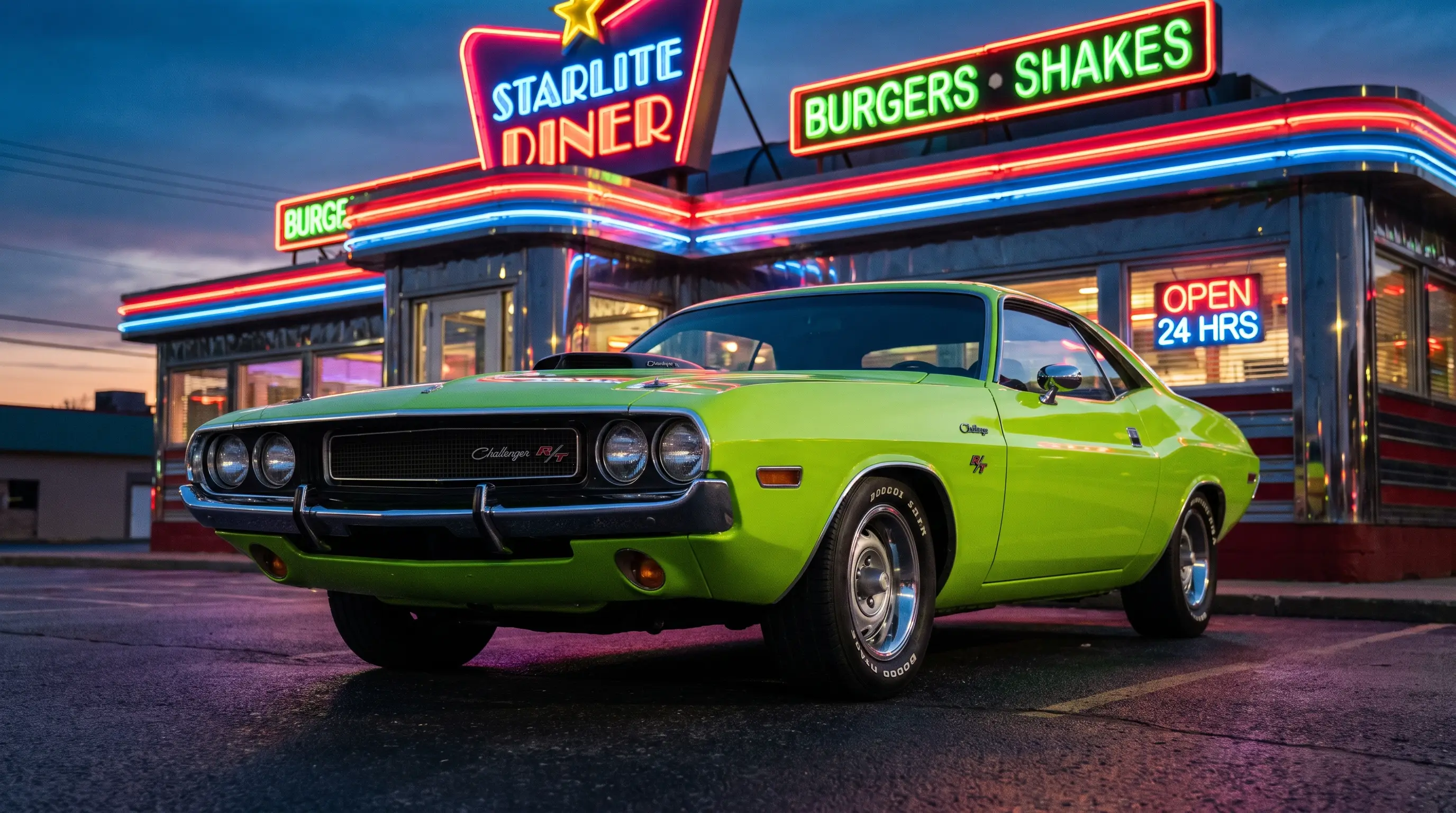
A friend of mine keeps a photograph on her refrigerator of her father standing next to a Sublime green Challenger outside a diner somewhere in Pennsylvania, sometime in 1971. He is squinting into the sun, one hand on the fender, looking like a man who knows exactly how good he looks standing next to that particular shade of green. She never met that version of him. He died before she was born. The car did not survive either, sold off decades ago to pay for something more urgent than nostalgia. But the color did survive, and so did the photograph, and that is really what a sublime green challenger means to a lot of people who never even owned one.
A color that argued with everything around it
Sublime landed in Chrysler's High Impact palette for the 1970 model year, a bright yellow-green that read almost fluorescent under direct sunlight and settled into something closer to a rich lime in shade. It was loud by design, meant to stop a browsing customer in the middle of a dealer lot full of more conventional colors. Dodge and Plymouth both offered versions of it that model year, and it became one of the signature shades associated with the whole High Impact concept, right alongside Plum Crazy and Go Mango.
What made Sublime different from some of the other loud colors was how well it photographed. Magazines from the era loved shooting cars in this color because it separated so cleanly from asphalt and chrome in black and white or early color print. That visual advantage baked the color into the era's imagery in a way some of its High Impact siblings never quite matched, even ones that were technically rarer on paper.
The window closed faster than people remember
Like most of the High Impact colors, Sublime's run on the Challenger was short. The full palette existed in its boldest form mainly through 1970 and 1971 before the muscle car market began cooling and Chrysler trimmed the option list heading into 1972. A car ordered in Sublime in that narrow window carries a kind of built-in scarcity that no amount of later demand can manufacture after the fact. You either got in during those two years or you did not get in at all, not with a genuine factory build sheet to back it up.
That scarcity is why a documented Sublime Challenger draws serious attention today, decades removed from the parking lot it was designed to dominate. The people chasing these cars now were mostly not even alive to see one new. They know the color from photographs like the one on my friend's refrigerator, from old magazine spreads, from a kind of secondhand memory that somehow still carries weight.
Why people keep these cars for the memory, not the money
Talk to enough owners of documented Sublime Challengers and you notice how rarely the conversation turns purely to value. There is always a person attached to the story, a father, an older brother, a first car remembered through a haze of nostalgia that has nothing to do with horsepower figures. The color seems to attract that kind of attachment more than some of the more common factory shades, maybe because it was such a specific, deliberate choice in the first place. Nobody ends up with a Sublime Challenger by accident or by simply taking whatever the dealer had on the lot that week.
My friend never got her father's car back, and she has told me she has stopped looking, not because she gave up but because she realized the photograph does the same emotional work the actual car once did. That is an unusual thing to say about a machine, that its image can carry nearly as much weight as its metal. But Sublime seems to do that to people more than most colors manage.
"Every Sublime Challenger I have written about comes with somebody's face attached to it. That is not true of every color. Some shades just happen to end up in more family photographs than others."
- Nora Beckett
Where this color fits in the wider story
Sublime is one piece of a much larger picture Chrysler built with the entire High Impact program, a marketing decision that turned into one of the defining visual signatures of the whole muscle car era. If you want more on the dodge challenger high impact colors program as a whole, that piece walks through how each shade fit into the strategy and how collectors rank them against each other today. And if you have not yet read about where this started, the full model history gives you the context these individual color stories build on top of.
For anyone who has been thinking about finding their own version of that refrigerator photograph, something worth standing next to in the sun someday, there are classic Challengers on the market right now, Sublime and otherwise. Not every car needs a sad story attached to be worth owning. Sometimes the color alone is reason enough, and Sublime has always been reason enough for the people who chose it.
The magazine spreads that kept the color alive
Part of why Sublime stayed so visible over the decades comes down to plain luck in timing. The color arrived right as automotive magazines were expanding their color photography budgets, and editors kept reaching for Sublime Challengers specifically because the shade reproduced so well on the printing presses of the era. A duller green might have muddied on the page. Sublime held its brightness through the printing process in a way that made photo editors happy, and happy photo editors meant more coverage.
That extra coverage compounds over decades in a way that is easy to underestimate. Every reprint of an old road test, every retrospective feature written twenty or thirty years later pulling archival photos, kept putting the same handful of Sublime cars back in front of new readers who had never seen the color in person. A color that gets photographed well in period ends up remembered well decades later, almost independent of how many cars were actually built in that shade compared to its High Impact siblings.
My friend's refrigerator photograph is a small, private version of exactly that same phenomenon. One good photograph, taken by an amateur outside a diner rather than a professional photographer for a magazine, still managed to carry the color and the memory forward for two generations. Sublime seems to reward whoever points a camera at it, whether that camera belonged to a magazine staffer in 1971 or a Pennsylvania diner customer with nothing more than a personal snapshot in mind.