
Production records from Chrysler's 1970 model year are not perfectly clean, and anyone chasing exact challenger ta production numbers quickly runs into the same problem researchers have wrestled with for decades: the surviving broadcast sheets and dealer invoices do not always agree with each other. What is not in dispute is that the Challenger T/A was built in a single model year, 1970 only, as a homologation special tied to Dodge's Trans-Am racing program, and that the number built was small relative to the Challenger lineup as a whole.
Car Features
7 min read
How Many Challenger T/As Were Built
Published totals for the 1970 Challenger T/A vary by source, and the real answer to how many were built matters less than the fender tag documentation on the specific car in front of you.
The commonly cited figure and its problems
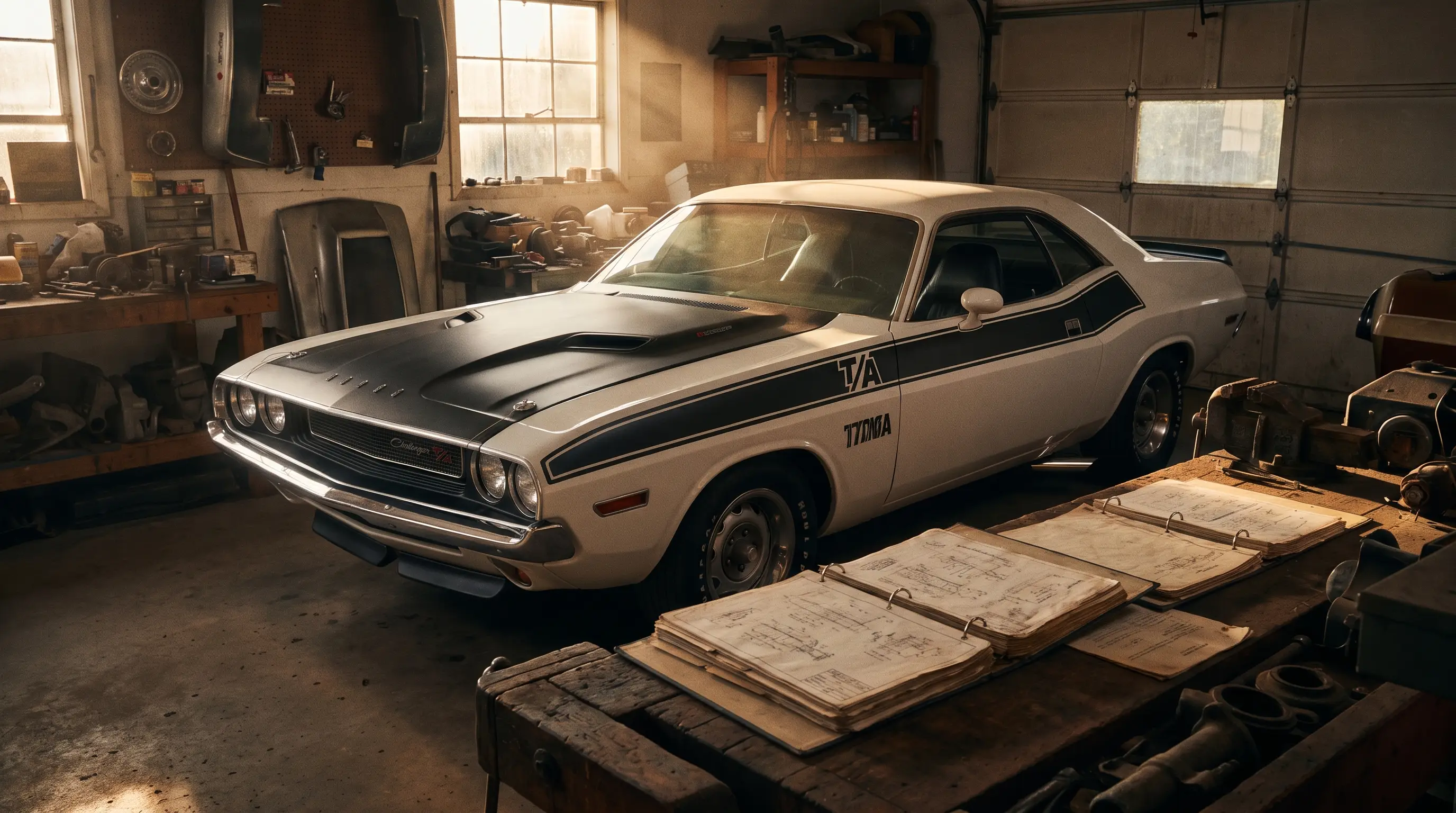
Most published references put total 1970 Challenger T/A production at 2,399 units, a figure that has been repeated across enough owner's club literature and price guides that it has become something close to accepted wisdom, with roughly 1,410 built with automatic transmissions and 989 with manuals. But that figure deserves some skepticism as a precise count rather than a rounded estimate. Chrysler's own build records from this era were kept for manufacturing and warranty purposes, not for future historians, and different sources parsing the same underlying documents have arrived at figures that vary by a few hundred units depending on how they define what counts as a T/A versus a Challenger fitted with T/A style options after the fact.
The SCCA's homologation requirement for the Over 2.0-Liter Trans-Am class called for a production run equal to 1/250th of a manufacturer's prior year output, with a 2,500 unit floor, which worked out to roughly 2,800 units for Dodge specifically, and there has long been debate among historians about whether Dodge actually hit that number with genuinely T/A specified cars or whether the total includes cars built to satisfy the letter of the rule with less rigor than enthusiasts might assume. This is not a controversy specific to Dodge. Homologation rules across multiple racing series in this era were frequently satisfied with production runs that manufacturers and sanctioning bodies both had incentive to round generously.
Why the paper trail matters more than the round number
For a car this specific and this old, the individual paper trail on a given example tells you more than any published production total ever will. Fender tags, broadcast sheets, and Chrysler's own build codes are what separate a documented, numbers matching T/A from a Challenger that has been dressed up to look like one, and given that reproduction parts for nearly every T/A specific component have existed for decades, that documentation is not optional homework. It is the difference between buying the real thing and buying a very convincing story.
Serious collectors and appraisers treat any T/A without a verifiable fender tag and supporting broadcast sheet with real caution, regardless of how correct the car looks in photographs or in person. The T/A's various colors, its unique hood, its Six Pack induction, and its side exhaust are all things a skilled builder can replicate on a donor Challenger, which is precisely why the production number debate is not just academic trivia. It is directly tied to how many genuine survivors are actually out there versus how many cars on the market today are recreations wearing the identity of a rarer car.
What the low production number means for the market
Whatever the precise figure turns out to be, a production run in the low thousands out of a Challenger model year that saw somewhere in the range of 76,000 to 84,000 total units built, depending on which published source you trust, puts the T/A firmly in rare territory relative to the rest of the lineup. That scarcity, combined with the one year only production window and the racing pedigree behind the car, is a large part of why documented T/As sit well above standard Challenger R/T values in the current collector market. Rarity alone does not drive value in classic cars, but rarity paired with a well known, well documented backstory usually does, and the T/A has both.
"I have seen three different published totals for how many T/As Chrysler actually built, and none of them come from a source I would call definitive. What I trust is the fender tag on the individual car in front of me. That document does not lie the way a rounded production number in a price guide can."
- Tom Ramirez
How production splits between hardtop and other variants
The T/A package was offered on the Challenger's hardtop coupe body style, and within that broader total, records suggest a further split by transmission type and by the handful of exterior colors Dodge offered for the package that model year. Reconstructing exact splits by individual color or transmission choice is even harder than reconstructing the total production count, since regional dealer allocation records from 1970 are not centrally archived the way modern manufacturer data would be. Club researchers have spent years cross-referencing surviving broadcast sheets specifically to build out these finer breakdowns, and the picture remains incomplete even after that work, with certain color and drivetrain combinations understood only through a handful of confirmed surviving examples rather than any comprehensive registry.
This incompleteness is not unique to the T/A. Most 1970 model year specialty packages across Detroit have similar gaps in their documented history, simply because nobody involved in building these cars at the time expected researchers fifty years later to need granular breakdowns. What makes the T/A's case notable is how much collector interest has been focused on filling those gaps, precisely because the car's value is so closely tied to verified originality rather than general condition alone.
What this means practically for a buyer today
None of this production number uncertainty should scare a serious buyer away from a well documented T/A. It should instead push you toward treating documentation as a primary purchase criterion rather than a nice-to-have. A car with a clear title history, a legible fender tag, and ideally a broadcast sheet or at minimum consistent dealer paperwork gives you a much stronger position than a car sold purely on the strength of how correct it looks, regardless of what any published production total claims about how many T/As theoretically exist.
Researching a specific car
If you are trying to verify a T/A's authenticity rather than just its general rarity, the process starts with the fender tag, which encodes the trim level, engine, color, and options Chrysler assigned to that specific vehicle identification number at the factory. A broadcast sheet, when one survives with the car, provides an even more granular record of exactly how that unit moved down the assembly line. Neither document guarantees a car has not been modified since 1970, but together they establish what the car was when it left the factory, which is the baseline every other claim about a T/A's authenticity has to be measured against.
This kind of research is a natural extension of understanding where this started, since the production story only makes sense once you understand why Dodge built the T/A in the first place and why the run was necessarily limited. For buyers weighing whether a specific example is worth the premium documented T/As command, that background is not optional context, it is the foundation the whole buying decision rests on. Once you have that grounding, it is worth browsing classic Challenger for sale listings with a clear sense of what separates a well documented survivor from a car simply wearing the right badges.
Sources and notes
Related Reading
#production numbers
#fender tag
#mopar history
#muscle car authentication
#dodge challenger
#Challenger T/A

About the author
Tom Ramirez
Corvette researcher and historian based in Bowling Green, Kentucky. Two decades documenting Corvette production history from original factory records.
Related Listings - Dodge Challenger

Comments
Be the first to comment on this article.