
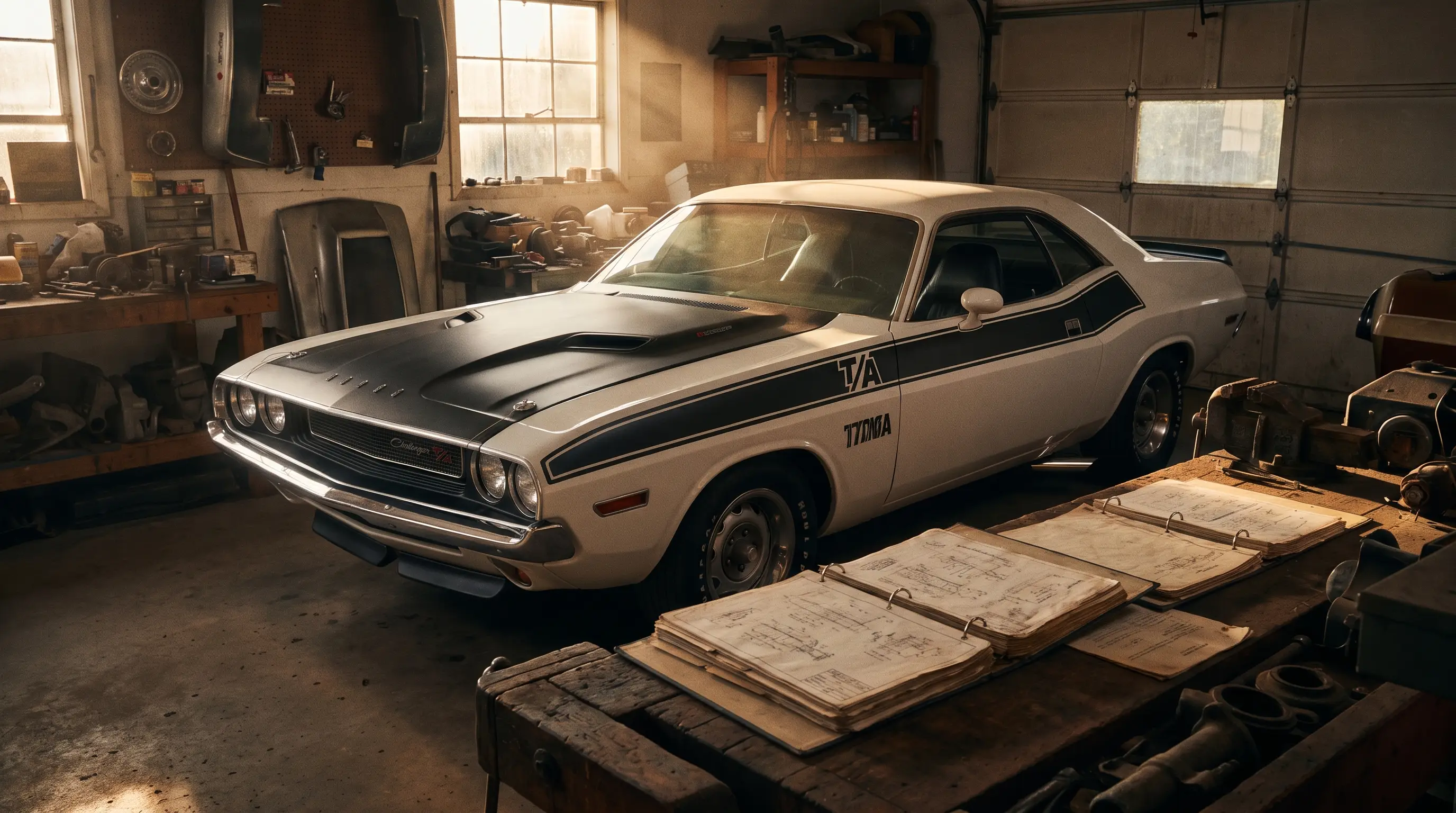
Look at a 1970 Challenger T/A from the side and the detail that stops most people is the exhaust exiting ahead of the rear wheel instead of trailing out back like every other muscle car on the block. That side-exit setup is at the center of most challenger ta exhaust conversations among owners and shoppers, and it is not there for noise alone, though it does plenty of that too.
Car Features
7 min read
Side-Exit Exhaust and the T/A's Rake
The Challenger T/A's side-exit exhaust came straight from Dodge's Trans-Am race cars, and combined with staggered tires it gave the street car its signature forward rake.

Why Dodge routed the exhaust out the side
The T/A's exhaust exits through chrome tipped outlets set just ahead of the rear wheel opening on each side, a layout borrowed directly from the Trans-Am race cars Dodge was campaigning that season. On the race cars, routing exhaust out the side rather than under the rear bumper helped with ground clearance and weight distribution during hard cornering, since a full length exhaust run to the back of the car adds length, weight, and heat exactly where a road racer does not want it under sustained lateral load. Dodge brought that visual and functional cue to the street car largely intact, which is unusual. Most homologation specials borrow styling from their race counterparts without bothering to replicate genuinely functional details, but the T/A's side pipes were a real engineering choice before they became a styling signature.
The result on the street car was an exhaust note that hit your ears differently than a conventional rear-exit system, sharper and more immediate since the sound was not traveling the length of the car before it reached open air. Owners describe it as one of the more visceral things about driving a T/A, a car that already announced itself with a matte black hood and bold graphics before you even started the engine.
The rake it created
Side exit exhaust is only half of what gives a T/A its distinctive stance. Paired with staggered tires, a narrower front and wider rear combination, the car sits with a slight forward rake that makes it look like it is already leaning into a corner while parked at the curb. That combination of side pipes and staggered rubber is arguably the single most recognizable visual signature of the T/A package, more so even than the matte black hood, because it changes the car's silhouette in a way photographs from any angle pick up immediately.
Living with side pipes day to day
Side exit exhaust looks dramatic, but it comes with real world tradeoffs that period owners understood and that current owners still deal with. Heat from the exhaust runs closer to the passenger compartment and closer to the rear tire sidewall than a conventional system, and the exposed routing under the rocker panels is more exposed to road debris, salt, and general underbody wear than an exhaust tucked up and out of the way. None of that stopped Dodge from selling the package, and it clearly did not stop buyers from wanting it, but it is part of why surviving original side pipe systems in good condition are harder to find than you might expect from a car that is otherwise well documented in reproduction parts catalogs.
That reproduction parts availability is itself worth mentioning. Because the T/A's side exhaust is such a visually obvious identifier, it is also one of the most commonly reproduced components on the car, which means a correct-looking side pipe setup on a car for sale today does not by itself confirm the car is a real T/A rather than a clone built around a standard Challenger. Genuine T/A verification comes back to the fender tag and broadcast sheet, not to how good the exhaust looks in photos.
"Everybody wants to talk about the horsepower rating on these things. I'd rather talk about the exhaust. It's the one part of the T/A package you can't fake with a spec sheet, you either hear it or you don't, and once you've heard a real set of side pipes on one of these you don't forget it."
- Mike Sullivan
How the exhaust connects to the whole T/A concept
It is worth stepping back and looking at how many of the T/A's individual features reinforce each other rather than standing alone. The side exhaust does not just make noise in a different place, it changes how the car sits, since routing hot exhaust gases out along the rocker panel affects heat management decisions that ripple into how the rear suspension and fuel system were shielded. Dodge's engineers were not simply grafting a race car detail onto a street car for show. They had to make the whole package work together as a functioning production vehicle that also happened to look and sound like something out of a Trans-Am paddock, and that balancing act between show and function is part of why the T/A still reads as a genuinely engineered special rather than a trim package with a few extra decals.
Compare that to some other manufacturers' homologation specials from the same period, where a distinctive hood scoop or a set of stripes was largely cosmetic dressing on top of an otherwise standard drivetrain. The T/A's side exhaust, staggered tires, and Six Pack induction all interact with each other mechanically in ways that go beyond appearance, and that is a meaningful part of the car's reputation among people who have actually owned and driven one rather than just admired photographs of it.
Sourcing correct parts today
Because the exhaust is such a visible identifier, aftermarket suppliers have reproduced side pipe systems for the T/A for decades, with varying degrees of fidelity to the factory original in terms of tubing diameter, tip design, and heat shield construction. A careful buyer or restorer will compare candidate reproduction parts directly against documented factory photographs rather than trusting a supplier's marketing description alone, since small differences in tip shape or mounting bracket design are exactly the kind of detail that separates a correct restoration from one that merely looks close at a glance.
What to check if you are evaluating one
If you are looking at a T/A and the side exhaust is part of what is drawing you in, treat it as one data point among several rather than the whole story. Check that the exhaust routing, heat shielding, and rocker panel condition underneath match what you would expect from a car with genuine mileage and age, since poorly executed reproduction side pipe kits can leave telltale gaps in fitment or shielding that a careful inspection will catch. Combine that with a look at the fender tag, and you start building a real picture of whether the car in front of you is the genuine article Dodge built for one single model year. For the full story on how the T/A package came together as a whole, the exhaust is just one piece of a car that was engineered end to end around its racing pedigree, and once you understand that context it is worth taking a look at what is currently available if you want to browse classic Challenger listings.
Sources and notes
Related Reading


#trans-am racing
#muscle car restoration
#mopar history
#dodge challenger
#Challenger T/A
#side exhaust

About the author
Mike Sullivan
Detroit-area muscle car enthusiast and restoration specialist with three decades of hands-on experience working on American iron.
Related Listings - Dodge Challenger



Comments
Be the first to comment on this article.