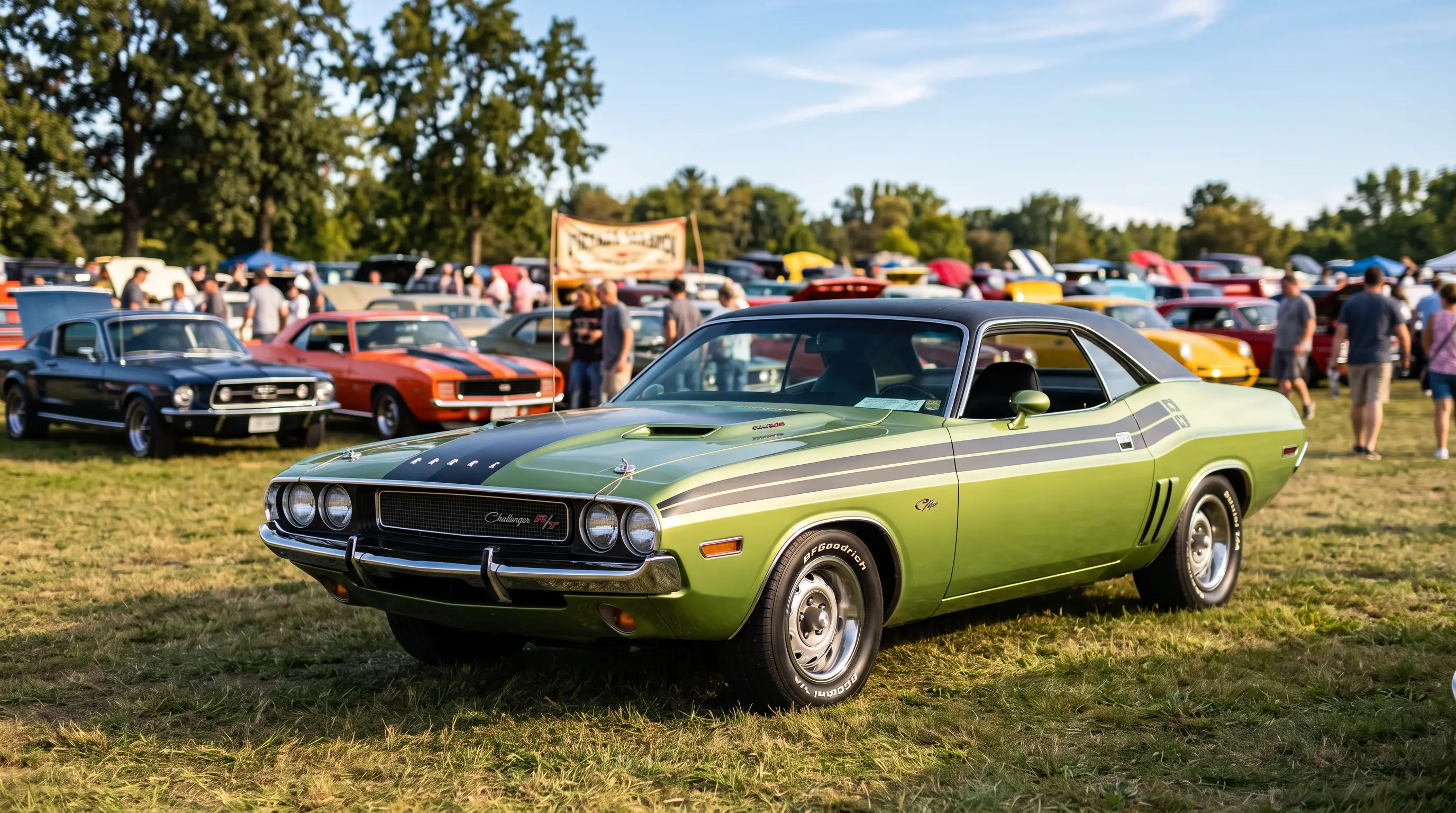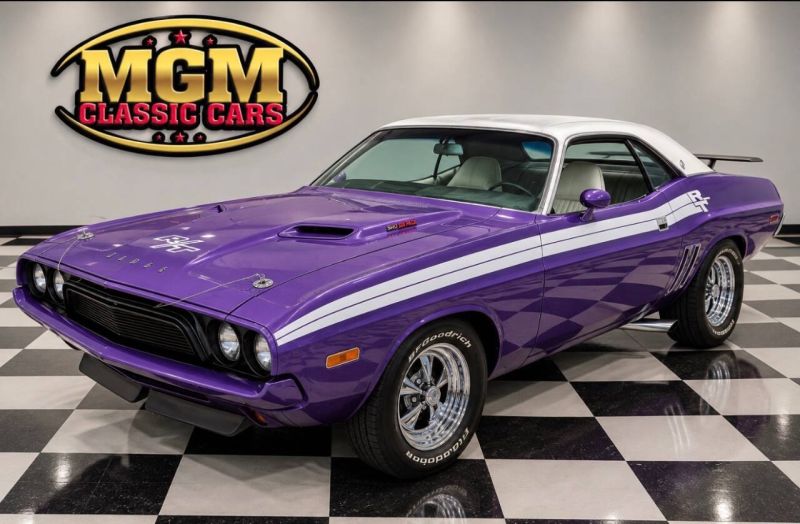
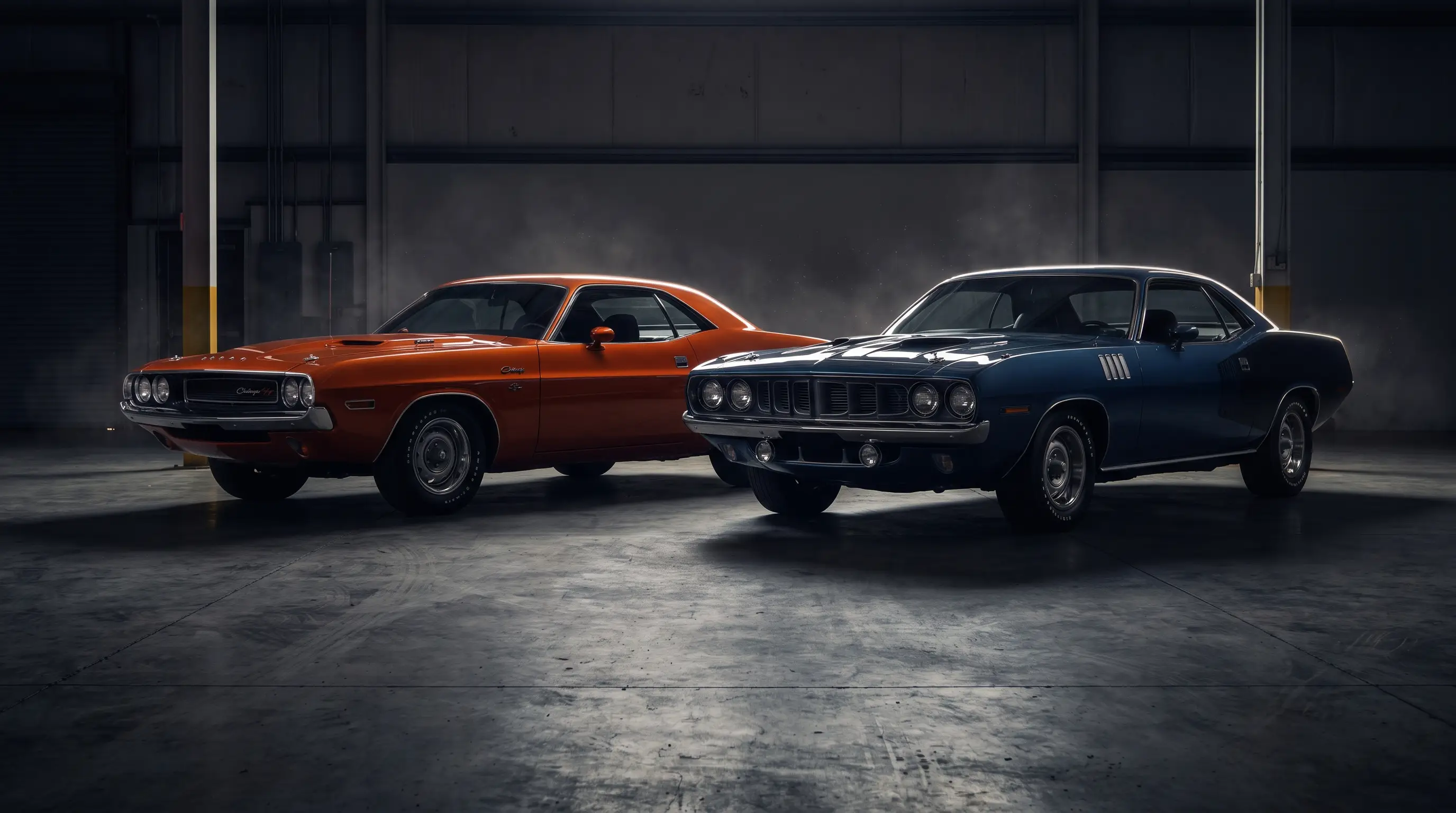
Stand a 1970 Dodge Challenger next to a 1970 Plymouth Cuda and a casual observer might call them the same car in different paint. They would be wrong, and the differences matter more the longer you look. Understanding challenger vs cuda differences means getting past the shared platform and into the details that actually separated Dodge's pony car from Plymouth's, because Chrysler did not simply badge-engineer one into the other.
Two divisions, one platform, different intentions
Both cars rode on Chrysler's E-body platform, developed specifically to compete with the Ford Mustang and Chevrolet Camaro in the booming pony car market. But Dodge and Plymouth were separate divisions competing for separate customers within the same corporation, and each division pushed its version toward a distinct identity rather than settling for a rebadge. That internal competition, unusual for how directly Chrysler let its own brands duplicate effort, produced two cars that looked related from a distance and felt distinct from the driver's seat.
The wheelbase tells part of the story immediately. The Challenger rode on a wheelbase two inches longer than the Cuda's, at 110 inches versus 108. That difference sounds small on paper and reads as substantial in person. The Challenger's proportions stretch out longer and lower, giving it a more graceful, almost personal-luxury silhouette, while the Cuda's tighter wheelbase kept it looking coiled and aggressive, more overtly a street fighter than a boulevard cruiser.
Styling choices that set them apart
Dodge aimed the Challenger at a slightly older, more affluent buyer than Plymouth targeted with the Cuda. That intention shows in the details. The Challenger's grille sat wider and more formal, its taillights ran a full-width design that read as upscale rather than sporty, and interior trim options leaned toward comfort features the Cuda skipped. Dodge even offered the Challenger in a base trim alongside the performance-focused R/T, giving buyers a genuine choice between a Challenger built for cruising and one built for the strip.
The Cuda, by contrast, committed harder to a singular aggressive identity. Plymouth's marketing leaned into a younger, brasher customer, and the styling followed that lead with a more tucked-in stance and a nose that read as purposeful rather than elegant. Shaker hood scoops, when ordered, sat more prominently on the Cuda's silhouette, reinforcing the sense that this was a car built first for performance and only second for comfort.
"People ask me which one is the real muscle car and which one is the pretender. Wrong question. They're both real. They just picked different fights."
- Patrick Walsh
Engine availability and trim structure
Both cars could be ordered with Chrysler's full range of big block and small block engines, up to and including the 426 Hemi, but the way each division packaged those options differed. The Cuda's AAR variant, built specifically to homologate the car for Trans-Am racing, had no direct Challenger equivalent, giving Plymouth a distinct halo model that Dodge answered with its own T/A trim aimed at the same racing series but built with different aerodynamic details and a different personality.
Interior and dashboard design diverged as well. The Challenger's dash used a different gauge layout and switchgear arrangement from the Cuda's, and buyers cross-shopping the two at a Chrysler dealer lot in 1970 would have noticed the difference in seating position and instrument visibility immediately, even if the underlying mechanicals felt familiar once they got moving.
Why the distinction still matters to buyers today
Collectors chasing either car need to understand these differences because they affect value, parts sourcing, and the overall ownership experience in ways that go beyond badge preference. A numbers-matching Cuda in AAR trim commands a different market than a comparable Challenger T/A, not because one is objectively better but because each attracted its own dedicated following that has grown more entrenched over five decades of ownership culture.
If you want the full challenger vs cuda history rather than just the trim-level breakdown, that deeper dive covers how the rivalry played out in showrooms and on the track. And if the shared underpinnings interest you as much as the differences, a related story covers exactly what the two cars had in common beneath the styling choices.
Convertibles, rarity, and how production numbers diverged
Production numbers between the two cars told their own story about how buyers actually voted with their wallets. Dodge and Plymouth split the same E-body customer base, and neither car dominated the other in raw volume across the run, but specific configurations diverged sharply in rarity. Certain big block convertible combinations turned out far rarer in one badge than the other, a fact that only became widely appreciated once collectors started cross-referencing build sheets decades later rather than assuming parity between the two nameplates.
That rarity gap keeps surprising newer collectors who assume a shared platform means shared scarcity. It does not. A specific engine, transmission, and body style combination might number in the low hundreds for one badge and considerably higher for the other, and that asymmetry shows up directly in auction results whenever a well-documented example crosses the block. Serious buyers learn to check production data for their exact configuration rather than treating "E-body" as a single category with one value curve.
Shopping the market with the differences in mind
Whichever side of the rivalry appeals to you, both cars have earned their reputations honestly, and the market today reflects five decades of enthusiasts sorting out which details matter most to them personally. Some buyers want the Challenger's longer, more composed lines. Others want the Cuda's tighter, more aggressive stance. Neither preference is wrong, and the right answer usually comes down to which car you saw first, parked somewhere, and couldn't stop thinking about afterward.
Whichever direction that pull takes you, you can browse Challengers for sale now and compare real examples against everything covered here. Trim level, wheelbase, engine option, and originality all factor into what a given car is worth, and understanding the differences before you shop puts you in a much stronger position than walking in cold.
Fifty-plus years on, the debate between the two hasn't cooled off one degree, and honestly, it shouldn't. Owners clubs for each car maintain their own registries, their own show classes, and their own opinions about which nameplate deserves more respect, and that ongoing rivalry keeps both cars relevant in a hobby that could easily have let one badge fade into the other's shadow. Neither did, and that says something about how well Chrysler let its two divisions build genuinely different cars from the same starting point.