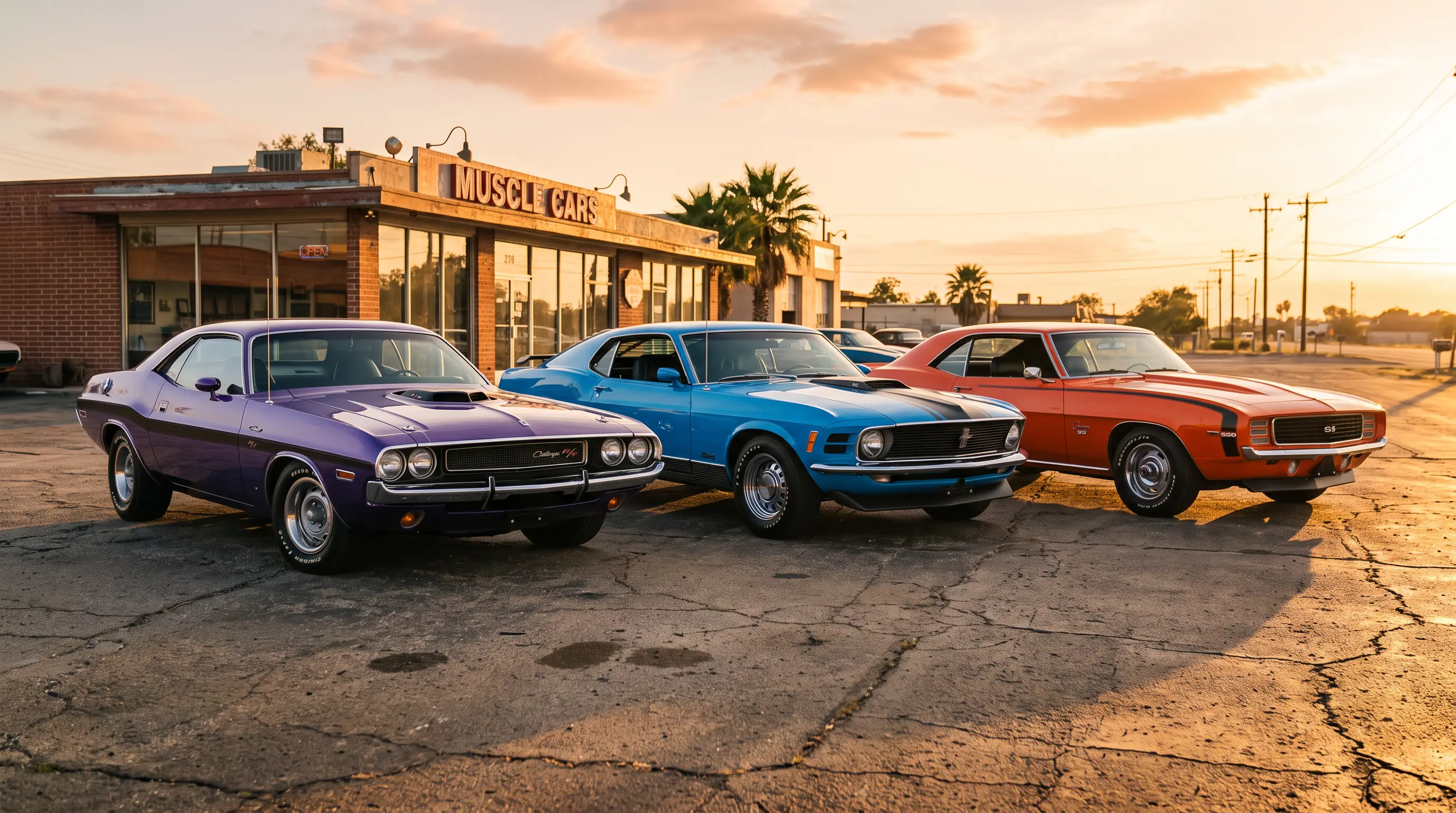
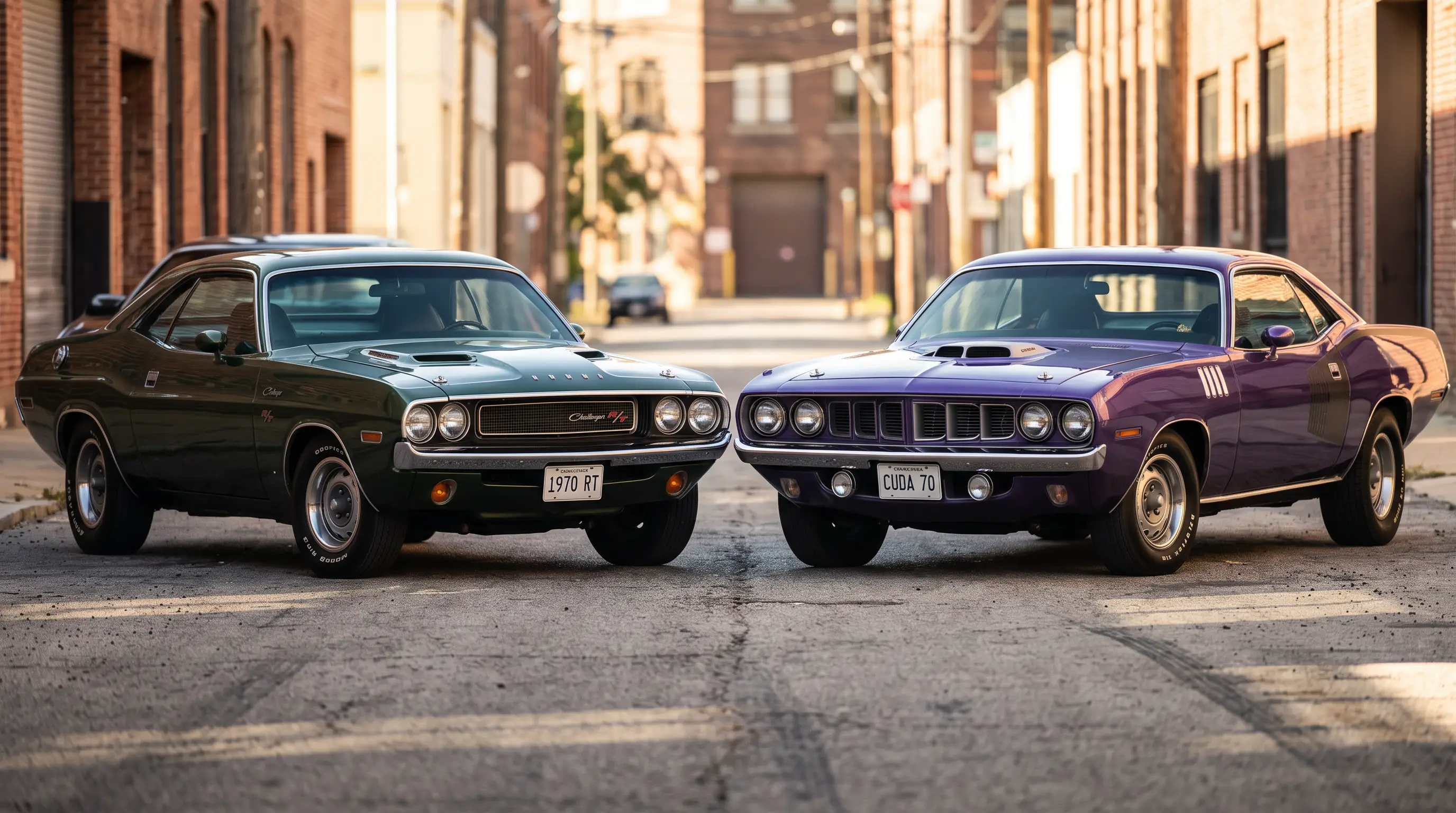
I once watched a man at a car show stand between a 1970 Dodge Challenger and a Plymouth Cuda for a full ten minutes without saying a word, just walking a slow circle around both cars like he was trying to solve them. That is the challenger vs cuda styling debate in its purest form. Two cars, one shared platform, and two completely different answers to the question of what a pony car should look like standing still.
Same bones, different silhouette
Both cars rode on Chrysler's new E-body platform introduced for 1970, but Dodge stretched the Challenger's wheelbase roughly two inches longer than the Barracuda's, and that small dimensional change rewrote the entire proportion of the car. The Challenger reads as longer, lower, and more substantial from every angle, a car built to feel like it takes up more room on the road. The Cuda, riding the tighter wheelbase, feels coiled and compact, its shorter overhangs giving it a scrappier, more aggressive stance that some owners describe as looking ready to fight before it even leaves the driveway.
Neither approach is objectively correct, and that is exactly why this argument has never actually ended at any car show I have attended. Dodge designers were chasing a slightly more upscale, personal-coupe presence, aiming at buyers who might otherwise look at a Mercury Cougar. Plymouth designers leaned into a leaner, more overtly performance-focused shape that tied directly into the Cuda's drag racing and Trans Am identity.
The front end argument
Up front, the Challenger's twin-headlight grille sits inside a wider, more horizontal opening that gives the car a broader, more planted face. The Cuda's grille is narrower and set lower, with a shape that reads as sharper and more pointed, especially on Cuda and AAR Cuda models with their functional hood scoops and blacked-out treatments. Owners of each car will tell you their front end looks meaner, and depending on the lighting and the angle, both of them are right at different moments.
Rear styling splits opinion just as sharply
The Challenger's tail features a full-width taillight treatment on many trims that gives the rear a wide, low, horizontal signature. The Cuda's rear end, particularly on cars fitted with the shaker hood and bold graphics packages, leans harder into a performance-focused look with simpler, more vertically emphasized lighting. Neither rear treatment is more correct than the other. They are simply built around different design philosophies, one chasing width and presence, the other chasing aggression and simplicity.
"You can tell a Challenger and a Cuda apart from two hundred feet away in the dark, just from the silhouette. That is how different two cars sharing a chassis actually turned out."
- Patrick Walsh
Color and graphics packages sealed each car's identity
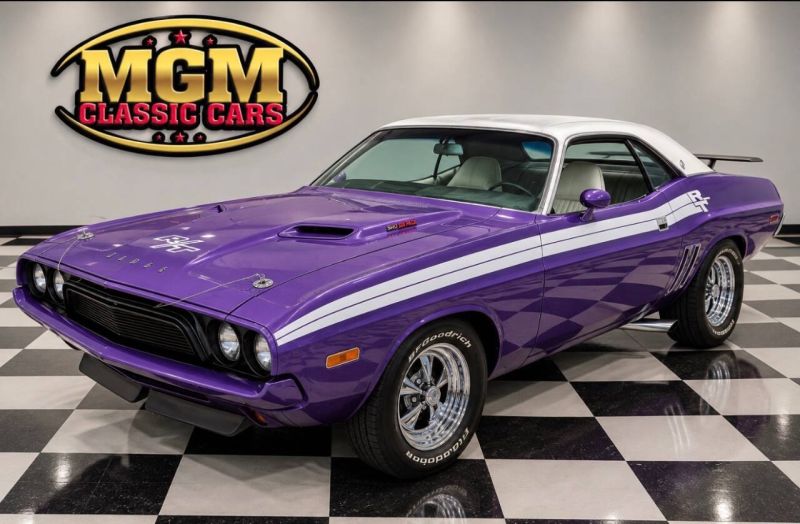
High-impact paint names like plum crazy, hemi orange, and sublime became inseparable from both nameplates, but the way each car wore bold graphics differed. The Cuda's factory graphics packages, including the strobe stripes on certain AAR variants, ran the length of the body in ways designed to emphasize the car's compact, aggressive shape. The Challenger's graphics, including the bumblebee stripe treatment on R/T models, tended to wrap the tail in a way that reinforced the car's wider, more horizontal rear styling. Neither brand was simply copying the other's playbook. Each was reinforcing its own car's specific proportions.
For readers who want the fuller history behind why these two cars ended up looking so different despite sharing an engineering department, challenger vs cuda history covers the full platform story, and if the broader Detroit rivalry of this era interests you, a related story looks at how Dodge, Ford, and Chevrolet all fought for the same design language during this period.
Which styling wins depends entirely on what you want
If you want a car that reads as substantial and commanding from a distance, the Challenger's proportions deliver that every time. If you want something that looks compact, aggressive, and ready to launch off the line before the engine even turns over, the Cuda's tighter stance has always done that job better. I have appraised and admired plenty of both, and the honest truth is that the challenger vs cuda styling argument says more about the buyer's taste than it does about either car being objectively superior. If the Challenger's wider, more commanding presence is the one pulling at you, Challengers for sale now is worth a look before you settle the argument for yourself.
Interior design followed the same philosophy split
Step inside either car and the same design divide continues. The Challenger's dashboard leans toward a more horizontal, wide-format layout with gauge clusters set into a broader panel, reinforcing the same sense of width the exterior styling projects. The Cuda's cockpit feels tighter and more driver-focused, with a dash layout that wraps closer around the occupant, echoing the compact aggression of its exterior lines. Buyers who preferred the Challenger's roomier feel from the outside consistently found that impression carried through once they sat down, and the same held true in reverse for Cuda loyalists who wanted a cockpit that felt like it was built specifically around them.
Seat design and available interior color combinations also diverged in ways that reinforced each car's personality. Dodge offered interior trims that leaned toward a slightly more upscale presentation, consistent with the Challenger's positioning against cars like the Cougar. Plymouth kept Cuda interiors feeling purpose-built for performance driving, with less emphasis on plush comfort options and more emphasis on the kind of hardware a driver actually used at speed, like factory tachometers and heavier-duty seat bolstering on the higher trims.
How restorers approach each car's styling differently
Restoration shops that specialize in one nameplate over the other often describe genuinely different priorities when returning a car to factory condition. Challenger restorers spend real effort getting that wider stance and full-width rear treatment exactly right, since even small deviations in trim placement immediately throw off the car's signature horizontal presence. Cuda restorers focus intensely on getting the factory graphics packages and shaker hood alignment correct, since those details carry so much of the car's compact, aggressive identity. Both disciplines require real expertise, and a shop that only knows one nameplate well often struggles when asked to restore the other correctly on the first attempt.
I have seen experienced Challenger restorers misjudge a Cuda's factory stripe width because they applied Dodge proportions out of habit, and I have seen the reverse happen just as often with shops that primarily work on Plymouth cars. The lesson for any owner commissioning a full restoration is simple: hire a shop with documented experience on the specific nameplate you own, not just general E-body familiarity, because the styling details that make each car distinct are exactly the details a generalist is most likely to get wrong.