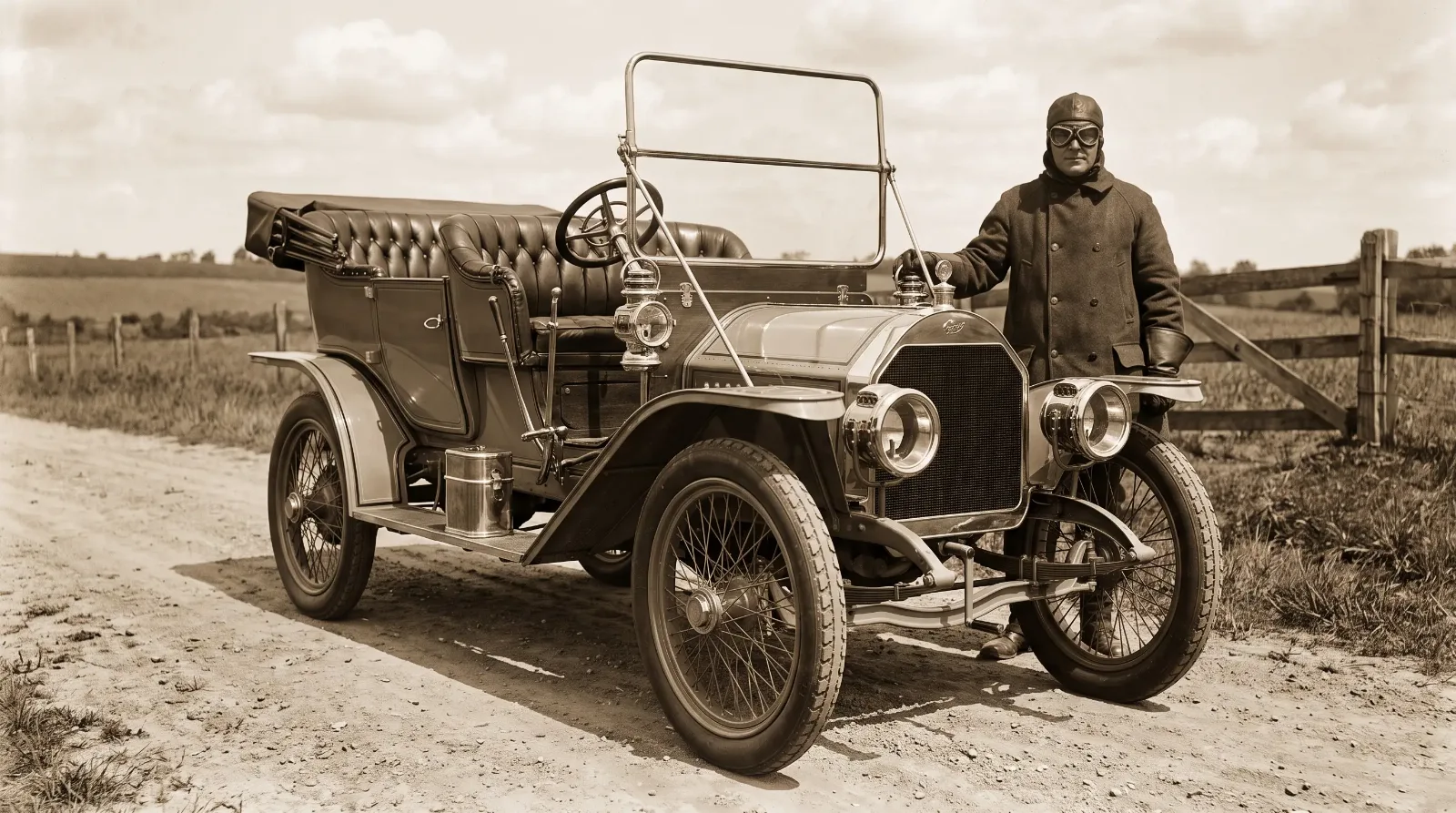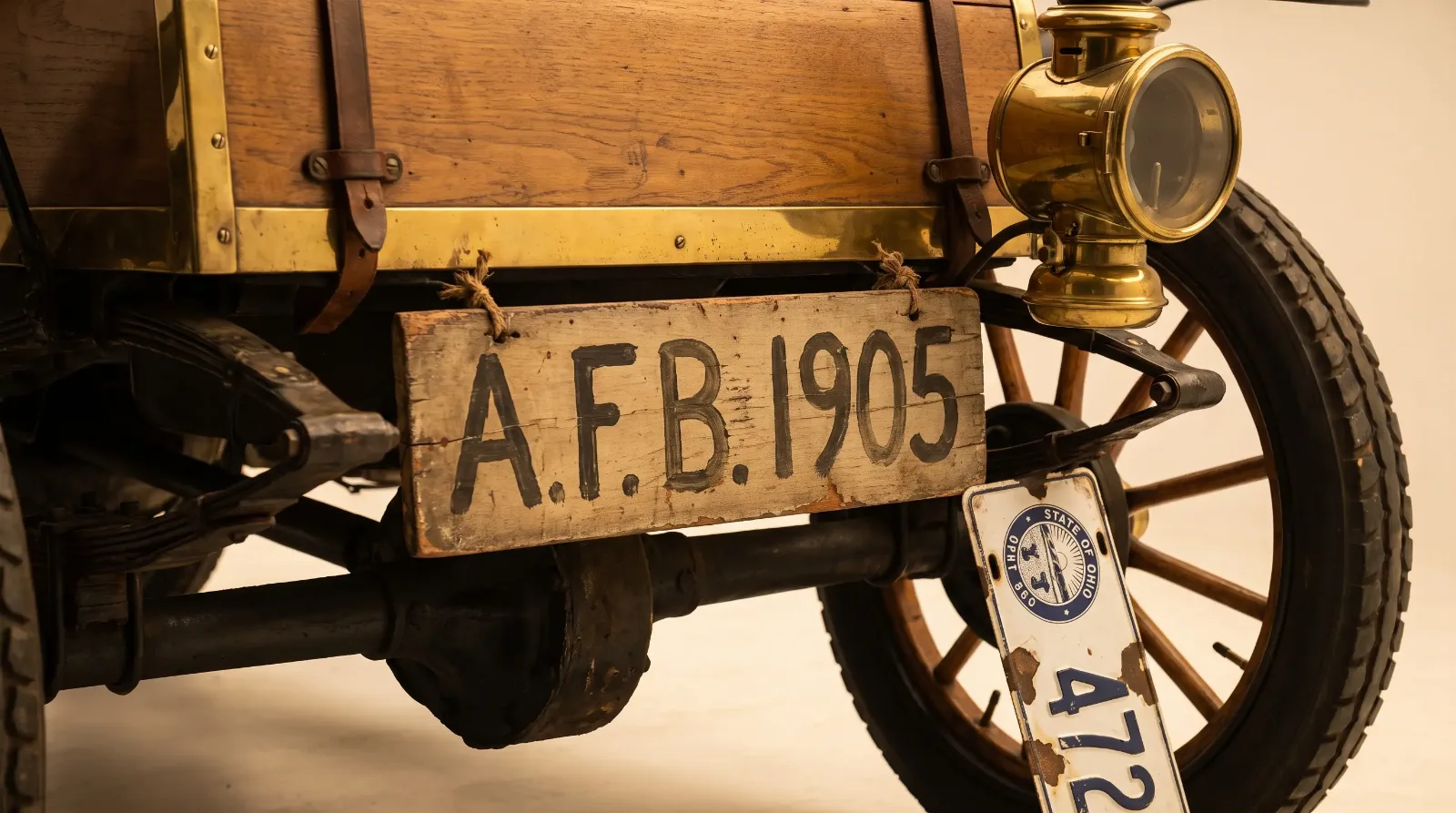
A man in New York in 1901 walked into a state office and became the first person in America required to register his automobile with the government. He was handed a certificate rather than a plate, and he was expected to paint his own initials on the back of the car himself, in whatever size and style he chose. It is a small, almost domestic detail, a state demanding proof of ownership while leaving the actual manufacture of that proof entirely up to the owner's paintbrush, and it tells you everything about how unprepared the country was for what the automobile was about to become.
The scattered, homemade beginning
New York's 1901 law was the first in the nation requiring registration, and other states followed within a few years, but almost none of them agreed on a format. Massachusetts issued the first actual state-manufactured plates in 1903, porcelain-on-iron pieces that at least gave owners a standardized object to mount. Elsewhere, drivers kept improvising for years, some painting numbers directly onto the car body, others ordering leather or metal plates from local shops, with no two examples looking quite alike.
This period of homemade registration is easy to overlook now, but it captures something true about the era. The automobile arrived faster than the institutions meant to regulate it, and government offices were essentially inventing the bureaucracy of car ownership from scratch, one state legislature at a time, with no federal template to work from and no precedent to lean on beyond what had governed carriages and bicycles before.
Why registration mattered at all
The push for registration was not really about revenue at first, though states quickly discovered the fee income was welcome. It was about accountability. As automobiles multiplied on shared roads with pedestrians, horses, and bicycles, and as collisions became a real public concern rather than a rare novelty, officials wanted a way to identify a car and its owner after an incident. A registration number tied a machine to a person in a way that had simply never been necessary for a horse and buggy.
That accountability argument grew louder as speeds increased and complaints piled up from residents in towns along popular touring routes, tired of dust, noise, and the occasional reckless driver. Registration gave local authorities a tool they had not had before, a way to identify and, if necessary, fine or summon a specific driver rather than simply complaining about automobiles as a general nuisance.
Standardization arrives, slowly and unevenly
Getting all the states onto anything resembling a common system took the better part of two decades. Each state set its own fees, its own renewal schedule, and its own plate design, and a driver crossing state lines in the 1910s might need to display multiple plates simultaneously or carry paperwork proving compliance with rules that varied significantly from one jurisdiction to the next. It was, by any modern standard, a mess, and it stayed a mess for longer than most people realize.
The material itself evolved gradually too. Early plates were often porcelain enamel over iron, heavy and prone to chipping, before states moved toward embossed steel in the years leading up to and through the First World War. Colors and formats changed year to year in many states, partly as an anti-fraud measure, since a plate that changed color annually was harder to counterfeit or carry over illegally from a prior year.
The paperwork that came with the plate
Registration was never just about the physical plate. States also began requiring some form of proof of ownership, an early title document or bill of sale, though the format and rigor of these requirements varied as widely as the plates themselves. Some states demanded little more than an owner's sworn statement. Others, particularly as automobile theft became a genuine concern by the mid-1910s, required more formal documentation tying a specific engine number to a specific registered owner.
That engine-number linkage turned out to matter enormously for how automobiles were tracked and, eventually, how theft was investigated. A stolen car with a repainted body could still sometimes be identified through its registered engine number, an early and imperfect version of the vehicle identification systems that would later become standard. The brass-era registration scramble, disorganized as it was, laid groundwork that the automobile industry would spend the next several decades refining into something far more systematic.
What survives, and why collectors care
Original brass-era plates, particularly the early porcelain examples and any surviving handmade or club-issued pieces from before formal registration existed, are genuinely scarce today. Porcelain plates chipped and corroded easily, and most were simply discarded once a car was sold, scrapped, or reregistered under a new system. A complete, correctly dated plate paired with a documented car from the same period adds real historical texture to a restoration, even though the plate itself was never part of the manufacturer's original equipment.
For a collector trying to date or authenticate a brass-era car, understanding a state's specific plate history can actually help narrow down when a car was in use and where, since surviving registration paperwork or a period photograph showing a plate can corroborate or contradict a car's claimed history. It is a small detail that occasionally settles a bigger provenance question.
"There is something almost touching about that first New York registration, a government asking a citizen to prove ownership of a machine nobody in the office had a form for yet. They were building the rules as the cars kept arriving, and you can feel that improvisation in every mismatched early plate that survives."
— Patrick Walsh
The wider story of how America adjusted, sometimes gracefully and sometimes not, to the sudden presence of the automobile on its roads is covered fully in the early registration antique cars guide, which places this regulatory scramble alongside the mechanical and cultural changes happening at the same time.
Registration was only one piece of the larger transformation happening in how cars were built and sold during these same years. The next story looks at where the assembly line itself actually began, and how it reshaped everything about who could afford to own one of these newly registered machines.
Sources and notes
- This Day of History: First U.S. state to require automobile license plates
- Time: The first license plates - why were they invented
- History.com: License plate history - their invention and evolution
- Wikipedia: Vehicle registration plates of the United States for 1903
- HowStuffWorks: The long strange history of license plates in the U.S.