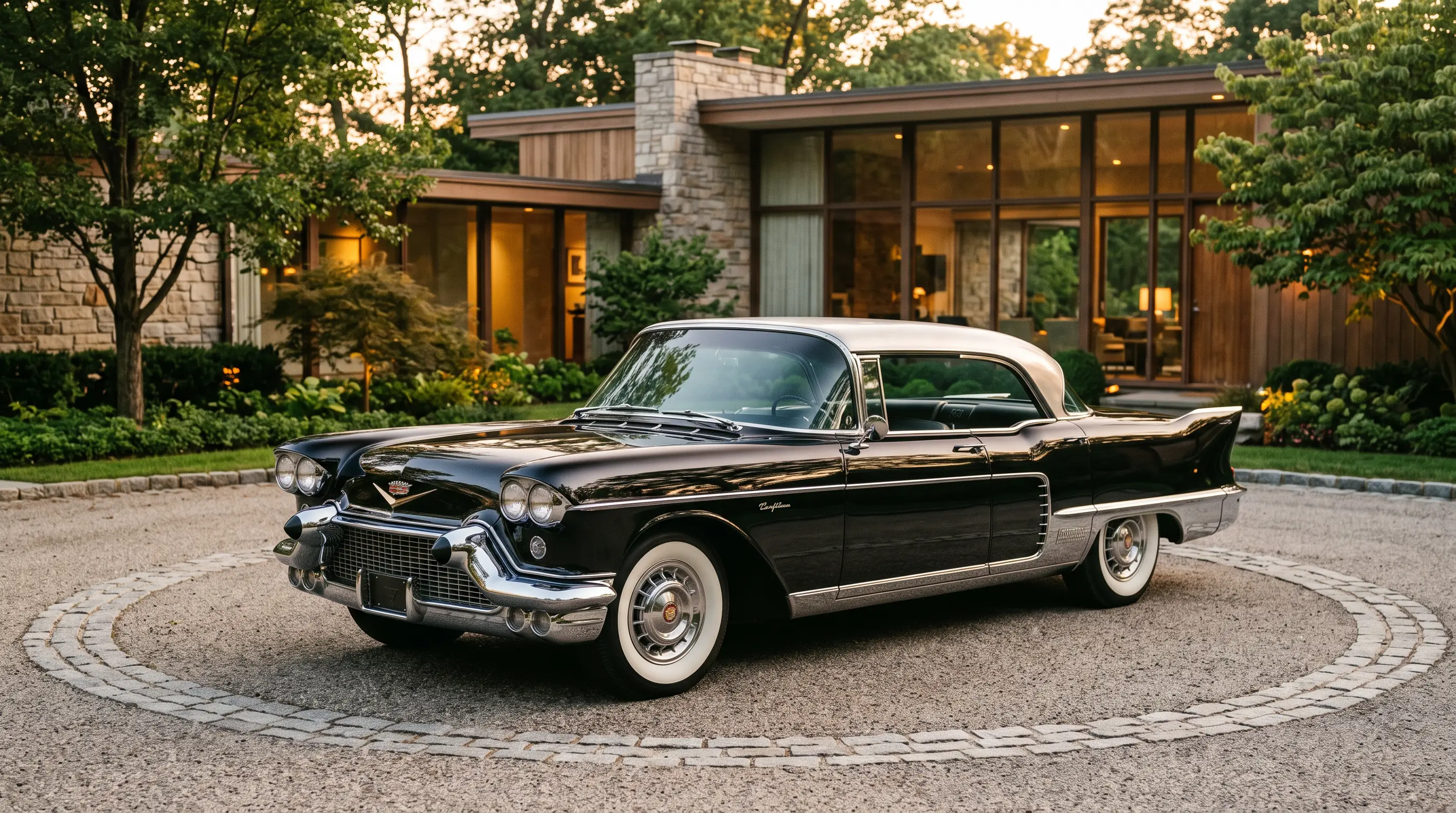
Scarcity is the single number that matters most when pricing a Cadillac Eldorado Brougham, and it is worth stating plainly up front: across four model years, from 1957 through 1960, the eldorado brougham production numbers stayed in the low hundreds, not thousands. That figure alone explains most of what makes this car behave differently than any other Cadillac in the collector market.
The numbers, year by year
Production tallies vary slightly depending on the source, since factory records from a hand built, low volume program like this were never kept with the same rigor as mainstream assembly lines, but the commonly cited figures give a clear picture of just how small these runs actually were.
| Model year | Approximate production | Body construction |
|---|---|---|
| 1957 | ~400 units | Detroit, hand assembled |
| 1958 | ~304 units | Detroit, hand assembled |
| 1959 | ~99 units | Pininfarina, Italy |
| 1960 | ~101 units | Pininfarina, Italy |
Even the higher end of these figures puts total Eldorado Brougham production across all four years somewhere around nine hundred cars, a number smaller than a single week's output of a mainstream Cadillac model during the same era. For readers who have not yet seen the cadillac eldorado brougham story in full, that context helps explain why Cadillac tolerated such tiny volumes on its flagship for four consecutive years.
Why the numbers dropped so sharply after 1957
The decline from roughly four hundred cars in 1957 to closer to three hundred the following year, then down to roughly one hundred for each of the Pininfarina built years, was not a story of falling demand outpacing what Cadillac could sell. It reflected the brutal economics of the program itself. Every Brougham built lost the company money, and shifting body construction to Pininfarina for 1959 and 1960 was a cost containment move that, ironically, coincided with even smaller production runs rather than larger ones, since the added shipping and coordination between two continents introduced its own constraints on how many cars could realistically move through the process each year.
Cadillac was never trying to maximize Brougham sales volume. The car existed to prove a technical and stylistic point, to sit at the top of a showroom lineup as a halo model, and to generate exactly the kind of prestige and press attention that a mass produced car never could. Low production was baked into that mission from the very beginning, not an unfortunate side effect of it.
Comparing the two eras' numbers
The Detroit built 1957 and 1958 cars together account for a clear majority of total Eldorado Brougham production, roughly seven hundred of the model's total output across all four years by most tallies. The Pininfarina built 1959 and 1960 cars, by contrast, together make up barely a quarter of that combined total, a genuinely small number even by the standards of a program that was never trying to build in volume to begin with. This split matters when comparing relative scarcity within the model line, since a Pininfarina bodied Brougham is meaningfully rarer on paper than a Detroit built example from the earlier years, even though both eras carry the same nameplate and the same basic mission.
It is worth noting that low production numbers alone do not tell the entire story of a car's collectibility. The 1957 model, despite being the highest volume year of the four, remains the most historically significant simply because it was the launch, the year every innovation debuted for the first time, the car every period magazine actually covered. Rarity and significance do not always point in the same direction, and buyers who chase pure production numbers without weighing historical context sometimes end up paying scarcity premiums for cars that the broader collector community values somewhat differently.
What survival rates look like today
Low original production is only half the scarcity equation. Attrition over seven decades, through accidents, neglect, poor storage, and simple parts cannibalization when a damaged car was stripped rather than repaired, has reduced the surviving population further still. Nobody tracks an exact, universally agreed survivor count, but serious Cadillac researchers and club registries have identified and documented a meaningful share of the cars believed to remain, which itself shows how tightly this community tracks individual chassis by history and ownership record rather than treating them as anonymous used cars.
This level of documentation matters enormously for buyers. A car with a continuous, traceable ownership history and a documented place in club or registry records carries real value beyond its physical condition, because that paperwork confirms authenticity in a market where the low production numbers alone make fakes and misrepresented cars a genuine risk worth guarding against.
"When total production across four years doesn't crack a thousand cars, every single survivor is a data point. That's not marketing language, that's just what a market this small actually looks like."
- David Mercer
Reading production figures with a healthy skepticism
Anyone spending time in Cadillac research circles will eventually run into slightly different production totals cited across different sources, sometimes off by a handful of cars for a given year. This is normal for a low volume, hand built program from the 1950s, where factory record keeping simply was not built around the assumption that historians would need exact figures seven decades later. The differences tend to be small, a few cars either direction, rather than dramatic disagreements about the overall scale of production. Serious researchers cross reference multiple sources, including registry data compiled by owner clubs, before treating any single figure as gospel, and buyers doing real diligence on a specific car should apply the same standard rather than repeating whatever number happens to appear first in a casual search.
What scarcity means for pricing
Extreme rarity does not automatically translate into extreme prices in every collector market, but for the Eldorado Brougham it consistently has, because the car pairs low production with genuine historical and engineering significance rather than scarcity for its own sake. Buyers are not just paying for a rare Cadillac. They are paying for a documented piece of a specific, well understood story about how far General Motors was willing to go to build a flagship regardless of cost.
Anyone researching the broader arc of the Eldorado nameplate, including the years before and after the Brougham chapter, should read the full story to see how this improbable, money losing halo car fits into a much longer running model line that ultimately spanned decades. And for buyers ready to see what is actually changing hands right now, classic Eldorados on the market is the place to compare current asking prices against everything the production numbers here suggest about relative rarity.
Sources and notes
- Curbside Classic: 1960 Cadillac Eldorado Brougham by Pininfarina
- Daniel Schmitt & Co.: 1960 Cadillac Brougham, Body 66 of 101 Built
- Heacock Classic: 1957-58 Cadillac Eldorado Brougham
- Autoevolution: 5 Reasons Why the 1957-58 Eldorado Brougham Was America's Most Daring Luxury Car
- Wikipedia: Cadillac Eldorado