
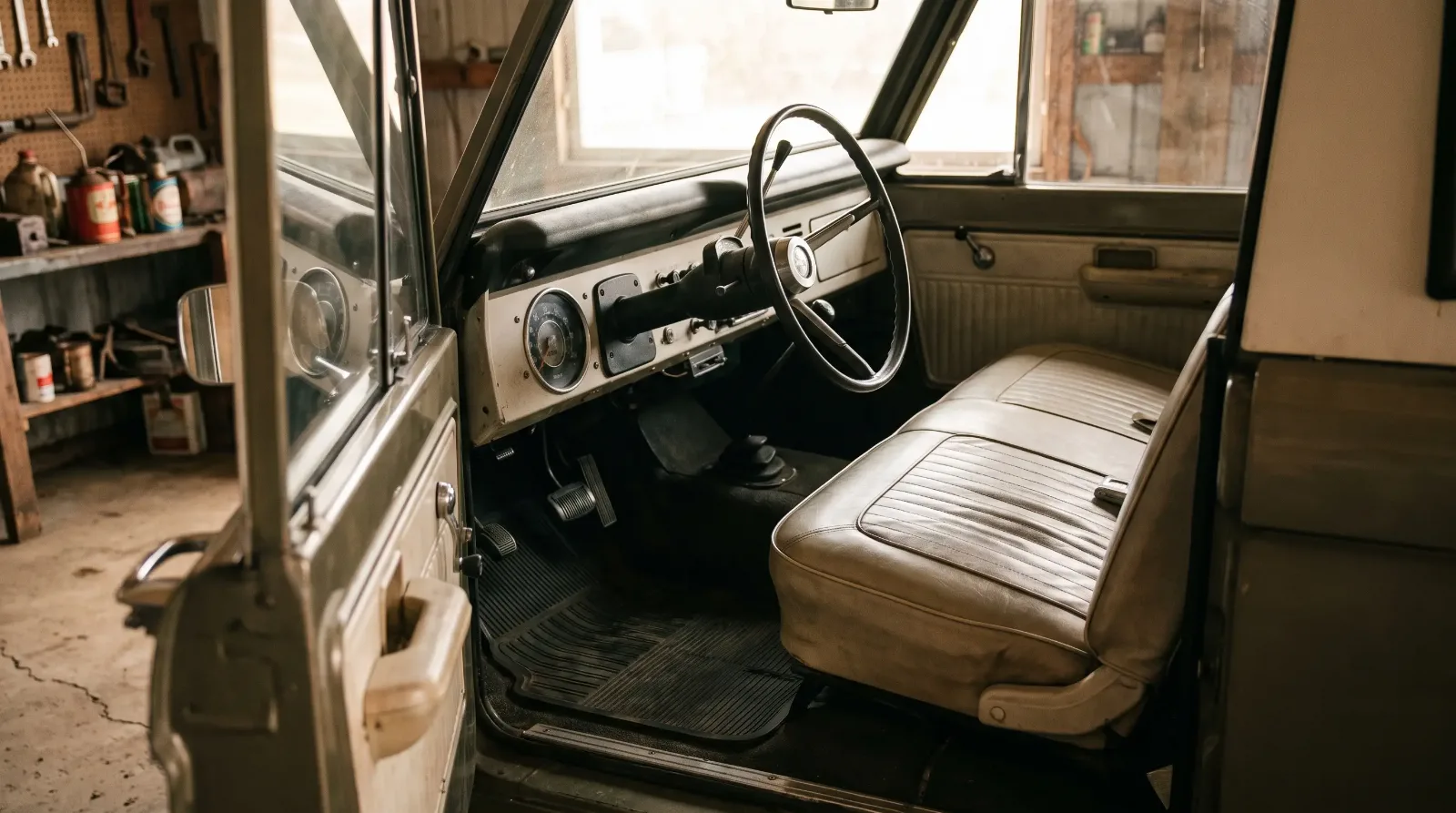
Sit in a 1969 Bronco and the first thing you notice is what is not there. No carpet underfoot on most base trucks, just rubber matting you could hose out. No sound deadening worth mentioning. A dash laid out with the honesty of a tool cart. The ford bronco 1969 interior was not designed to impress anyone sitting in a dealer showroom chair. It was designed for someone who was going to get in wet, muddy, or covered in hay dust and needed the cabin to survive that reality without complaint.
Car Features
6 min read
Inside the 1969 Bronco, Spartan but Evolving
A builder's look at the honest, no-frills 1969 Bronco cabin, what the Sport trim actually changed, and how to spot a real original interior from a poseur.
A cabin built for use, not comfort
Ford kept the Bronco's interior simple by design, and by 1969 that simplicity had barely softened from the truck's 1966 introduction. Vinyl bench seating came standard, tough enough to shrug off wet clothes and dog claws. The dashboard carried a basic instrument cluster, a few toggle switches, and not much else. Buyers who wanted more could step up through the trim levels Ford offered, most notably the Sport package, which added some brightwork, better seat material, and a bit more visual polish without changing the truck's fundamentally utilitarian bones underneath.
What strikes me every time I get into an original, unmolested 1969 example is how honest the whole layout feels. There is no pretense in this cabin. Every switch does exactly one thing and does it without apology. That is a different kind of design philosophy than what you see in trucks even a decade later, once manufacturers started chasing car-like comfort in their trucks and SUVs.
The Sport package and what it actually changed
People throw around the word Sport like it turned the Bronco into something plush. It did not. The Sport trim on a 1969 Bronco meant chrome trim pieces, sometimes a different seat pattern, and badges that told a passerby the owner had paid a little extra. Underneath that dressing, the bones were the same rubber floor, the same basic door panels, the same no-nonsense dash. I have had customers come to me expecting a Sport-trim Bronco interior to feel like a different animal from a base truck, and it just is not. It is the same honest cabin with a slightly nicer jacket on.
Why the simplicity holds up today
There is something to be said for an interior with nothing to fail. No power windows to seize up. No electronic gauges to go dark. A 1969 Bronco cabin, kept original, is mechanically simple enough that a patient owner can keep every gauge and switch working with basic knowledge and a little care. That reliability is part of why so many original interiors, even rough ones, are worth preserving rather than gutting for something modern.
Spotting a real one versus a poseur
I see a lot of Broncos come through that claim to be all original inside, and a fair number of them are not. The tells are usually small. Seat vinyl with a grain pattern that does not match period Ford supplier records. A dash pad that is the wrong shade of the correct color. Door panel fasteners that are the right style but wrong finish. None of these things ruin a truck by themselves, plenty of good, honestly built Broncos wear a mix of original and correct reproduction parts, but there is a real difference between a truck that is honest about what has been replaced and one being passed off as untouched when it is not.
"An interior tells you more about a truck's real history than the paint ever will. Paint gets redone all the time. A seat pattern, a dash texture, those things are harder to fake convincingly, and a careful eye can usually tell."
- Jim Vasquez
Buyers chasing an authentic example should treat the interior as a primary source, not an afterthought behind the engine bay and the sheet metal. A body can be repainted a dozen times and still tell you nothing false. A cabin that has been swapped out, upgraded, or dressed up to look older than it is can mislead a buyer who does not know what to look for.
Heaters, radios, and the small comforts buyers actually wanted
A base 1969 Bronco could be ordered without a heater, which sounds hard to believe until you remember plenty of these trucks were sold as second vehicles for ranch and farm work where comfort was never the point. Most retail buyers, especially the growing number buying for family and suburban use, checked the box for a heater and often a basic AM radio too. Neither option turned the cabin into something soft. The heater just kept a driver's hands from going numb on a January morning, and the radio gave a long drive something other than engine noise to listen to.
Air conditioning was rare and, on a truck this basic, almost beside the point. Owners rolled the windows down, which on a Bronco of this era meant an honest breeze through a cabin that was never trying to seal you off from the world outside it in the first place. That connection between driver and road, unfiltered by a decade of comfort features nobody had invented yet, is part of why so many owners today describe driving an original 1969 Bronco as feeling more honest than anything built since.
What to look for in a survivor
The interiors that impress me most are not the pristine, never-touched museum pieces, though those exist and they are special. It is the working interiors, worn in the right places, a seat cushion compressed from decades of real use, a steering wheel with the finish worn down to bare material where two hands gripped it for years. That kind of wear is honest in a way no restoration shop can replicate convincingly. It tells a real story about a truck that got used the way Ford intended it to be used.
For the full story on how the 1969 model year came together beyond just the cabin, it is worth reading the broader account of that year's production and design choices. And if you are hunting for a truck of your own with an interior worth caring about, take the time to look at classic Bronco for sale listings closely, since photographs rarely capture the small details that separate an honest original cabin from a well-dressed reproduction.
A Bronco interior from this era was never meant to be luxurious. It was meant to work, and the ones that have survived intact still do exactly that, decades later, without a single apology for what they lack. That is a hard thing to build on purpose, and an even harder thing to fake convincingly once you know what to look for.
Sources and notes
Related Reading

Have a
Ford Bronco
for Sale?
Reach thousands of serious classic car collectors across the US.
Sell It Here →
Selling a classic? Here's how: where to sell your classic car online
Are You a Classic Car Dealer?
List your full inventory and connect with targeted classic car buyers.
Join as a Dealer →
#classic truck restoration
#Ford Bronco
#original parts
#1969 Bronco
#Bronco interior
#Bronco Sport trim

About the author
Jim Vasquez
Southern California hot rod and custom car builder with roots in the traditional kustom kulture scene.
Related Listings - Ford Bronco
More in Car Features
Comments (1)
G
Gene Przybylski
1 week ago
That hose-it-out rubber mat is about the cheapest interior you'll ever restore. A buddy priced out his '69 and the floor covering was pocket change next to recovering the seat, which ate half his interior budget. Keep the original bench frame if it's straight. Foam and springs are cheap. A good frame from a truck that never sat in a field is not.