
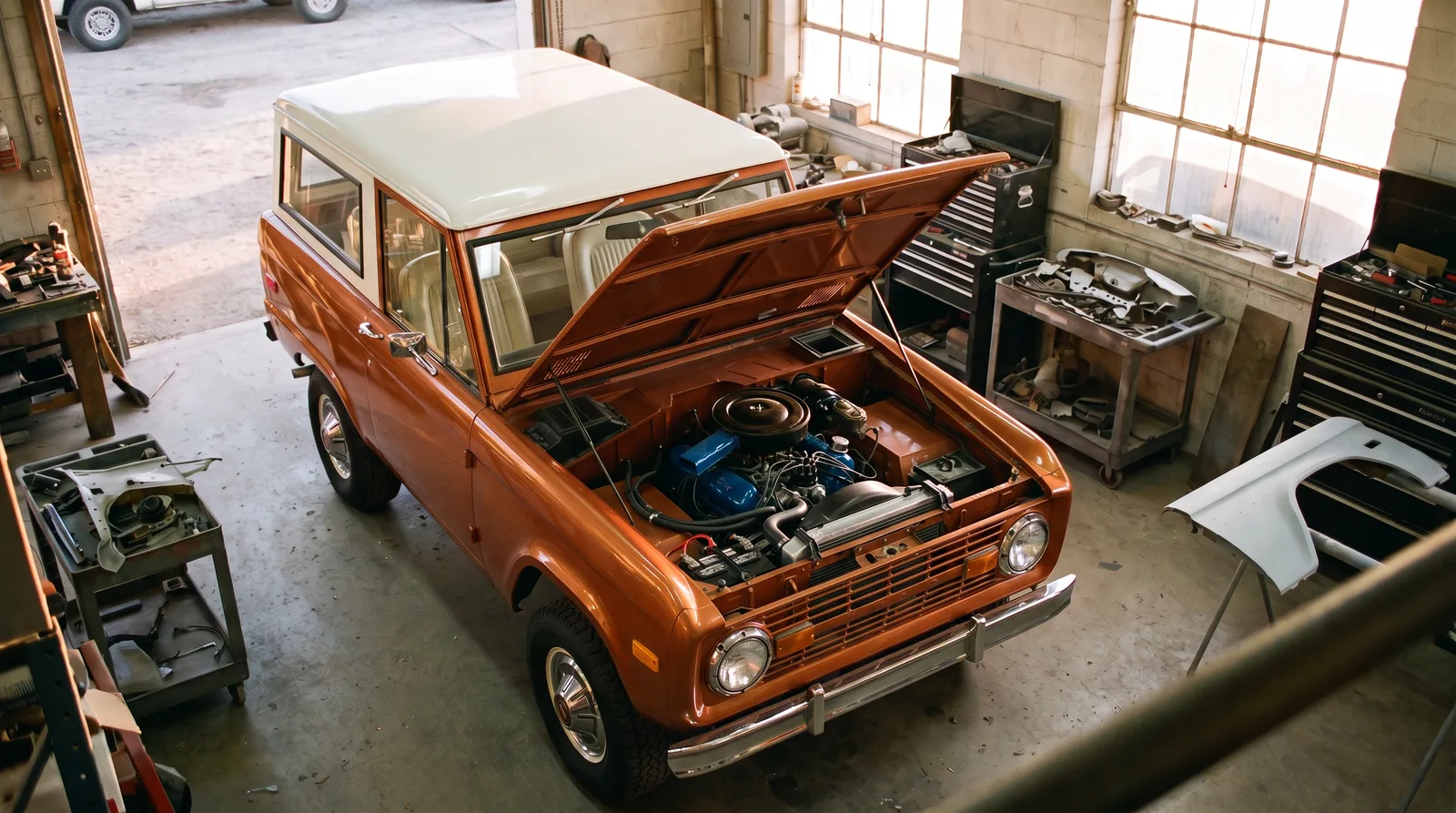
The ford bronco 1973 emissions era marks a genuine turning point for anyone who studies how federal regulation reshaped American light trucks. The 1973 model year sits right at the front edge of the emissions control push that would define the rest of the decade, and the Bronco, despite its small production numbers compared to Ford's car lines, was not exempt from the changes rolling through Dearborn's engineering offices.
Car Features
6 min read
The 1973 Bronco Meets the New Emissions Era
The ford bronco 1973 emissions era brought new carburetion and exhaust hardware to the classic 4x4, changing how the truck ran without changing its basic character.
What "emissions era" actually meant for a 1973 truck
By 1973, the Environmental Protection Agency had been operating for a few years, and the regulatory framework that would tighten dramatically through the mid and late 1970s was already taking shape. Ford's engines, including the 200 cubic inch six and 302 cubic inch V8 offered in the Bronco, carried emissions control equipment that had not existed on the truck just a few seasons earlier. This included changes to carburetion, ignition timing, and exhaust recirculation systems designed to reduce the pollutants coming out of the tailpipe.
Ford lowered compression ratios across its small-block V8 lineup, including the 302, through the early 1970s to accommodate lower-octane, unleaded-compatible fuel and tighter emissions limits, though exact year-by-year figures as installed in Bronco applications are not consistently documented in surviving factory literature. These adjustments came with real tradeoffs. Lower compression ratios and leaner carburetor tuning, both common responses to emissions pressure across the industry at this time, tended to reduce low-end torque and can make engines run hotter under load if not properly maintained. Bronco owners and mechanics of the era noticed the shift, even if the truck's basic character stayed recognizable.
Why the Bronco felt the pressure differently than passenger cars
Ford's car divisions absorbed emissions requirements alongside a huge, well-funded engineering effort, since passenger cars represented the overwhelming majority of the company's sales volume and regulatory exposure. The Bronco, a comparatively low-volume niche product, received emissions-compliant versions of engines developed primarily for higher-volume applications elsewhere in the Ford lineup. That meant the truck generally used adapted, rather than purpose-built, emissions solutions, a pattern common across the industry for low-volume specialty vehicles during this transition period.
For period buyers, this translated into a truck that still felt fundamentally like a Bronco, but one that ran slightly differently than the pre-emissions trucks from just a few years earlier. Idle quality, throttle response, and cold-start behavior were all areas where the new equipment could introduce quirks that earlier, simpler carbureted engines did not have.
How this shapes the 1973 Bronco's reputation among collectors
Collectors and mechanics who work on these trucks today generally view the 1973 emissions equipment as a manageable, well-understood system rather than a serious obstacle. Compared to the far more restrictive and complex emissions hardware that arrived on vehicles later in the 1970s, the 1973 Bronco's setup is relatively straightforward, and many owners maintain it in period-correct condition without major difficulty.
Still, the emissions equipment is a genuine part of the truck's documented history, and buyers evaluating a numbers-matching example should expect to see the correct emissions hardware present, even if some owners over the decades have removed or modified it in the name of simplicity or performance. A truck with intact, period-correct emissions equipment carries more originality value than one that has had it stripped out, a distinction that matters more each year as unmodified survivors become scarcer.
"When I assess originality on a 1973 Bronco, the emissions hardware is part of what I look for. It is easy to overlook next to bigger ticket items like the drivetrain, but a truck missing its period emissions components is a truck that has been altered from how it left the factory."
- Sarah Whitfield
Maintenance realities for owners running these systems today
Mechanics who service 1973 Broncos today generally agree the emissions equipment from this specific year is far easier to keep functioning than the more elaborate systems that arrived later in the decade, including catalytic converters and increasingly complex vacuum-controlled devices that showed up on Ford products by the mid and late 1970s. The 1973 system, built around carburetor tuning and basic exhaust recirculation, responds well to conventional tune-up practices and does not typically require specialized diagnostic equipment to keep running correctly.
That relative simplicity is part of why so many 1973 Broncos remain drivable on their original, unmodified engines today, rather than having been converted to later, easier-to-source drivetrains. Owners who understand the period-correct tuning specifications can keep these engines running close to their original factory behavior, an important consideration for anyone planning to show or sell the truck as an unmodified, numbers-matching example.
Reading the 1973 emissions story alongside the rest of the model year
The emissions changes did not arrive in isolation. They landed the same year Ford added optional power steering and continued refining the Bronco's comfort and safety equipment, meaning 1973 buyers experienced a truck that was simultaneously getting more comfortable to drive and more regulated under the hood. Readers who want the full story on everything that changed for the model year will find the emissions shift covered alongside those other developments in fuller context.
For anyone shopping today, the emissions equipment on a surviving 1973 Bronco is a legitimate detail worth understanding, both for originality purposes and for setting expectations about how the engine will run compared to earlier, unregulated Bronco years. Readers can browse classic Bronco listings to compare how sellers describe engine condition and originality across available 1973 examples.
What the emissions story tells us about the truck as a whole
Taken together, the emissions equipment, the newly optional power steering, and the ongoing trim refinements paint a consistent picture of a manufacturer managing a mature, well-understood platform through a period of real external pressure, both regulatory and competitive. Ford was not redesigning the Bronco in 1973. It was carefully tuning an existing formula to satisfy new federal requirements while still keeping the truck appealing to a buyer base that increasingly expected comfort alongside capability. That balancing act, quiet and largely invisible in period marketing materials, is exactly the kind of engineering history that gets lost without deliberate documentation, which is why period-correct emissions hardware deserves the same collector attention that flashier options like trim packages and drivetrain choices already receive. The next time you evaluate a 1973 Bronco, look under the hood as carefully as you look at the badges and upholstery. The story of that model year is written there too.
A careful buyer who understands the emissions equipment is also a buyer who can spot a poorly executed later modification, whether that means a mismatched carburetor from a different model year or a missing component that should be present on a truly original truck. That kind of scrutiny protects both the buyer's investment and the broader historical record, since every accurately preserved original truck makes the next generation's research a little easier.
Sources and notes
Related Reading
Have a
Ford Bronco
for Sale?
Reach thousands of serious classic car collectors across the US.
Sell It Here →
Selling a classic? Here's how: the best sites to sell a classic car
Are You a Classic Car Dealer?
List your full inventory and connect with targeted classic car buyers.
Join as a Dealer →

About the author
Sarah Whitfield
Third-generation classic car collector specializing in pre-war American and European coachbuilt automobiles. Researcher and concours enthusiast.
Related Listings - Ford Bronco
Comments
Be the first to comment on this article.