
The ford bronco 1978 free wheeling package is the loudest, most visually confident option Ford ever put on a full-size Bronco, and it remains one of the most immediately recognizable trims from the late 1970s truck era. Where the Ranger XLT quietly upgraded comfort, the Free Wheeling package did the opposite. It announced itself from across a parking lot with sweeping stripe graphics and colors that had no interest in blending in.
Car Features
7 min read
The Free Wheeling Bronco and Its Rainbow Stripes
Ford's Free Wheeling package turned the 1978 full-size Bronco into a bold, striped statement piece, and original graphics are now among the rarest details collectors chase.
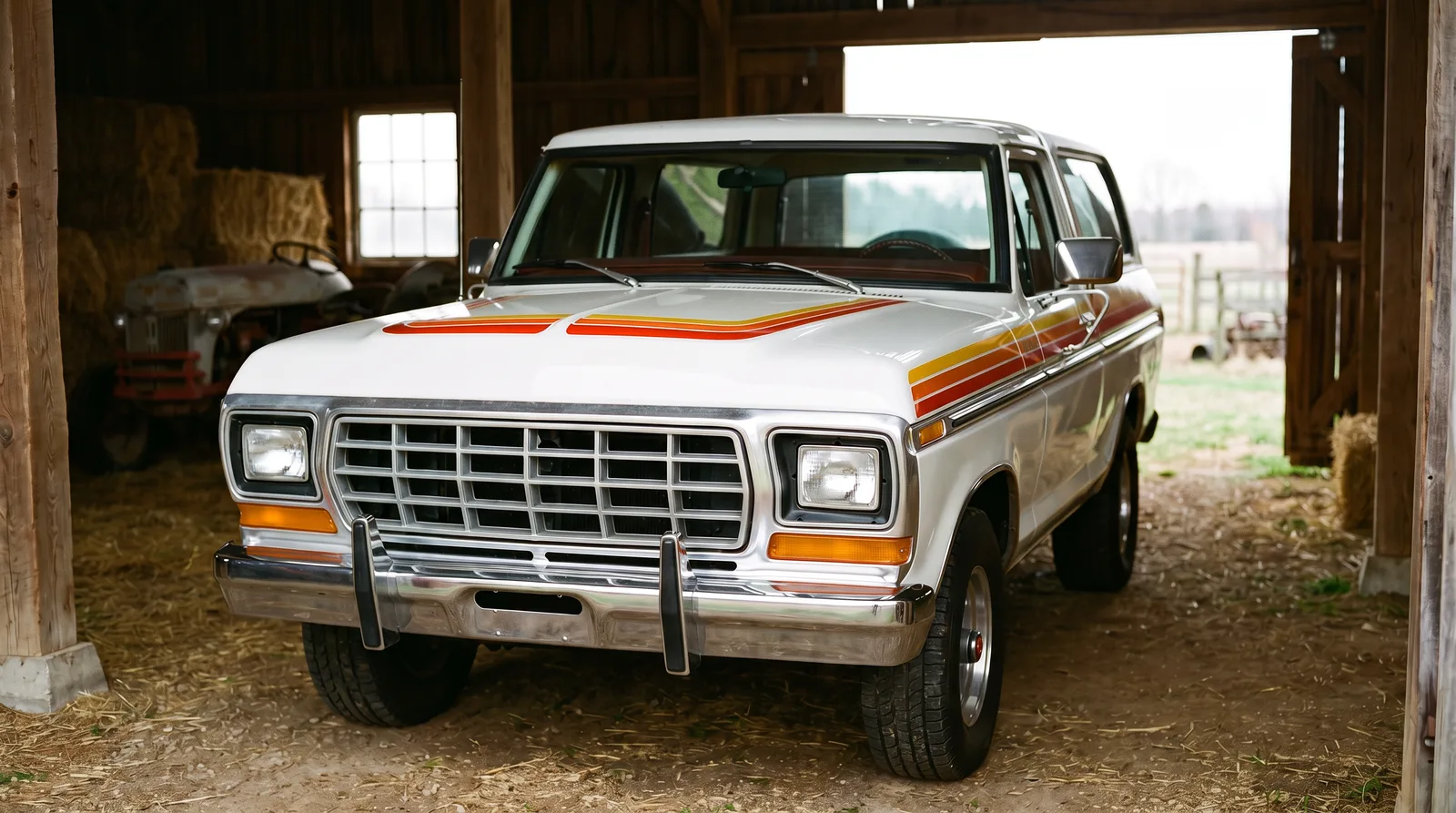
A package built for a very specific moment
The late 1970s produced a distinct genre of factory graphics packages across the American auto industry, from muscle car stripe kits to van conversion murals, and truck makers were not immune to the trend. Ford's Free Wheeling option applied that same spirit to the new full-size Bronco, wrapping the truck in bold multi-color stripe treatments that ran the length of the body, paired with specific paint colors chosen to make the graphics pop rather than recede into the background. The package existed alongside similar Free Wheeling treatments Ford applied to F-series pickups of the same era, part of a broader company push to give its trucks a younger, more energetic identity beyond pure utility. The exact stripe colors and paint pairings varied by model year and body color, and period documentation for the precise combinations is fragmentary today, which is part of why matching an original layout now takes careful reference work rather than a simple parts-catalog lookup.
What set the Free Wheeling Bronco apart from a simple appearance option was how completely it committed to the look. This was not a subtle pinstripe or a small badge. The graphics were designed to be the primary visual statement of the truck, turning a workaday full-size Bronco into something closer to a factory custom, the kind of truck a buyer chose specifically because they wanted to be noticed.
How the graphics reshaped the truck's identity
Underneath the stripes, a Free Wheeling Bronco used the same driveline and chassis as any other 1978 full-size Bronco, meaning the package was purely cosmetic rather than mechanical. That distinction matters for anyone researching these trucks today, since the Free Wheeling designation tells you nothing about engine choice or four-wheel-drive hardware, only about how the truck looked leaving the factory. Dealers marketed the package to younger buyers and outdoor enthusiasts who wanted their Bronco to read as recreational rather than purely functional, a positioning that stood in direct contrast to the Ranger XLT's more conservative, comfort-focused approach.
Combined with the removable fiberglass top that defined the entire full-size Bronco generation, a Free Wheeling truck with its top off and stripes catching the sun was about as far from a farm truck as Ford's lineup got in 1978. That contrast, rugged four-wheel-drive hardware wrapped in loud, youthful graphics, captured something specific about how trucks were being marketed at the end of the decade, straddling the line between working vehicle and recreational statement piece.
Why survivors are so scarce today
Factory stripe graphics from this era were vinyl applications, and vinyl does not age gracefully across five decades of sun exposure, washing, and general wear. Many original Free Wheeling Broncos lost their graphics entirely over the years, either faded beyond recognition or stripped off during a repaint, which means an intact original stripe package is now one of the rarest details a collector can find on a full-size Bronco. Reproduction kits exist, but matching the original color placement and proportions correctly requires careful reference to period photography and factory documentation rather than guesswork.
This scarcity has started to show up in what these trucks command compared to plainer full-size Broncos from the same two model years. A documented, original Free Wheeling truck, even in driver-quality condition, tends to draw more interest than a nicer but visually generic example, simply because the graphics package is so much harder to authenticate and replace correctly. For the broader context of how this generation of Bronco came together and where the Free Wheeling package fit within Ford's 1978 lineup, our complete history covers the launch year in full.
"A Free Wheeling Bronco was never trying to be subtle. Ford built it to be seen, and fifty years later that same boldness is exactly why collectors chase it."
- Sarah Whitfield
How it compared to other factory graphics packages
Ford wasn't alone in chasing this look. Jeep's various special editions carried their own bold graphics through the same period, and General Motors offered plenty of striped and two-tone appearance packages across its truck lineup. What made the Free Wheeling Bronco stand out within that crowded field was the sheer scale of the graphics relative to the truck's size. A full-size Bronco offered a lot of body surface for Ford's designers to work with, and the Free Wheeling package used nearly all of it, running stripes across the hood, down the beltline, and onto the rear quarters in a way that smaller vehicles simply couldn't replicate with the same visual impact.
That scale is part of why the package still photographs so well decades later. Where a lot of 1970s graphics packages look busy or dated in modern light, a well-preserved Free Wheeling Bronco tends to read as bold and confident rather than cluttered, proof that Ford's design team balanced the stripe layout carefully against the truck's already substantial proportions.
What to look for when hunting one down
Anyone searching for a genuine Free Wheeling Bronco should start by comparing a prospective truck's stripe pattern and color combination against period brochures and dealer photography, since aftermarket stripe kits sold for decades afterward and can easily be mistaken for the real thing by an inexperienced buyer. Original build sheets, when available, are the most reliable way to confirm a truck left the factory with the package rather than receiving it later as a cosmetic upgrade.
Condition of the surrounding paint matters just as much as the stripes themselves, since a proper Free Wheeling restoration requires matching both the base color and the graphic layout precisely. Buyers who want to see what is currently available across the full-size Bronco market, Free Wheeling examples included, can browse classic Bronco listings to compare pricing and condition before committing to a purchase. Few options from this era carry as much visual personality, and that personality is exactly what keeps the Free Wheeling package relevant to collectors decades after Ford stopped offering it.
Insurance and appraisal professionals who deal with these trucks regularly note that a documented original Free Wheeling Bronco often requires a specific rider or agreed-value policy, since standard classic car coverage can underestimate the graphics package's contribution to overall value. Owners serious about protecting their investment should treat photographic documentation of the stripes, taken from multiple angles in good light, as seriously as they treat mechanical records, since that documentation becomes essential if a claim or a future sale ever requires proving originality.
Sources and notes
Related Reading
Have a
Ford Bronco
for Sale?
Reach thousands of serious classic car collectors across the US.
Sell It Here →
Selling a classic? Here's how: compare the places to sell classic cars
Are You a Classic Car Dealer?
List your full inventory and connect with targeted classic car buyers.
Join as a Dealer →

About the author
Sarah Whitfield
Third-generation classic car collector specializing in pre-war American and European coachbuilt automobiles. Researcher and concours enthusiast.
Related Listings - Ford Bronco
Comments
Be the first to comment on this article.