
By the time the 1979 Bronco reached dealers, federal emissions regulation had already reshaped nearly every engine Detroit built, and the ford bronco 1979 emissions changes that separated this model year from the 1978 truck sitting next to it on the lot were, for the most part, invisible to a casual buyer. They mattered enormously to the engineers who had to keep the truck's V8 lineup compliant while a decade of tightening federal rules kept moving the target.
Car Features
7 min read
The 1979 Bronco and the Catalytic Converter Era
The 1979 Bronco looked like a carryover from 1978, but tightening EPA rules quietly reworked its V8 tuning for another year of compliance.
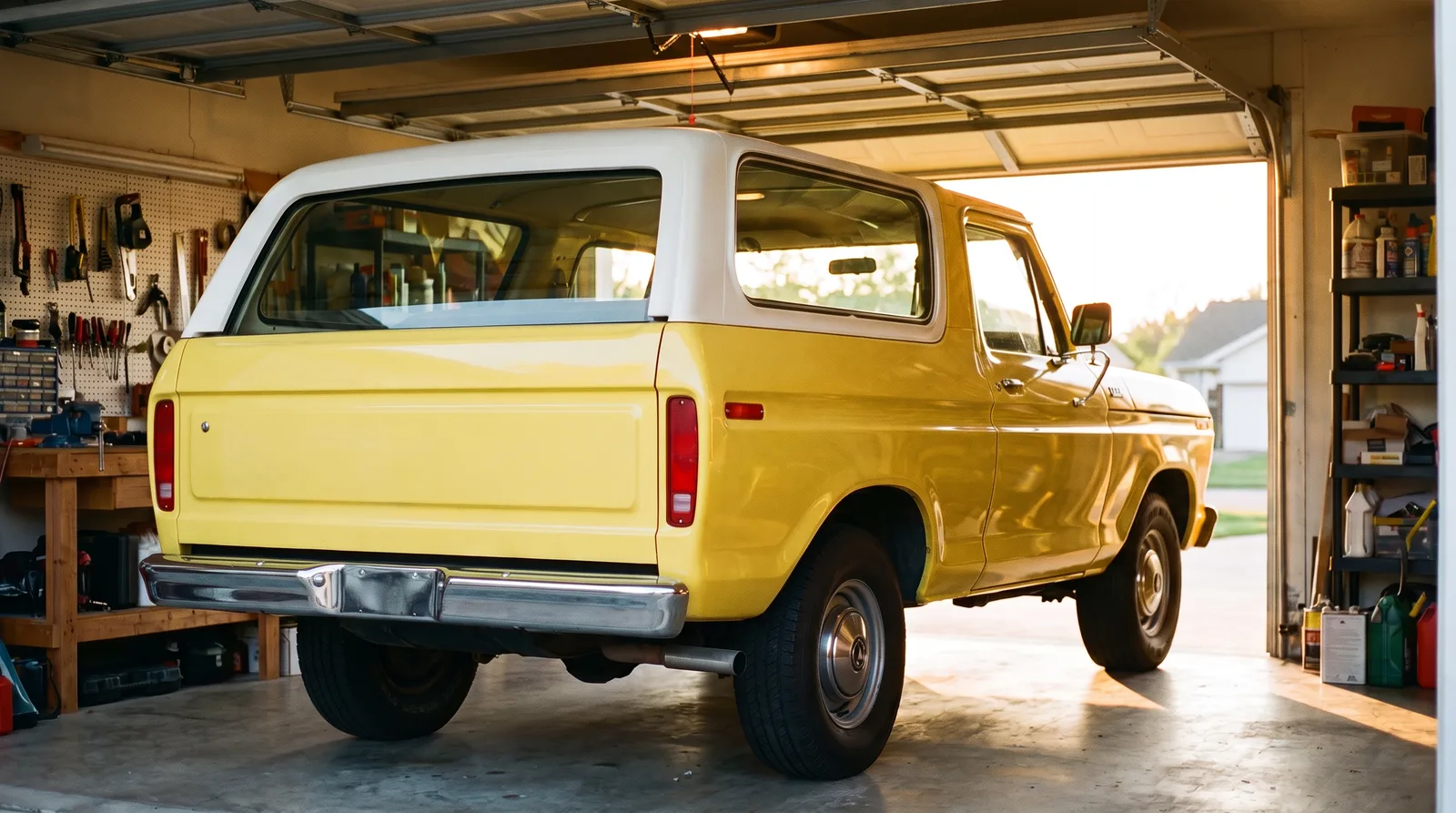
The regulatory backdrop by 1979
The catalytic converter had become standard equipment across most of the domestic passenger car industry starting with the 1975 model year, a response to Environmental Protection Agency standards for hydrocarbon and carbon monoxide emissions. Light trucks, including the Bronco, ran on a slower phase-in schedule than passenger cars through the mid-1970s, so the full-size Bronco's V8s were still running without a catalytic converter through the 1978 model year. That changed for 1979, when Ford added catalytic converters, along with other emissions equipment, to both the 351M and 400 V8 in the Bronco and across its light-truck line, closing the gap between truck and passenger car emissions hardware.
The full-size Bronco, built on the F-Series platform since the 1978 redesign, inherited whatever emissions hardware Ford's truck engineers developed for the pickup line, since the two shared engines and much of the exhaust system. Any change made to keep an F-150's V8 compliant for 1979 applied to the Bronco built on the same line.
What actually changed under the hood
For 1979, Ford's V8 lineup in the Bronco gained the catalytic converter for the first time, alongside refined carburetor calibrations, exhaust gas recirculation settings, and running changes to ignition timing curves that traded a small amount of low-end responsiveness for cleaner combustion. Unlike some of the smaller running changes Ford made in other model years, adding the converter was a real hardware change, not just a tuning adjustment, and it is the single biggest mechanical difference between a 1978 and a 1979 Bronco V8.
Fuel economy and drivability both took modest hits as a direct result, a pattern common across the entire domestic industry during these years. Owners and mechanics of the period often noted that engines from the late 1970s felt less eager off idle than their early-decade counterparts, even when displacement and advertised horsepower looked similar on paper. The 1979 Bronco's V8 options were not immune to that trend. read the background on the 1978 redesign that established the platform and engine lineup these 1979 emissions changes were layered onto.
| Area | 1979 change vs 1978 |
|---|---|
| Emissions hardware | Catalytic converter added to both V8s, plus refined EGR and carburetor calibration |
| Ignition timing | Adjusted for compliance, slight low-end tradeoff |
| Fuel economy | Modest decline, industry-wide pattern |
| Body and chassis | Essentially unchanged from 1978 |
Why this era gets a bad reputation, and where that is fair
Enthusiasts sometimes describe the late 1970s as a low point for American V8 performance, and the emissions-driven changes to trucks like the 1979 Bronco are part of why that reputation exists. It is a fair characterization in narrow terms. Horsepower and throttle response were both compromised compared to earlier, unrestricted engine tuning. But it misses the bigger picture that automakers, including Ford, were adapting in real time to regulations that did not yet have mature solutions. Fuel injection, computer-controlled ignition, and more sophisticated catalyst designs that would later let manufacturers meet emissions targets without sacrificing as much drivability were still years away from widespread use in trucks.
The 1979 Bronco's engines represent a transitional point in that story, built with the emissions hardware available at the time, doing the best job that generation of technology could manage. Judged against later trucks, they underperform. Judged against what Ford's engineers actually had to work with in 1979, the compromises look more reasonable.
How Ford's approach compared across the industry
Every domestic manufacturer selling trucks in 1979 faced the same regulatory pressure Ford's engineers were working under, and the industry's responses looked broadly similar from one brand to the next. Chevrolet's Blazer, built on the same C/K pickup platform philosophy as the Bronco, carried its own set of emissions-driven calibration changes for the same model year, and International Harvester's engineers were making comparable adjustments to keep the Scout compliant. None of these companies had a technological edge that let them sidestep the tradeoffs the others were making. The entire industry was working with carburetors, mechanical ignition systems, and early catalytic converter designs that all shared the same fundamental limitations.
What differed slightly between manufacturers was how aggressively each one prioritized drivability against strict compliance margins, a balance every engineering team had to strike on its own. Ford's truck engineers, working from the F-Series platform that underpinned both the pickup and the Bronco, tended toward calibrations that favored reliability and consistency across a wide range of operating conditions, since the same basic tune had to work in a work truck and in a Bronco used for towing and family duty alike. That is a reasonable engineering priority, even if it meant the resulting engines were rarely described as lively by contemporary road tests.
Understanding this broader context helps explain why the 1979 Bronco's V8s feel the way they do to drive today. They were not uniquely compromised compared to their direct competitors. They were representative of an entire generation of domestic trucks built during a genuinely difficult stretch of regulatory transition, one that every manufacturer navigated with roughly the same tools and roughly the same results.
What buyers should know today
For someone shopping a 1979 Bronco now, the emissions-era engine tuning is mostly a curiosity rather than a practical concern. Most surviving examples have had decades of carburetor adjustments, tune-ups, and in some cases modifications that have moved well past the original factory calibration. The historical significance is worth knowing, particularly for buyers who care about matching-numbers originality, but it should not be the deciding factor in a purchase decision the way engine condition, rust, and drivetrain health should be.
"People assume 1979 was just 1978 again. Under the valve covers it was not. Ford's engineers were chasing a moving regulatory target almost every model year through this period, and the Bronco's V8s show it if you know where to look."
- Sarah Whitfield
Documentation matters more than most buyers expect when originality is the goal. Emissions labels, vacuum diagrams affixed under the hood, and original carburetor part numbers can help confirm whether a truck's engine bay still reflects its factory 1979 configuration or has been altered somewhere along the way. For collectors chasing accuracy rather than just usable transportation, that paperwork trail is often the clearest way to separate a genuinely original 1979 example from a truck that has quietly picked up parts from other model years over four and a half decades of ownership.
If you want to compare surviving examples and their engine condition for yourself, you can find a classic Bronco currently listed from this and other model years.
Sources and notes
Related Reading
Have a
Ford Bronco
for Sale?
Reach thousands of serious classic car collectors across the US.
Sell It Here →
Selling a classic? Here's how: sell my classic car
Are You a Classic Car Dealer?
List your full inventory and connect with targeted classic car buyers.
Join as a Dealer →

About the author
Sarah Whitfield
Third-generation classic car collector specializing in pre-war American and European coachbuilt automobiles. Researcher and concours enthusiast.
Related Listings - Ford Bronco
Comments
Be the first to comment on this article.