
A guy at our club's fall show last year brought a half-cab Bronco he had owned since the truck was practically new, and half the people wandering past assumed it was some kind of custom job. It was not. The U14 half-cab was a real factory configuration Ford sold right alongside the wagon and the Roadster, and the fact that so many newer enthusiasts do not recognize it says a lot about how quietly this version has slipped out of common memory.
Car Features
6 min read
The U14 Half-Cab, the Bronco Pickup
The U14 half-cab traded the wagon's rear seats for a real cargo bed, and decades of being overshadowed have quietly turned it into one of the rarer body styles to find honest today.
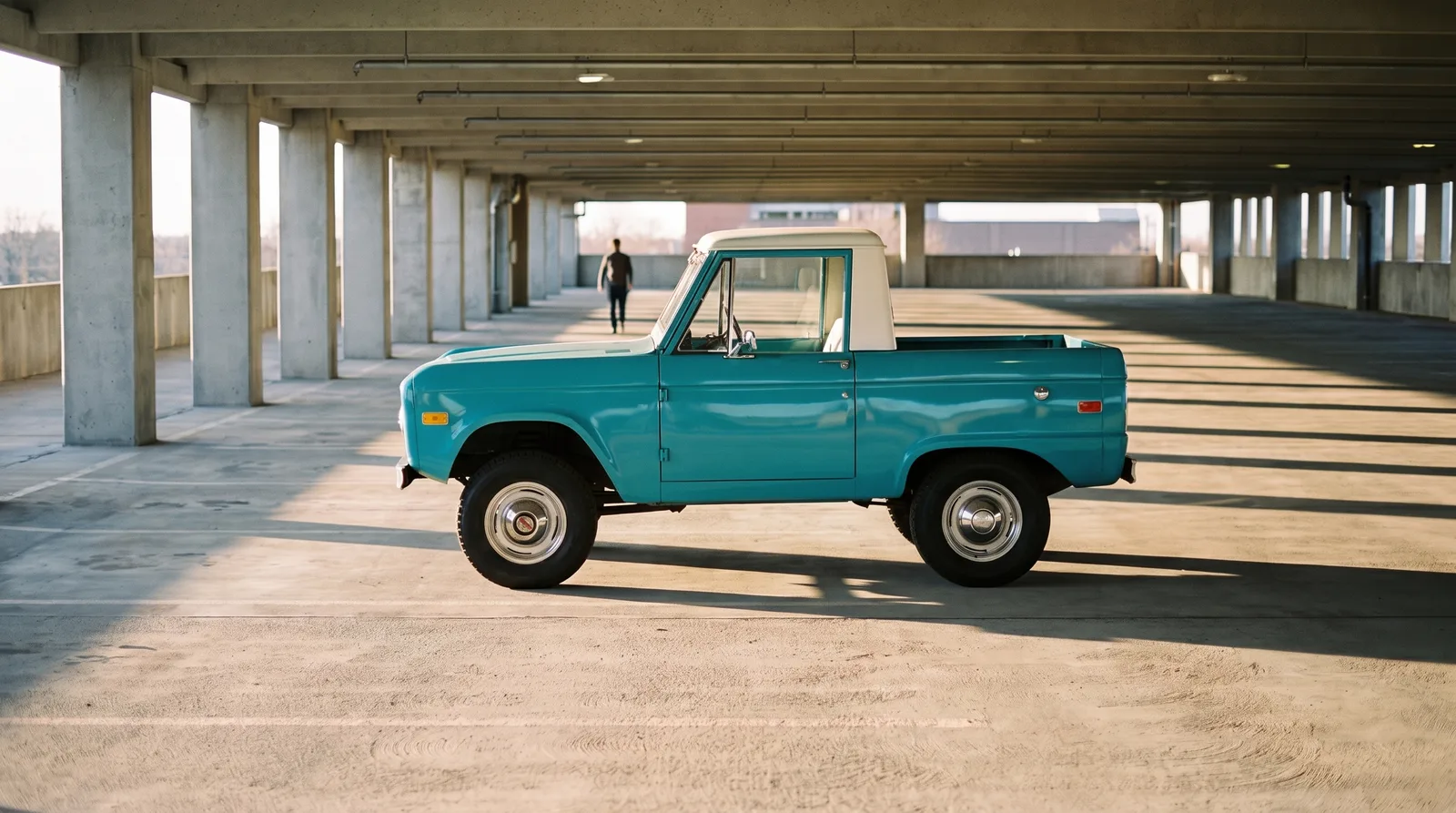
What Ford actually built with the U14
The U14 designation covered the pickup version of the original Bronco, sometimes called the half-cab because it kept a small enclosed cab up front and an open cargo bed behind it, unlike the fully enclosed U15 wagon. It sat between the stripped U13 Roadster and the more practical wagon in terms of layout, offering buyers who wanted some hauling capacity a genuine truck bed without the added weight and cost of the full wagon body.
Ford aimed the half-cab at exactly the kind of buyer you would expect, ranchers, tradesmen, and anyone else who needed to actually carry gear rather than just passengers. It never sold in the same numbers as the wagon, which offered more weather protection and interior room for the same basic platform, but it found a loyal following among owners who valued the bed space and did not mind the tradeoffs that came with it.
The tradeoffs that made the half-cab its own thing
Owning a half-cab means accepting some real compromises compared to a wagon. Cargo in the open bed is exposed to weather, there is no rear seating to speak of in a practical sense, and the shorter enclosed cabin changes the whole feel of the interior compared to riding in a wagon. None of that stopped period buyers who genuinely needed a small pickup bed more than they needed rear seats, and it does not stop today's owners who want a Bronco that looks and feels distinct from the far more common wagon body.
That distinctiveness is a big part of the half-cab's current appeal. At any Bronco show, wagons dominate the field simply because Ford built so many more of them. A half-cab stands out immediately, and owners who have one tend to talk about that visual difference as much as they talk about the truck's mechanical qualities. It is a truck that gets noticed without needing custom paint or aftermarket parts to do it.
Buying and owning a genuine one
Finding a real U14 today takes more patience than finding a wagon, simply because fewer were built and fewer have survived in honest condition. The open bed design means rust and structural issues show up in different places than on a wagon, and anyone shopping for one should pay close attention to the bed floor, the cab-to-bed mounting points, and the rear of the cab itself where water tends to find its way in over the decades.
There is also the same authenticity concern that shows up across the early Bronco lineup. Because certain components were shared or modified across body styles over the decades, a buyer should confirm a truck's configuration through its build documentation rather than assuming a bed and cab arrangement means the truck was born that way. It usually was, since converting a wagon into a half-cab convincingly is a lot more work than most people are willing to put in, but confirming it costs nothing and protects you either way.
"Every half-cab owner I know ends up defending the body style at some point, usually to a wagon guy who cannot believe anyone would give up the extra seats on purpose."
- Wayne Coburn
Where it fits in the bigger Bronco story
The U14 makes the most sense once you see it next to the U13 and U15 as part of Ford's original strategy for the Bronco lineup, offering three distinct answers to three distinct kinds of buyers on one shared platform. For the full picture of how all three body styles and their engine options compared across the original production run, our complete history lays out the whole lineup in one place.
If the half-cab's mix of practicality and rarity appeals to you, patience is the name of the game in this market. Good ones do not come up often, and when they do, word tends to travel fast through club circles before a listing even goes public in some cases. Keeping an eye on the broader market is still worthwhile though, and you can start by browsing to find a classic Bronco and seeing what configurations are currently available, half-cab included. The truck rewards the search, even when that search takes longer than you would like.
Why the half-cab got overshadowed for so long
Part of the reason the U14 slipped out of common memory the way it did comes down to simple sales math. Ford's own numbers, and the surviving population today, both point to the wagon as the body style most buyers actually wanted in period, which meant magazine features, restoration guides, and eventually internet forums naturally gravitated toward wagon-specific content because that is what most owners were dealing with. The half-cab never had a dedicated fanbase large enough to keep its specific quirks and parts knowledge as widely documented, and that gap only widened as decades passed and fewer people restoring Broncos had firsthand experience with one.
That has started to shift as the broader classic truck hobby has matured and collectors have gone looking for exactly the kind of variety a half-cab offers against a market saturated with wagons. Rarity that once worked against the U14, making parts and knowledge harder to come by, now works in its favor at auction and at shows, where a genuine half-cab draws a different kind of attention than yet another clean wagon rolling through. Owners who stuck with these trucks through the lean decades when nobody was paying much attention are, in a lot of cases, sitting on something more valuable than they realized when they bought it.
The guy at our fall show did not buy his half-cab as an investment. He bought it because he needed a small truck decades ago and never got around to selling it once his needs changed. That kind of ownership history, unglamorous and practical, is exactly how a lot of the best surviving U14s made it to today in honest, unmolested condition. It is worth remembering the next time someone tells you the wagon is simply the better truck. Better for what you need is a fair question. Better in every sense is a harder case to make once you have spent an afternoon looking closely at what the half-cab actually offers.
Sources and notes
Related Reading
Have a
Ford Bronco
for Sale?
Reach thousands of serious classic car collectors across the US.
Sell It Here →
Selling a classic? Here's how: sell my classic car
Are You a Classic Car Dealer?
List your full inventory and connect with targeted classic car buyers.
Join as a Dealer →

About the author
Wayne Coburn
Longtime Corvette owner, judge and club figure who knows the cars, the records and the people behind them.
Related Listings - Ford Bronco
Comments
Be the first to comment on this article.