
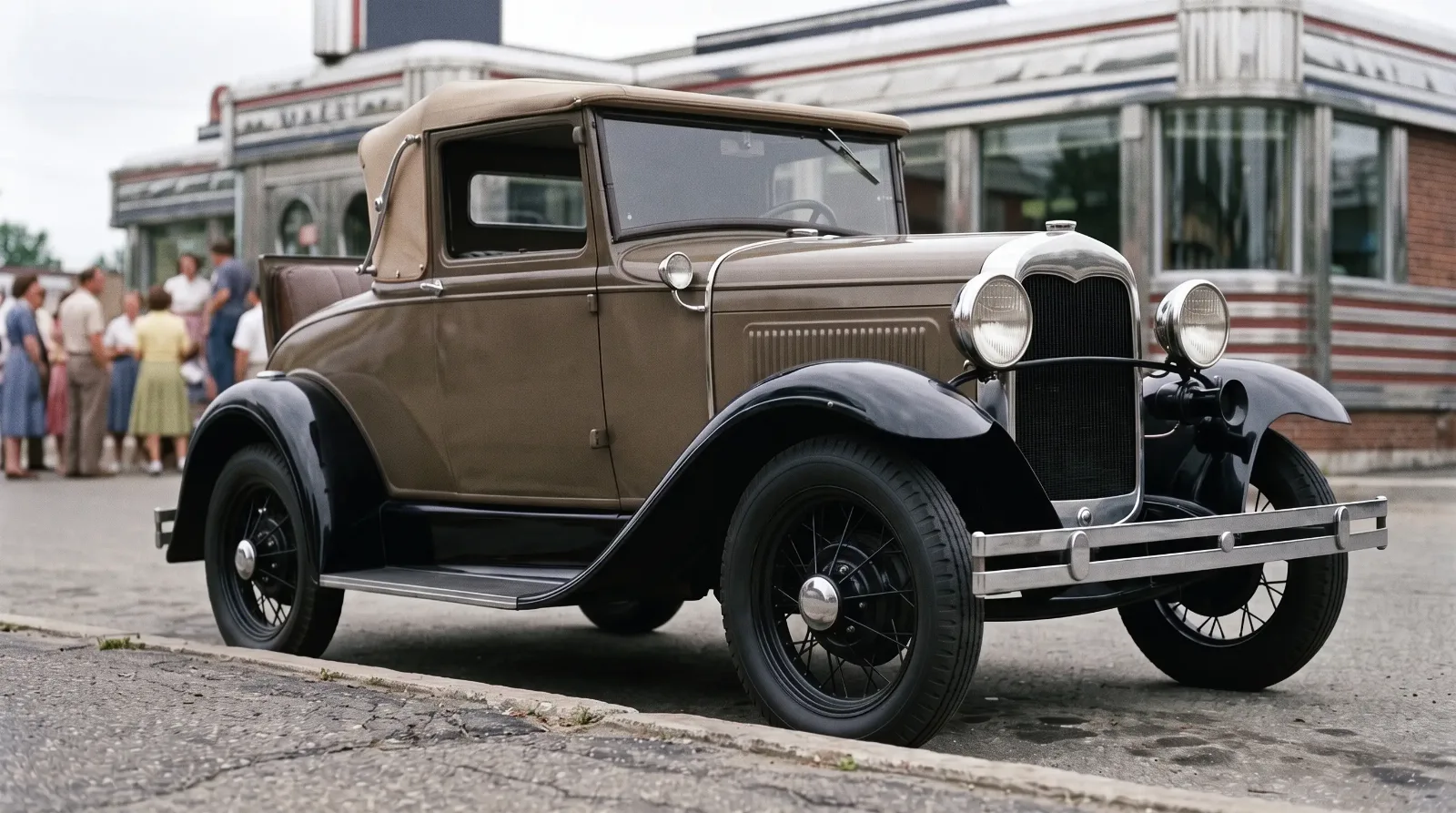
Of all the open cars Ford built between 1928 and 1931, the Ford Model A phaeton is the one that kept the oldest idea alive: a full-size car for a family, with no fixed roof and no glass in the doors. It was there from the start. When Ford put the new car in front of the public in Kansas City, the exhibit showed six bodies, and the phaeton was one of them, alongside the Tudor, Fordor, Roadster, Coupe and Sport Coupe. Four model years later it was still in the price list, joined by a lower, sportier De Luxe version that collectors now treat as a separate car. This article looks at the phaeton as an artifact: its body numbers, its builders, what it cost, how it changed in 1930, and how to read one that survives today.
Car Features
8 min read
The Ford Model A Phaeton
The open four-seat Model A, from the 1928 35-A to the 1930 De Luxe Phaeton: body numbers, builders, prices and how to read a survivor.
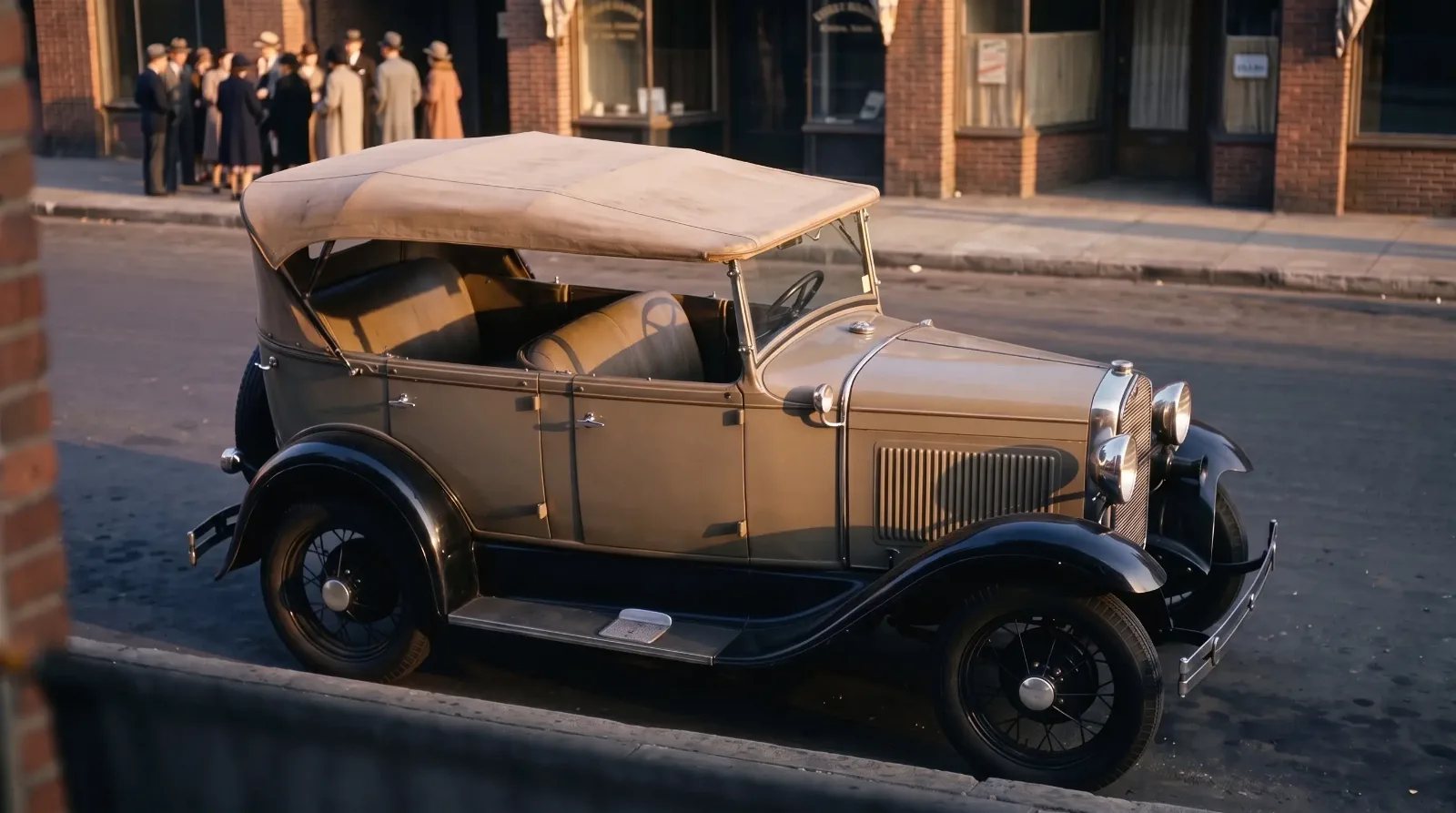
What Ford meant by a phaeton
A phaeton, in Ford's vocabulary, was an open car with a folding top and seating for more than two. The roadster sat two up front, with a rumble seat for extras. The phaeton put a proper rear seat inside the body, behind a second pair of doors, so a family of four or five rode under the same canvas. Weather protection came from the top and from side curtains that buttoned or clipped in when the rain started. There was no roll-up glass.
The word matters because the museum world does not always use it. The Henry Ford, which shows a 1930 example in its Driving America exhibit (object 76.143.1, a gift of John F. Morse), catalogs the car as a "Ford Model A Touring Car." The Model T buyer would have understood that name at once. Ford's own body lists for the Model A used phaeton, and that is the term clubs, judges and parts suppliers follow.
Mechanically the phaeton was a Model A like any other: the 200.5 cubic inch L-head four rated at 40 hp at 2,200 rpm, a three-speed sliding-gear transmission, and four-wheel mechanical brakes. The body was the whole story. For the way it sat against the closed cars and the coupes, there is more on the body styles cars in our overview.
Body numbers: 35-A, 35-B and the 180-A
Ford assigned style numbers to every Model A body, and the phaeton has three worth knowing. The standard phaeton began as the 35-A, introduced in November or December 1927. Budd supplied panel assemblies for the 1928 phaeton, roadster and Tudor, which makes the early 35-A one of the few Model A bodies with Budd steel in it. When Ford restyled the car for 1930, the phaeton was reissued as the 35-B, part of the new family of "B" bodies that also included the 40-B roadster, 45-B coupe and 55-B Tudor.
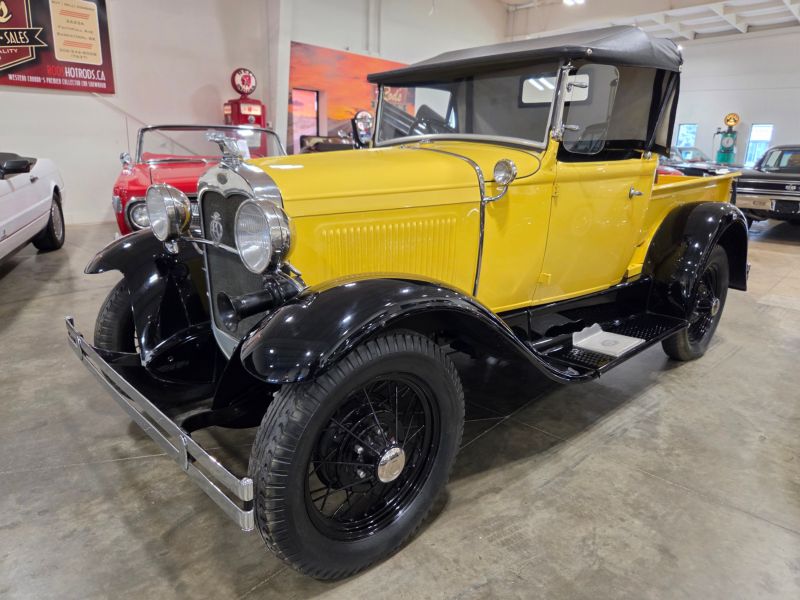
The third number is the 180-A, the De Luxe Phaeton, introduced in June 1930. Briggs built it, and the builder's tag carries the prefix 159, not 180. That gap between Ford's style number and the body maker's tag number trips up a lot of first-time buyers. Ford's number describes the style; the tag tells you which plant and which supplier made the shell.
| Model year | Phaeton list price | Roadster list price | De Luxe Phaeton |
|---|---|---|---|
| 1928 | $395 | $385 | not offered |
| 1929 | $440 | $435 | not offered |
| 1930 | $440 | $450 | $625 |
| 1931 | $435 | $430 | $580 |
All prices are factory list, f.o.b. Detroit, without accessories. The standard phaeton stayed within $10 of the roadster every year, which says something about how Ford priced it: as the roadster's practical sibling, not as a step up.
What changed in 1930
The 1930 restyle reached every Model A, and the phaeton took all of it. The hood and radiator were raised, the radiator shell became stainless steel, and a higher cowl made room for a larger fuel tank. Wheels dropped from 21 inches to 19 inches with wider tires, which lowered the whole car. One change belonged to the open cars alone: the roadster and the phaeton gained fold-down windshields.
Those details are how you date a body at a glance. A tall, narrow radiator and the big 21 inch wheels mark a 1928 or 1929 35-A. A brighter radiator shell, a higher hood line and the smaller wheels mark the 1930 and 1931 35-B. On a car that has been through several owners, check that the body and the front sheet metal agree. Mixed parts are common, and a 1929 body under 1930 sheet metal does not fit as neatly as the seller may claim.
The De Luxe Phaeton, 1930 to 1931
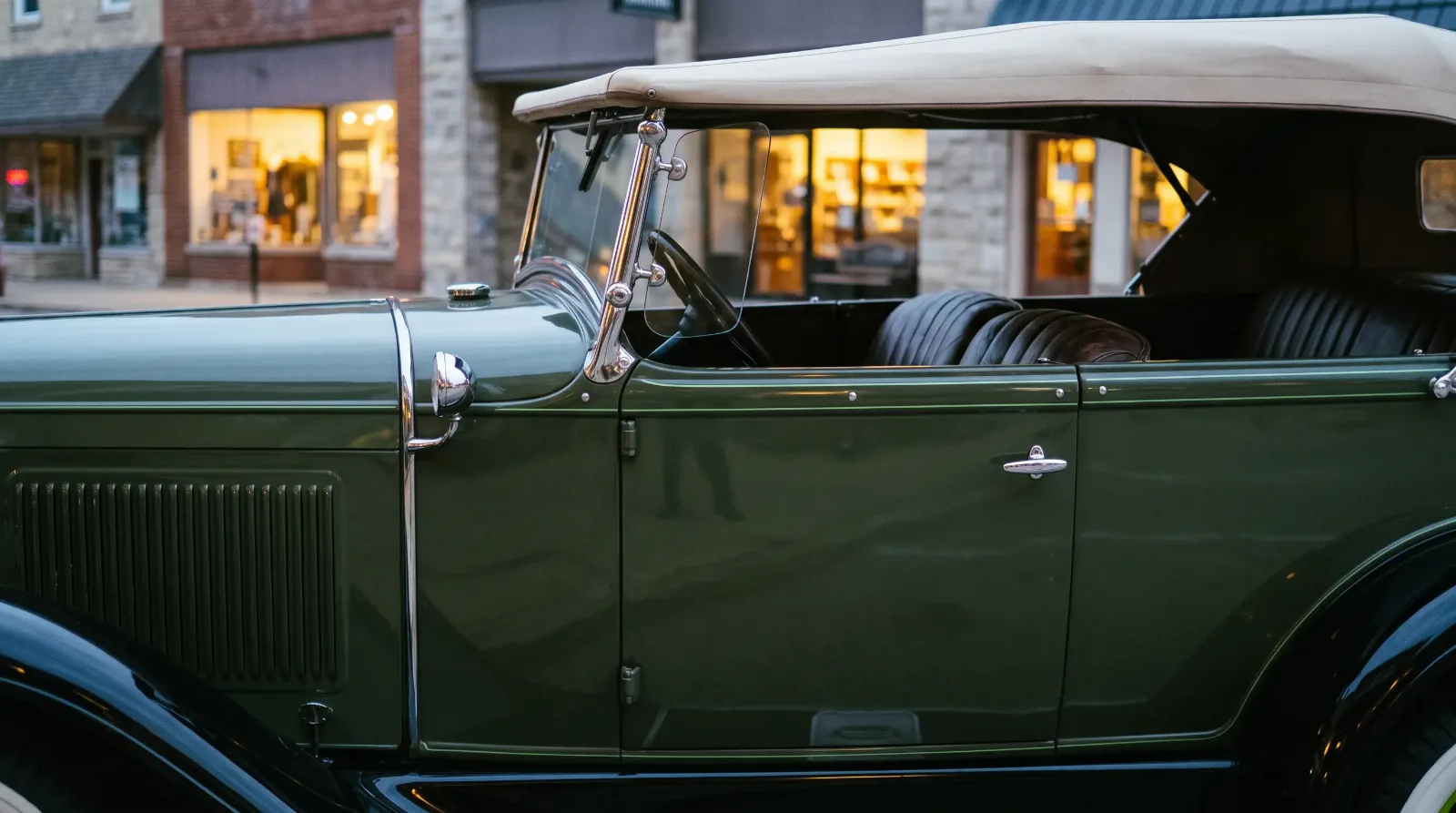
The De Luxe Phaeton is the car most people picture when they hear the name now, and it is not the same body as the standard car. It is a sporty two-door phaeton with a lower top and windshield line, built by Briggs and offered only in 1930 and 1931. Ford priced it at $625 in 1930 and $580 in 1931, roughly $145 to $185 above the standard phaeton, and in the same bracket as the cabriolet.
That comparison is worth making, because the two cars answered the same buyer from different directions. The phaeton gave a family open air with side curtains; the cabriolet gave a couple roll-up windows and a padded top. The De Luxe Phaeton split the difference in style, if not in comfort.
It was also rare when new. Auction and museum records put US production at 3,946 in 1930 and 2,229 in 1931, counted by calendar year. Collector forums add a few hundred more each year from Ford's plants abroad, but those counts have no published Ford source behind them. The Henry Ford's record for its own 1930 car states that 16,470 open phaetons were sold that year, out of nearly 1,160,000 Model As. Even allowing that the two counts may not share a basis, the open four-seater was a small slice of the Model A business by 1930.
"A phaeton tells you what it is through its numbers before it tells you anything through its paint. Read the style number, read the body tag, and if the two do not belong to the same car, you have learned the most important thing about it."
Sarah Whitfield
Reading a Ford Model A phaeton that survives
For a judge or a careful buyer, originality on a phaeton comes down to four things. The first is the body identity: 35-A, 35-B or 180-A, with the tag that matches. The second is the windshield, which should be the fixed type on a 1928 or 1929 car and the fold-down type on 1930 and 1931 cars. The third is the top and side curtain hardware, which is easy to lose and expensive to recreate correctly. The fourth is paint.
Paint on an open car follows the club chart for phaetons and roadsters, which is laid out by body group and year, with separate columns for upper body, lower body, reveal, molding and stripe. Copra Drab, for example, appears on the 1928 phaeton and roadster listing and again on 1930 and 1931 cars, but not on 1929 entries. Tacoma Cream striping appears on 1931 phaetons and roadsters from July 1931. A restorer who copies a color from a coupe photograph can be correct for the coupe and wrong for the phaeton.
The record that matters most survives on paper: the body tag, any dealer documents, and photographs from before restoration. The Henry Ford's 1930 touring car shows a related problem with documents. Its catalog lists a price of $645, while Ford's own list price for a standard 1930 phaeton was $440. The museum figure most likely includes accessories. Period numbers are evidence, and they still have to be checked against the factory list.
Market data for the standard phaeton is thinner than for Tudors and coupes, simply because fewer were built and fewer survive. One reference point: a restored 1928 phaeton sold for $15,000 at Mecum in 2016, the same figure as a restored 1928 Tudor at that sale. That tells you the open body did not command a large premium at the time. The De Luxe Phaeton is a different market: a restored 1930 example from the Jeffrey Day collection sold for $52,250 at RM Sotheby's Hershey sale in 2014. Current values should be checked against recent sales before anyone quotes a figure.
The reason to own one has little to do with price. A phaeton is a family car built on the old open pattern, at a time when Ford's buyers were moving into closed bodies, and it carries its history in plain view: the curtains, the folding windshield on a later car, the style number stamped where it should be. Start with the paperwork, then look at the car.
Sources and notes
Related Reading
Have a
Ford Model A
for Sale?
Reach thousands of serious classic car collectors across the US.
Sell It Here →
Selling a classic? Here's how: compare the places to sell classic cars
Are You a Classic Car Dealer?
List your full inventory and connect with targeted classic car buyers.
Join as a Dealer →

About the author
Sarah Whitfield
Third-generation classic car collector specializing in pre-war American and European coachbuilt automobiles. Researcher and concours enthusiast.
Related Listings - Ford Model A




Comments
Be the first to comment on this article.