
Ford sold two Model A body styles that let a buyer lower a real folding top and still wind up glass windows: the Model A cabriolet, from 1929, and the Convertible Sedan, which arrived in May 1931 as the last body style added to the line. They look alike at a distance, and they are often confused at shows. Up close they are different cars, built by different body suppliers, for different buyers. This piece sorts out the codes, the construction and the details a judge looks at, rather than retelling the whole Model A story.
Car Features
7 min read
Model A Cabriolet and Convertible Sedan
The Model A cabriolet (68-A, 68-B, 68-C) and the 1931 Convertible Sedan (400-A): codes, builders, prices and how to tell them apart.
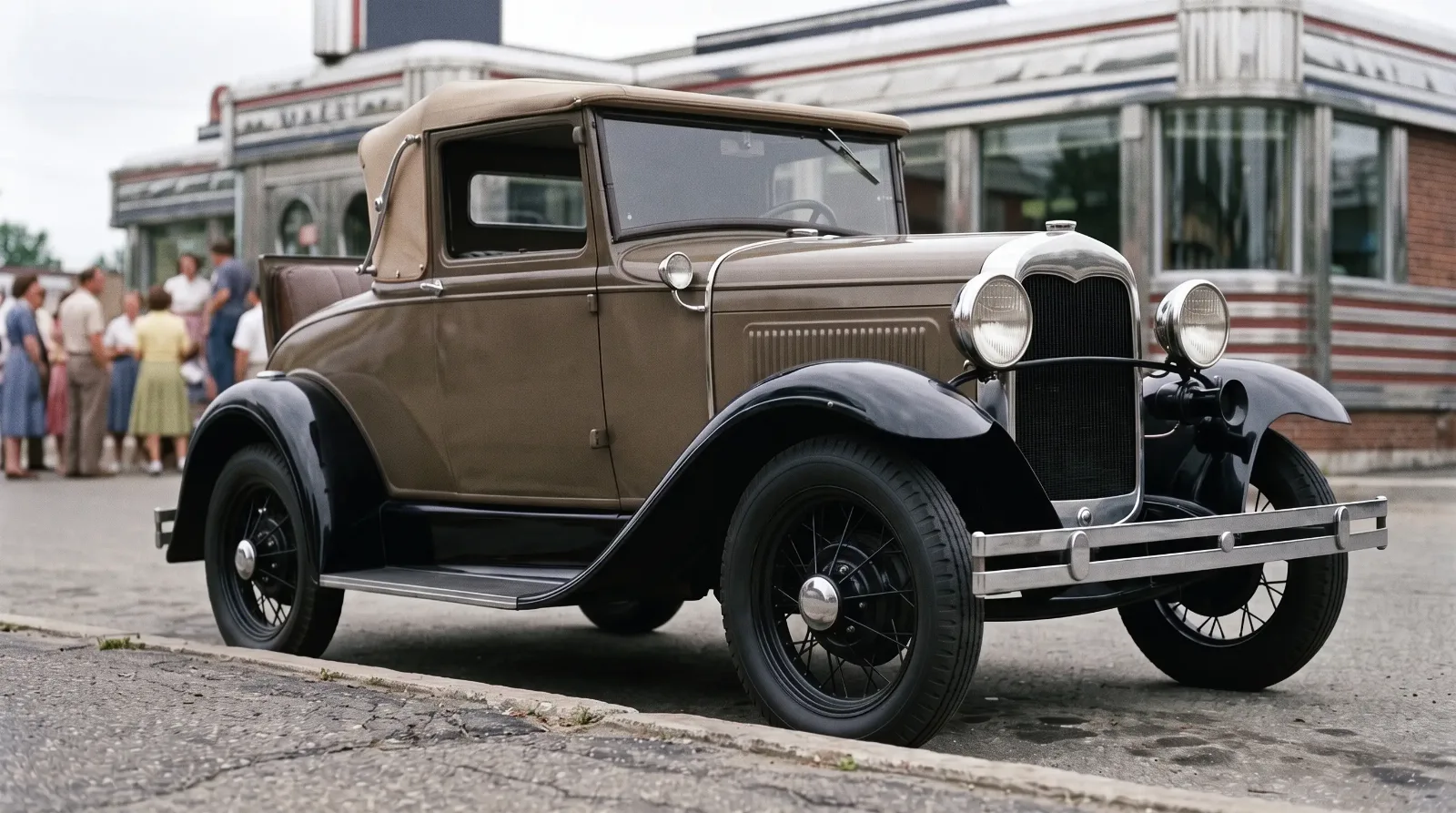
For the full family of closed and open bodies, the parent guide to Model A body styles has the details. Here the focus is narrower: what made these two convertibles different from the roadster and phaeton, and from each other.
What the Model A cabriolet was
The cabriolet is a convertible coupe. It has a real folding top, a fixed windshield, roll-up glass in the doors and folding door posts. It seats two inside, with two more in the rumble seat. The landau irons on the top are all chrome, and unlike the Sport Coupe it carries no sun visor over the windshield.
That list matters because the roadster did things differently. The roadster used side curtains for weather protection. The cabriolet added roll-up windows and the fixed windshield, which made it a car you could drive in the rain without assembling anything. In 1929 that convenience cost $645, against $435 for a roadster.
The Sport Coupe is the other source of confusion. It had a fixed roof covered in fabric, decorative landau irons and a sun visor, and was styled to look like a cabriolet. Its top does not fold. The Sport Coupe outsold the cabriolet by a wide margin over the four years, so a "cabriolet" at a swap meet deserves a second look at the top frame before anyone takes the seller's word for it.
Cabriolet body codes: 68-A, 68-B and 68-C
Every cabriolet body was built by Briggs. Ford's style number family is 68, in three versions, and each one also carries a different Briggs tag prefix. Reading both numbers is the first step in judging originality.
| Body | Ford style | Builder and tag prefix | Introduced | US list price |
|---|---|---|---|---|
| Cabriolet | 68-A | Briggs, 194- | March 1929 | $645 (1929) |
| Cabriolet | 68-B | Briggs, 161- | 1930 (built into 1931) | $625 (1930) |
| Cabriolet, slant windshield | 68-C | Briggs, 138- | May 1931 | $630 (1931, MAFCA) |
| Convertible Sedan | 400-A | Murray, 400A | May 1931 | $640 (1931) |
The 1931 cabriolet price is not settled. MAFCA lists $630; another 1931 price list gives $595. Neither source dates its figure, so a mid-year price cut is possible but unproven. Production is easier to pin down for the later years. LeMay, America's Car Museum, gives 25,068 cabriolets for 1930. For 1931 the Standard Catalog of American Cars gives 11,801, and Jim Schild's Original Ford Model A splits that into 4,959 of the 68-B and 6,842 of the 68-C. I have not found a 1929 figure from a source I would stand behind, so I leave it out.
The 68-C is the late car. It took the slanted windshield that Ford used on the 1931 Victoria and the 160-series Fordors, and it is the cabriolet most collectors picture first. If you want to know how that windshield changed the look of the closed cars, our article on the slant windshield follows it through the Fordor line.
The 1931 Convertible Sedan, body 400-A
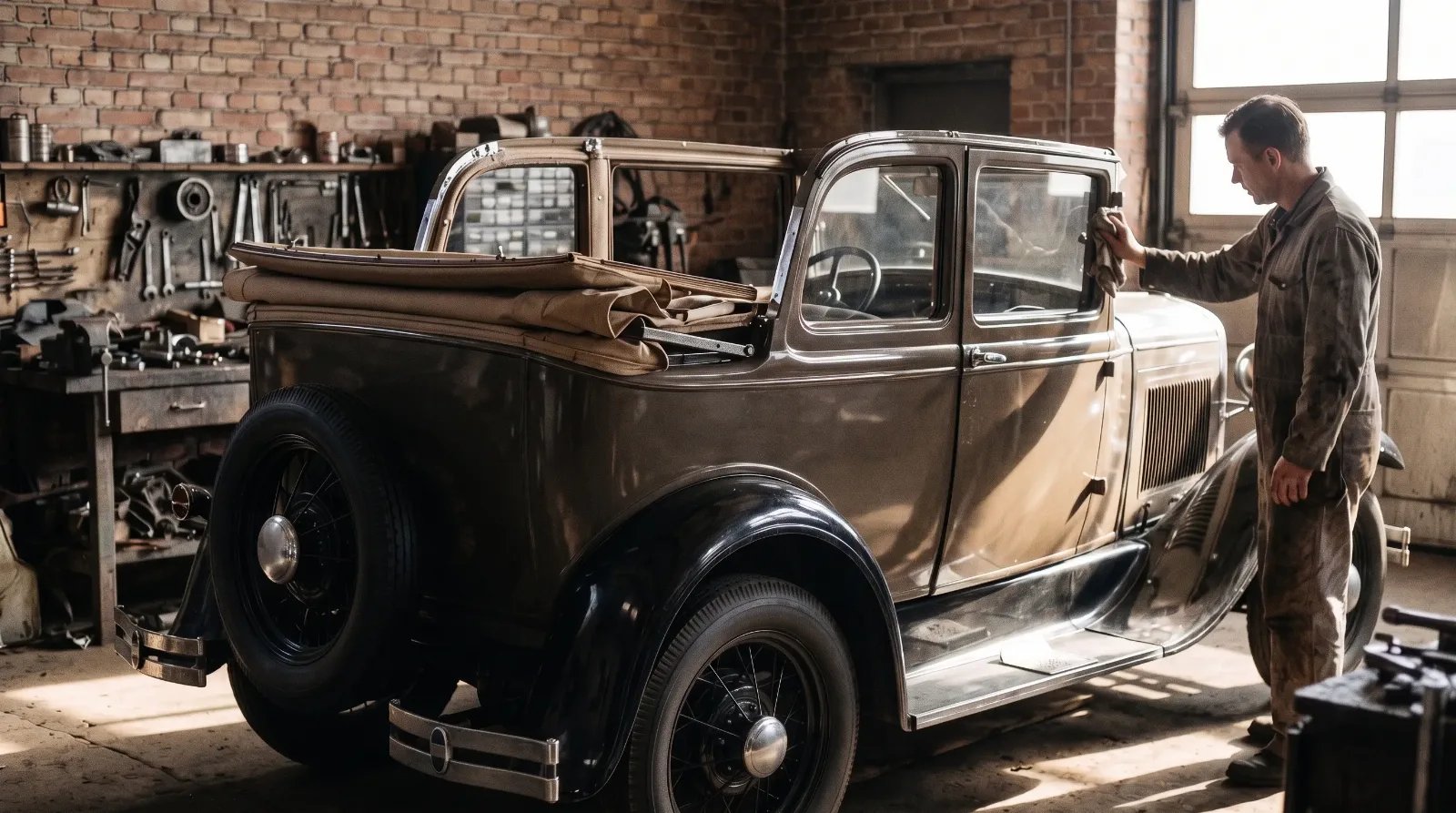
The Convertible Sedan was Ford's last new Model A body. Ford's style number is 400-A, which enthusiasts usually turn into "A400". Production started on May 22, 1931, and the car went on public sale in June. At $640 it was the most expensive standard Model A of 1931.
Murray held the main body contract, and the body was designed by the Murray stylist Amos Northup. The construction is unusual. The car has two doors. The front door glass frames are fixed to the doors, and the rear quarter window frames are part of the body, so when the top is folded the window frames stay up and leave a long top rail running the length of the car. Ford's own claim was that this arrangement "eliminates entirely all rattles". That is advertising language, but the design logic is sound: fixed frames give the top something rigid to seal against.
It shares parts with its closed sibling. The same door window channel retainer was used on the Victoria 190-A and the Convertible Sedan 400-A, which tells you how closely Murray's 1931 bodies were related under the skin.
Production is usually given as 5,085, of which 208 were built at Ford plants abroad. Other figures circulate, including 4,864 and 5,007, and one supplier simply says "just over 5,000". You will also see survival counts quoted for the 400-A; none of them comes with a registry behind it, so I would not repeat one.
"On a 400-A, the fixed window frames are the signature. A Convertible Sedan with its frames missing has lost the one feature that made Murray's body different from every other open Model A."
Sarah Whitfield
Telling them apart on the show field
The two cars answer different questions. The cabriolet is a two-seat car with a rumble seat, built by Briggs from 1929. The Convertible Sedan is a sedan, with its rear seat inside the body, built by Murray only in 1931. Both have roll-up glass; only the Convertible Sedan keeps its window frames standing with the top down.
Paint details also differ by month. On the MAFCA chart the Convertible Sedan changed its stripe in July 1931, and the cabriolet changed after June 1931, both moving to Tacoma Cream. A restorer who matches the stripe to the build date is doing the job properly; one who picks the stripe by taste is not.
Where they sit in the Model A story
Both cars belong to the later Model A, when Ford stopped selling one simple car and began offering a wide catalog of bodies at different prices. By 1931 the line ran from $430 for a roadster to $640 for the Convertible Sedan. That spread is a long way from the one-model thinking that defined the earlier car; the story of the Model T and Henry Ford explains how the company got from there to here.
For a collector in 2026 the practical point is documentation. Body tags, style numbers and stripe colors are the evidence. A cabriolet or Convertible Sedan with matching tags and period-correct details is an artifact of the coachbuilding trade that supplied Ford. One without them is a pleasant open car of uncertain history.
Sources and notes
- Mac's Motor City Garage: Model A Sport Coupe and Cabriolet, mistaken identities
- Mac's Motor City Garage: Ford's unconventional 1931-32 Convertible Sedans
- MAFCA: Model A new car prices by year
- MAFCA: Model A paint by year and body style
- Popular Restorations: Model A cabriolet body types and 1931 production
- Conceptcarz: 1931 Ford Model A Convertible Sedan
Related Reading
Have a
Ford Model A
for Sale?
Reach thousands of serious classic car collectors across the US.
Sell It Here →
Selling a classic? Here's how: sell my classic car
Are You a Classic Car Dealer?
List your full inventory and connect with targeted classic car buyers.
Join as a Dealer →

About the author
Sarah Whitfield
Third-generation classic car collector specializing in pre-war American and European coachbuilt automobiles. Researcher and concours enthusiast.
Related Listings - Ford Model A




Comments
Be the first to comment on this article.