
Of all the bodies Ford put on the 103.5 inch Model A chassis, one was built for a driver who was not the owner. The Ford Model A Town Car, style 140-A, carried an open front compartment for a chauffeur and a closed, upholstered cabin behind a glass partition for the people being driven. It was the most expensive car on the Model A price list, it lasted barely two model years, and it remains the body style that tells you most about how far Ford was willing to stretch a single chassis. This is a close reading of what the ford model a town car was, who built it, how it was trimmed, and why so few were made.
Car Features
8 min read
The Ford Model A Town Car
Style 140-A, a Briggs body, an open chauffeur seat and a $1,200 price: the Ford Model A Town Car lasted two years and about 1,200 cars.
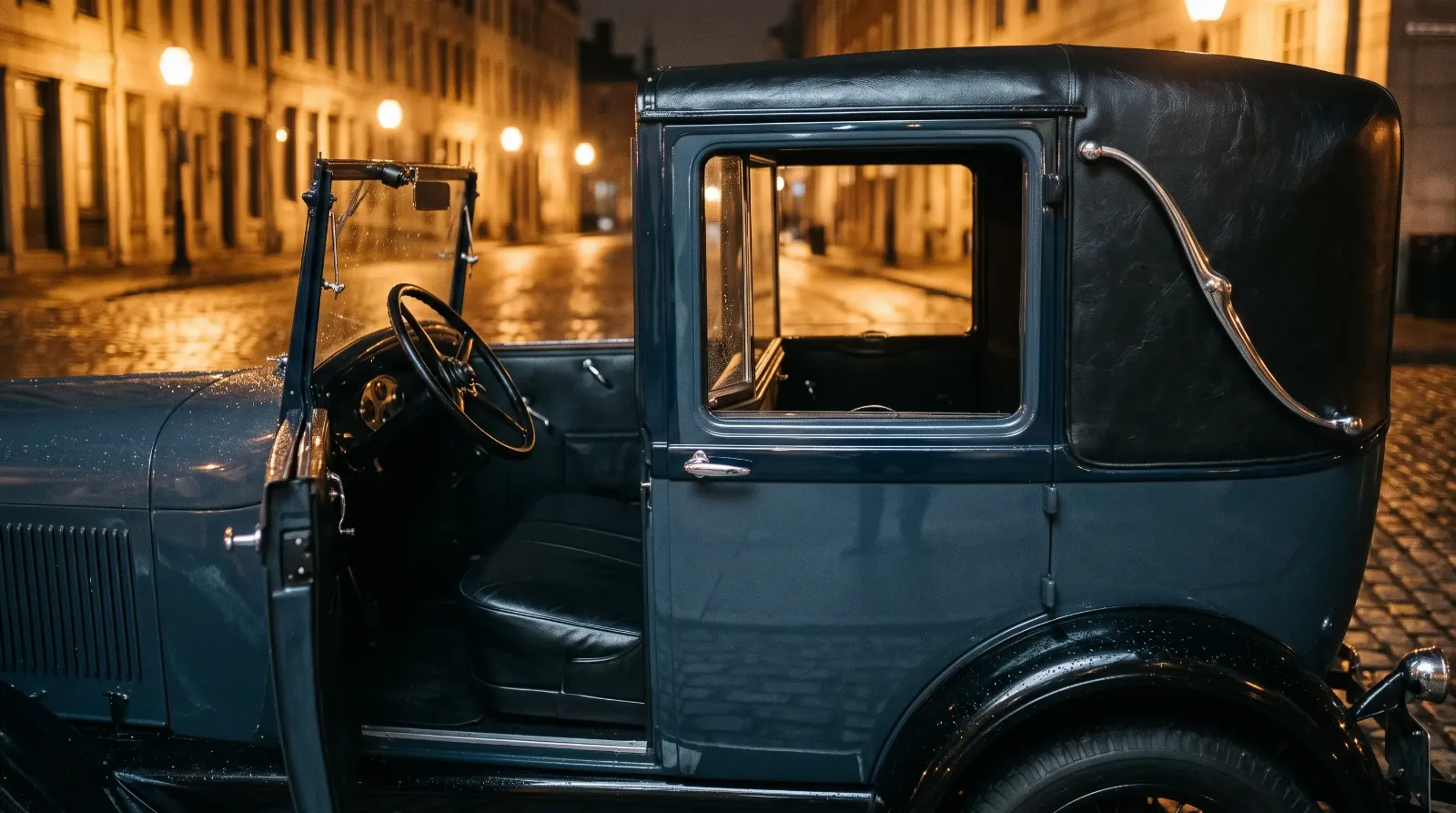
A formal body on a four-cylinder chassis
The town car layout was an old coachbuilding idea by 1929. The driver sat out in the weather, or nearly so, while the passengers rode enclosed. Ford had offered a Town Car body on the Model T as early as the 1909 model year, and early town cars of that era were often painted green. The Model A version revived the name for a very different market, and it did so without any mechanical changes.
Underneath, the Town Car was a standard Model A. It used the same 200.5 cubic inch four, rated at 40 hp, the same three-speed gearbox and the same 103.5 inch wheelbase as a Tudor or a roadster. Everything that set it apart was above the frame rails: the body, the trim and the fittings. For readers who want the whole family of bodies in one place, the full story sets the Town Car beside every other style Ford catalogued.
"The chassis was ordinary on purpose. What Ford sold with the Town Car was the body, and the body is where the evidence lives."
Sarah Whitfield
Style 140-A: Briggs and the body numbers
Ford assigned the Town Car style number 140-A, with a later 140-B variant. The body itself came from Briggs Manufacturing of Detroit, and Briggs stamped its own tag prefix, 193-, on the bodies it supplied. That double numbering matters to anyone authenticating a survivor. The Ford style number and the builder's tag are different series, and a correct Town Car should carry both in their proper form.
Briggs had become the largest independent body builder in the country during the 1920s, and its share of Model A work included the two-window Fordors, most of the coupes, the cabriolets, the Taxi, the Deluxe Phaeton and the Town Car. The more utilitarian the wood wagon went to Murray instead, a reminder that Ford spread its body contracts by type rather than by price.
| Item | Ford Model A Town Car |
|---|---|
| Ford style number | 140-A (also 140-B) |
| Body builder | Briggs Manufacturing, Detroit (tag 193-) |
| Model years | 1929 and 1930 |
| List price, 1929 and 1930 | $1,200 FOB Detroit |
| Approximate production | About 1,000 in 1929, about 200 in 1930 |
| Engine | 200.5 cu in four, 40 hp, three-speed |
| Wheelbase | 103.5 in |
Coachwork and trim in detail
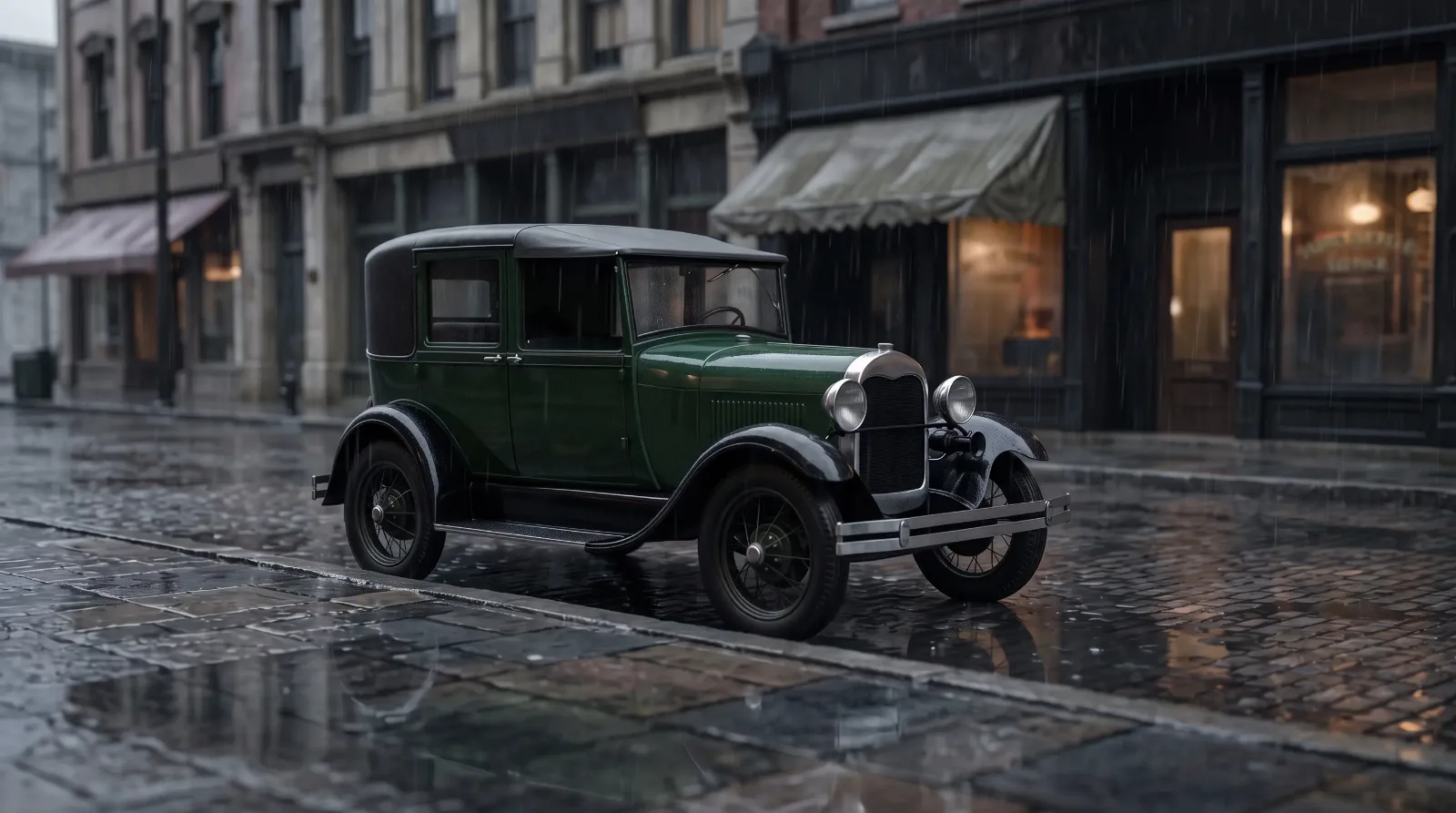
The front compartment was finished in black leather and protected only by a snap-in top. The rear cabin was the opposite in spirit: closed, upholstered in French broadcloth or Bedford cord, and separated from the driver by a glass partition. Over the rear passengers the roof was covered in leather in the landau manner, the visual signature of a formal car in the late 1920s.
One structural detail is easy to miss and important to a researcher. The Town Car used a straight cowl, a form not seen on other Fords until 1930. On a 1929 car that cowl shape is a period clue, not a later modification, and it is one of the points to confirm when comparing a survivor to factory photographs.
Ford also fitted what it called "accoutrements": a vanity case and notebook, a clock and an electric cigarette lighter. These small pieces are the easiest parts of a Town Car to lose over nine decades, and the hardest to source correctly. A car that still has its original fittings is a different artifact from one that has been dressed with reproductions, however good.
The price ladder and why the Town Car stalled
The club price table, drawn from Floyd Clymer's records, lists the Town Car at $1,200 in both 1929 and 1930, and shows no Town Car for 1928 or 1931. Set against the rest of the 1929 list, that figure is striking. A Roadster cost $435, a Tudor $500, a Fordor $600 and the Town Sedan $670. The Town Car cost close to three Roadsters. Secondary sources quote higher figures for the same car, and one auction house puts its launch in 1928; the club table is the more conservative and better documented record, and it is the one used here.
If the four-door Fordors are your reference point, the Tudor and Fordor naming is explained here; the gap between those family sedans and the Town Car was not a matter of doors but of purpose.
Production began late in 1928 for the 1929 model year. Records for the FG-series body run from January 1929 to February 1930. Output was about 1,000 cars in 1929 and about 200 in 1930, when the style ended. Both are round figures, and a more precise count of 1,065 that circulates among enthusiasts could not be confirmed.
The usual explanation for its short life is that it pleased no one fully. A wealthy buyer who wanted a chauffeur-driven car had grander choices than a 40 hp four-cylinder Ford. An everyday Ford buyer had no chauffeur and no reason to pay twice the price of a Fordor. Demand dried up quickly, and some Town Cars ended their working lives as taxicabs, which is a plain enough verdict on the formal pretensions of the body.
Studying a Ford Model A Town Car in 2026
With roughly 1,200 built across two seasons, survivors are scarce, and each one should be read as a document. The questions a concours researcher asks are straightforward, even if the answers take time.
The open front compartment deserves particular attention. Black leather left exposed with only a snap-in top ages faster than anything inside the car, and many survivors will have had the chauffeur's seat redone. That is not a fault in itself. What matters is whether the work follows the original pattern and material, and whether the restorer documented what was found.
The landau roof is the other weak point. Leather over a wooden frame suffers from water, and a sagging or replaced roof covering can hide frame repairs underneath. A correct restoration keeps the proportions of the landau section, which define the car's profile from the side.
Value questions are best left to the auction record for each individual car, which is thin given the numbers built. What can be said with confidence is that the Town Car's interest lies in its coachwork and its fittings, not its mechanicals. Two cars with identical engines can differ enormously as historical objects depending on how much of the Briggs body and the original trim survives.
The Town Car was a small experiment in reach. Ford took a chassis designed to carry farmers, salesmen and families, and asked whether it could also carry a chauffeur and a pair of passengers behind glass. The answer, measured in roughly 1,200 sales, was no. Yet the experiment left a body style that shows the Model A at its most formal, and a set of details (the straight cowl, the landau roof, the broadcloth cabin, the small fitted accessories) that a careful eye can still verify on the cars that remain.
For a researcher, that is the appeal. The Ford Model A Town Car is a short, well bounded chapter: two years, one body builder, one style number with a single variant, and a modest production count. Few corners of the Model A story are so clearly defined, and few reward close study so directly.
Sources and notes
- Mac's Motor City Garage: A rolling contradiction, the Ford Model A Town Car
- MAFCA: Model A prices when new, from Floyd Clymer
- The Henry Ford: 1929 Ford Model A Town Car factory photograph
- Christie's: 1929 Ford Model A Town Car lot notes
- Wikipedia: Briggs Manufacturing Company
- Old Cars Weekly: 1909 Ford Model T body styles and colors
Related Reading
Have a
Ford Model A
for Sale?
Reach thousands of serious classic car collectors across the US.
Sell It Here →
Selling a classic? Here's how: the best sites to sell a classic car
Are You a Classic Car Dealer?
List your full inventory and connect with targeted classic car buyers.
Join as a Dealer →

About the author
Sarah Whitfield
Third-generation classic car collector specializing in pre-war American and European coachbuilt automobiles. Researcher and concours enthusiast.
Related Listings - Ford Model A
Comments
Be the first to comment on this article.