
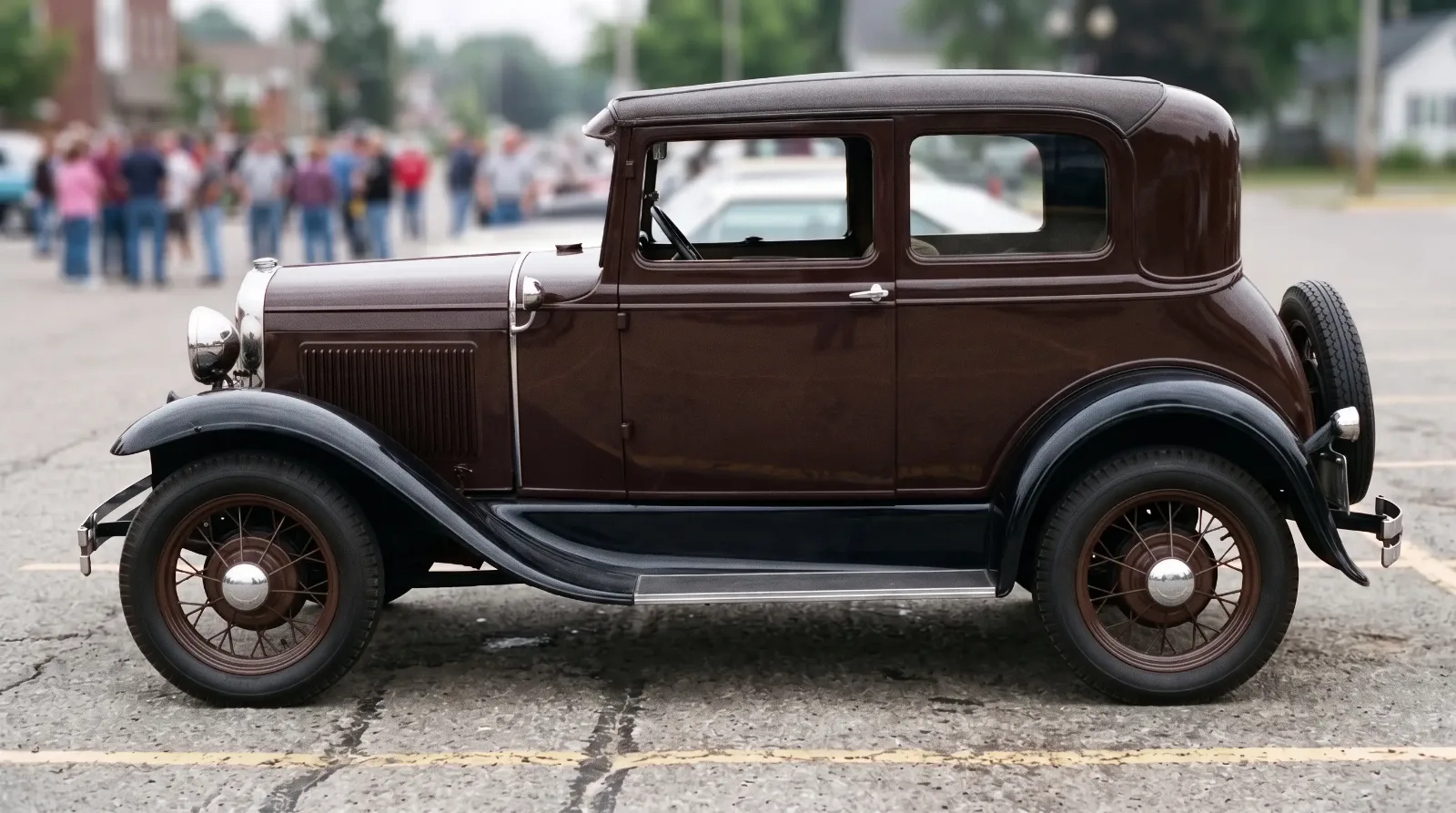
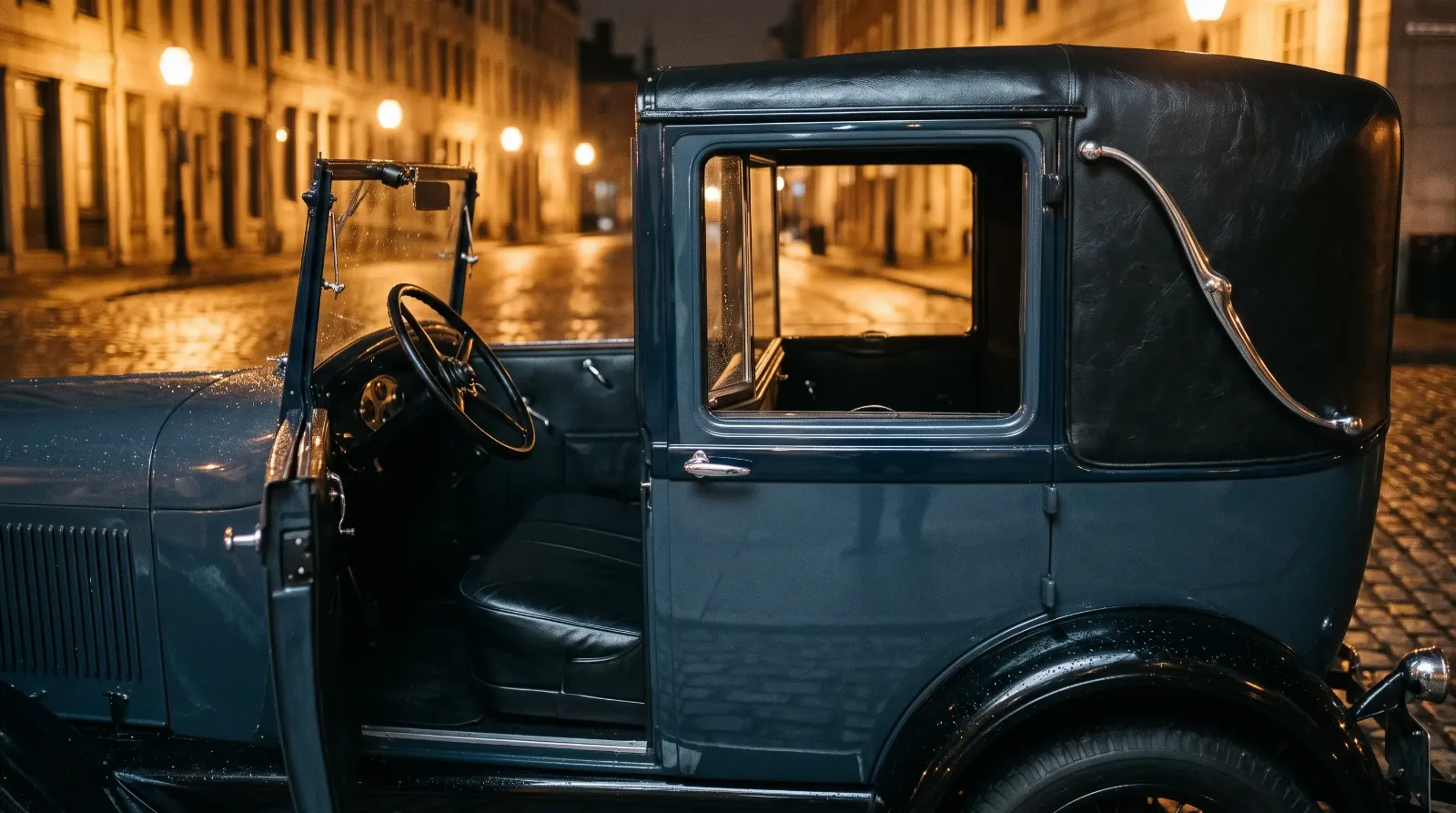
Seen in profile, the Ford Model A Victoria gives itself away at both ends. At the front the windshield leans back and wears no visor. At the rear the body swells into a bustle, a rounded trunk space carried inside the body line rather than bolted on behind it. Between the two, the roofline sits low. It arrived late in the program, in November 1930, and it was built for less than a year. That short run, and a change of materials partway through it, make the Victoria one of the more rewarding Model As to study closely.
Car Features
6 min read
The Ford Model A Victoria
The 190-A Victoria of November 1930: bustle back, visorless slanted windshield, Murray body, leatherback or steel back, and about 40,000 built.
Where the Victoria fits among the coupes, sedans and open cars is covered in our guide to Ford Model A body styles. This piece concentrates on the car itself: its design, its builder, the two versions of its rear quarters, and the figures that survive.
The Ford Model A Victoria at introduction
Ford introduced the Victoria in November 1930 as one of five new body styles that year. Its Ford style number is 190-A. It listed at $580 in both 1930 and 1931, FOB Detroit.
That price placed it carefully in the range. In 1931 the Victoria cost more than the Tudor at $490 and the De Luxe Tudor at $525, and less than the Fordor at $590 and the De Luxe Fordor at $630. Ford was selling a closed car with a two-door body and a style premium, priced just below its four-door sedans.
| Item | Ford Model A Victoria |
|---|---|
| Ford style number | 190-A |
| Introduced | November 1930 |
| Body builder | Murray (US, tag 190A); CT&BC in Canada |
| US list price | $580 (1930 and 1931) |
| Engine | 200.5 cu in four, 40 hp |
| Transmission | Three-speed |
| Wheelbase | 103.5 in |
| Production | About 6,300 to 6,400 in 1930; roughly 40,000 in all |
Mechanically there was nothing special underneath. The Victoria used the same 200.5 cubic inch four of 40 horsepower and the same three-speed gearbox as every other Model A, on the standard 103.5 inch wheelbase.
Design: bustle back, slanted glass and a lower roof
The Victoria's styling is a set of related decisions rather than a single feature. The sources list four: a bustle back for luggage behind the rear seat, a lower roofline, a slanted windshield with no visor, and a lowered steering column. The four belong together: a lower roof leaves less headroom, and a lowered column suits a driver sitting lower in the car.
Access to the rear seat came through folding front seats, since the Victoria had only two doors. That puts it in the same practical family as the Tudor, yet the profile is entirely different, with the luggage space drawn into the body behind the passengers.
The slanted windshield links the Victoria to the 1931 cars that followed it. The 1931 slant-windshield Fordors and the 68-C Cabriolet used the same idea, and the Victoria shares at least one part with the 400-A Convertible Sedan: the same door window channel retainer was used on both.
Leatherback and steel back: the mid-run change
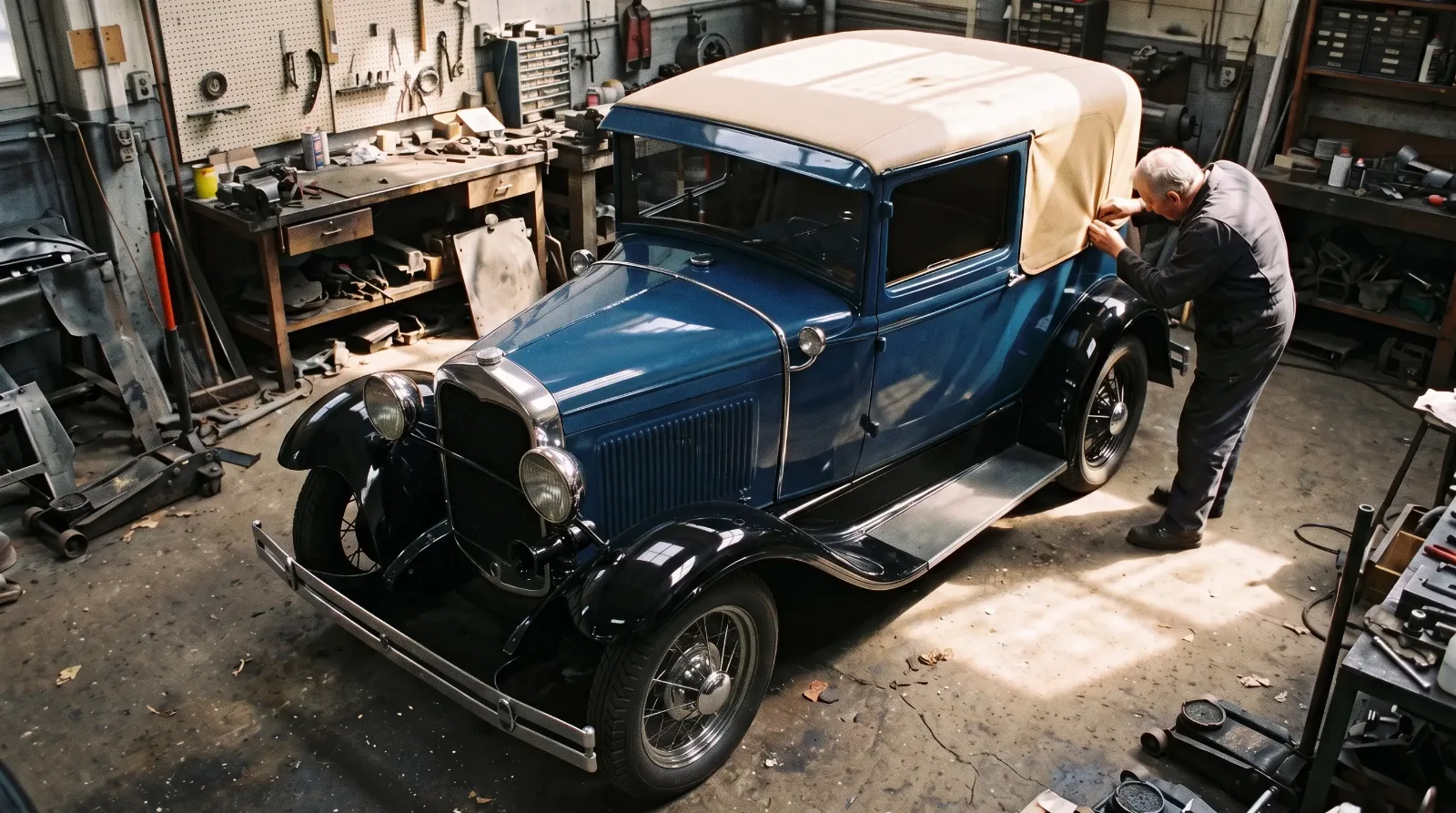
For collectors, the most important fact about the Victoria is that there are two kinds. The early cars had fabric-covered rear quarters, the treatment Murray called the "leather-back." In February 1931, after body number 28185, Murray changed to an all-steel rear.
The sources mostly agree that Murray built the 190-A bodies, and the builder's tag reads 190A. One auction catalog says the cloth-top cars came from Briggs and only the steel-top cars from Murray, but the body-tag chart and a second catalog both credit Murray with the leatherback, and that is the stronger reading. Canadian Victorias carried bodies from CT&BC.
"With a Victoria, the body number is the first document I want to see. It tells you whether the car should have a leatherback or a steel back, and a car that has been converted from one to the other is a different object from the one Ford sold."
Sarah Whitfield
How many were built, and why the figures differ
No primary Ford production figure for the Victoria turned up in the sources we checked, and the two auction-house figures disagree. One catalog gives 6,447 built in late 1930 and nearly 37,000 delivered by August 1931. Another gives 6,306 for the 1930 model year and 40,212 in all. The difference may come from counting calendar year against model year, and neither source cites Ford's records. The fair summary is about 6,300 to 6,400 in 1930 and roughly 40,000 in total.
The August 1931 date matters too. One of those catalogs says US Model A production wound down that month, which helps explain why the Victoria's run was so short. The Model A body catalog ended with the 1931 model year.
The Victoria among its closed-car siblings
Against the Tudor's more than 1.3 million, roughly 40,000 Victorias is a small number. It makes the car scarcer on the road and at shows, though not rare in the way of the most limited bodies. The 140-A Town Car, at about 1,000 built in 1929 and about 200 in 1930, is far scarcer, and it came from a different idea of luxury altogether: an open chauffeur's compartment and a closed rear cabin. Our piece on the Town Car covers that one.
The Victoria's appeal is of another kind. It brought lower lines, slanted glass and luggage built into the shape of the car to a Ford that cost $580. For a collector, that combination, together with a documented body number that settles the leatherback question, is what makes a Victoria worth seeking out.
Sources and notes
- Ford Garage: US Model A body style numbers and builders, 1928 to 1931
- RM Sotheby's: 1931 Ford Model A Victoria (Hershey 2011)
- RM Sotheby's: 1930 Ford Model A Victoria (Hershey 2022)
- RM Sotheby's: 1931 Ford Model A Victoria by Murray
- Model A Ford Club of America: new car prices, 1928 to 1931
- Mac's Motor City Garage: the Ford Model A Town Car
Related Reading
Have a
Ford Model A
for Sale?
Reach thousands of serious classic car collectors across the US.
Sell It Here →
Selling a classic? Here's how: compare the places to sell classic cars
Are You a Classic Car Dealer?
List your full inventory and connect with targeted classic car buyers.
Join as a Dealer →

About the author
Sarah Whitfield
Third-generation classic car collector specializing in pre-war American and European coachbuilt automobiles. Researcher and concours enthusiast.
Related Listings - Ford Model A
Comments
Be the first to comment on this article.