
A latch at the header, a press of a switch, and the power top folds back with its glass rear window riding down inside it. At a Fox body cruise night the owners of the early convertibles do this without thinking, the way other people glance at the time. Few people in the crowd remember that for nine model years you could not do it in a new Mustang at all. The fox body Mustang convertible arrived for 1983, and with it came the first open Mustang Ford had sold since 1973.
Car Features
7 min read
The Convertible Returns in 1983
After nine model years without one, the Fox body Mustang convertible arrived for 1983. How it came back, what Ford built, and what is still unclear.
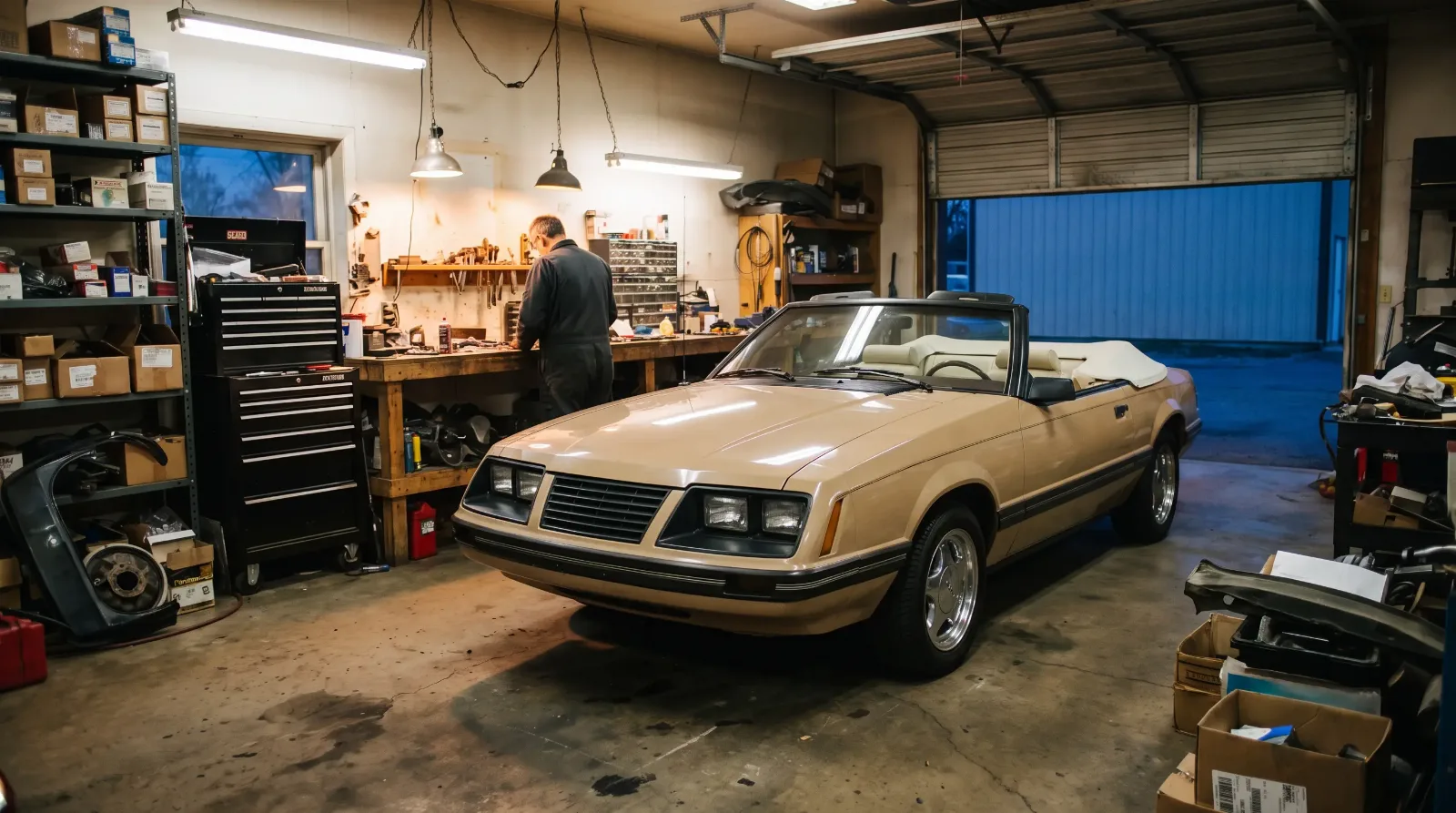
That return is the story here: why the top went away, how it came back, what Ford actually built in that first year, and who did the cutting. For the platform underneath it and the rest of the 1979 to 1993 run, the place to begin is the Fox-platform Mustang as a whole.
Nine years without a top
The 1973 convertible was the last open car of the first generation, and nothing with a folding roof followed it. The Mustang II came and went without one. When the Fox Mustang arrived for 1979, it came as a notchback or a hatchback, lighter and cleaner than the car before it, and still closed. The nearest thing to open air was the T-top, which joined the options list for 1981.
The explanation usually given for the long gap is that Detroit expected federal rollover rules to make convertibles impractical to build. The fear was real: Washington proposed new rollover protection standards in 1971, and through the mid-1970s the American makers dropped their open cars one after another. But it is only half the story. The roof-strength rule that eventually took effect applied to fixed-roof cars and left convertibles out, and open-car sales had been sliding since the 1960s as air conditioning, sunroofs and T-tops gave buyers other ways to feel the weather. Regulation spooked the industry; many customers had already wandered off. What is not in doubt is the absence itself. A whole generation of buyers came of age with the Mustang as a hardtop.
So when the convertible came back, it came back to people who remembered. The ones who had owned a 1966 with a white top, or wanted one and could not afford it, were now in their thirties with jobs and garages. The car Ford handed them was not the car they remembered, and in some ways that was the point.
How the fox body Mustang convertible came back
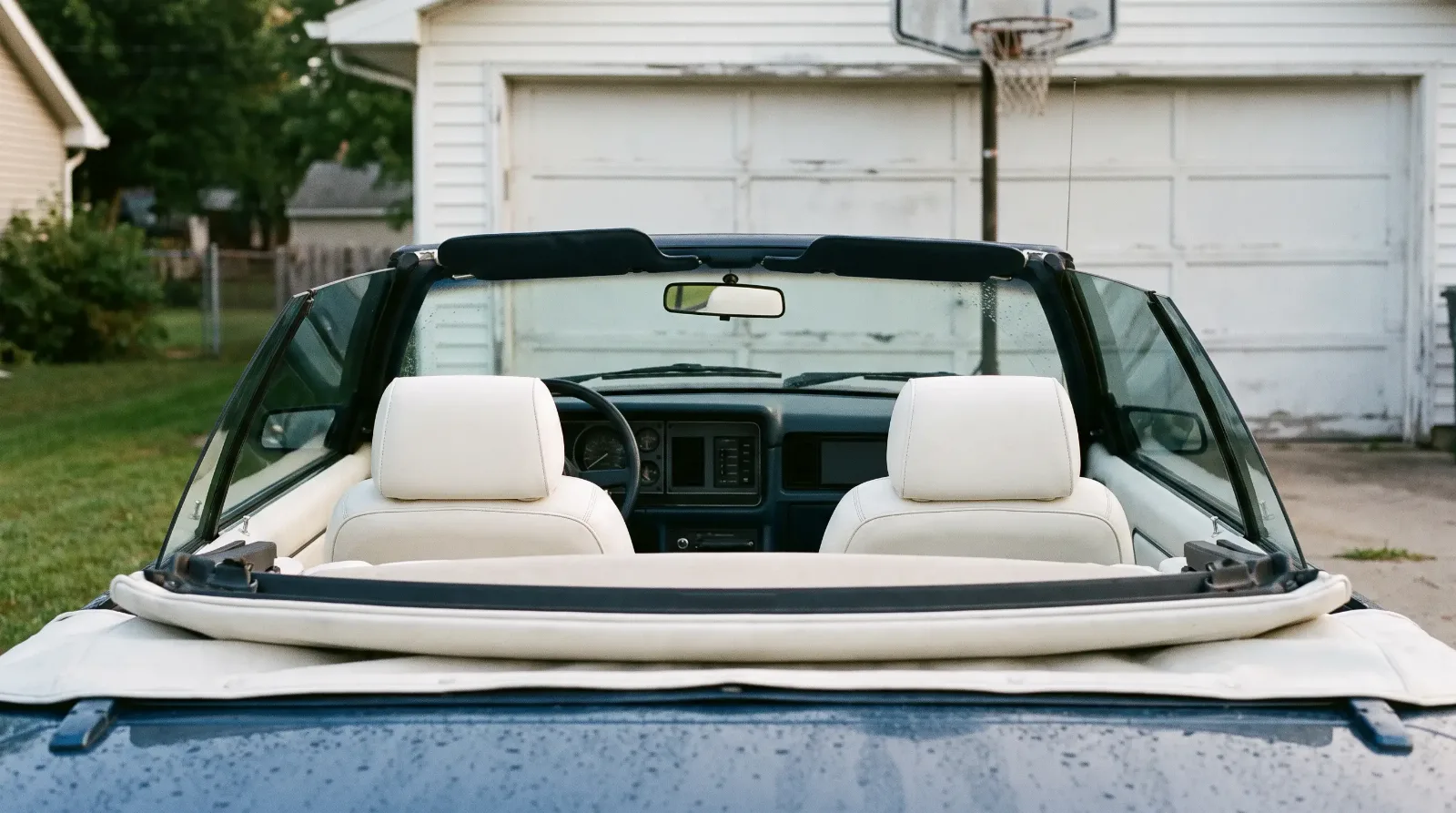
The convertible arrived in GLX trim with the 3.8 V6 under the hood. It had a power top and a real glass rear window, which does not cloud, scratch or crease the way a plastic one does after a few winters folded up. It was priced like the dressed-up car it was: the base convertible listed at $12,467.
Partway through the year, a GT convertible joined it. That mattered, because 1983 was a strong year to be a Mustang GT, and the reason was the 5.0 HO. It now breathed through a 600 cfm Holley four-barrel and was rated at 175 hp, up from 157 hp in 1982, and the T-5 five-speed manual arrived during the model year. A GT convertible cost about $13,500. For that money you got the 5.0 with the sky overhead, and very few people took Ford up on it.
The car wore new jewelry that year too. The 1983 Mustang was the first to carry the Blue Oval on its exterior, a small badge with a large meaning, since Ford was putting its own name on the car's face. On a convertible with the top down, the nose is the part people see first.
Who actually cut the roof off?
Two names come up whenever the 1983 Mustang is discussed: Cars & Concepts and ASC. The one the 1983 sources actually support is Cars & Concepts, a specialist from Brighton, Michigan, that had already done the T-tops for the 1979 Indy pace cars. Ford engineered the car and built notchback coupes; Cars & Concepts handled the conversion, cutting off the roof and reinforcing the A-pillars, cowl and quarter-panel areas, with a crossmember added between the rear wheelhouses. The fuzzy part is the where. Some accounts describe the work being done in a small area at Ford's Dearborn plant, which is why you will also read that the cars were built in-house, and I have not seen a document that settles it.
It is easy to see why ASC's name sticks. The company built the ASC McLaren Mustang from 1987 to 1990, just over 1,800 coupes and convertibles, so its link to open Fox Mustangs is real and documented for those later years. That later work is not evidence about 1983, and none of the sources I have read on the first-year car credit ASC with it.
"Every owner of a 1983 convertible has heard a confident answer about who built it. I have heard three. The one that holds up is Cars & Concepts; the exact building it happened in, I would still rather leave open than invent a birth certificate for the car."
Nora Beckett
The first year, by the numbers
The convertible was not a token. Ford built 120,873 Mustangs for 1983, and 23,438 of them were convertibles, close to one car in five. Nearly all of those were GLX cars, which tells you who the car was really for: someone who wanted the sun and the look more than the stopwatch. The GT convertible was the enthusiast's footnote.
| 1983 Mustang convertible | Figure |
|---|---|
| GLX convertible production | 22,437 |
| GT convertible production | 1,001 |
| Total convertible production | 23,438 |
| Total 1983 Mustang production | 120,873 |
| Convertible share of 1983 output | About 19 percent |
| GLX launch engine | 3.8 V6 |
| GT engine | 5.0 HO, 175 hp, 600 cfm Holley four-barrel |
| Base convertible price | $12,467 |
| GT convertible price | About $13,500 |
Taking the roof off a unibody costs stiffness, and every Fox convertible owner knows the gentle shimmer of the windshield frame over broken pavement. Nobody bought these cars for their rigidity. They bought them for a summer evening with the top folded and the radio up, and for that job the car was right from the start.
The convertible stays, 1984 to 1993
The open body never left the Fox line again. For 1984 Ford dropped the GL and GLX names and introduced the LX, and the convertible carried on under the new trims. The 20th Anniversary GT350 package that spring included 1,213 convertibles with the 5.0, 104 with the turbocharged four, and 15 VIP convertibles. By 1987, with the new aero nose, a convertible listed at $13,052.
Later, the convertible became the canvas for some of the most recognizable special editions of the era. The 1990 "7-Up" car was 4,103 Emerald Green LX 5.0 convertibles with white tops and white leather, built for a promotion that was canceled. When the SN95 arrived for 1994, Ford trimmed the Mustang down to a single coupe body, and kept the convertible. By then nobody at Ford needed to argue for it.
The 1983 car is where that run started, and it still has a particular quality the later ones do not quite match: it was the first in nine model years, built for people who had waited. For the wider picture of how this car fits among all the others, the Mustang's history in one read covers the whole line. But the best way to understand the 1983 convertible is the simplest. Find one on a warm evening, wait for the owner to press the switch, and watch the sky open up over a Mustang again.
Sources and notes
- MustangSpecs: 1983 Ford Mustang, convertible production, prices and the Cars & Concepts conversion
- Wikipedia: Ford Mustang (third generation)
- ClassicCars.com: 1983 Mustang convertible history and the coupe-to-convertible conversion
- SlashGear: were convertibles ever banned in the US?
- The Truth About Cars: America's 1970s convertible controversy
- Wikipedia: American Specialty Cars (ASC)
Related Reading
Have a
Ford Mustang
for Sale?
Reach thousands of serious classic car collectors across the US.
Sell It Here →
Selling a classic? Here's how: the best sites to sell a classic car
Are You a Classic Car Dealer?
List your full inventory and connect with targeted classic car buyers.
Join as a Dealer →

About the author
Nora Beckett
Automotive features writer and photographer who tells the human stories behind the cars, from show fields to cross-country road trips.
Related Listings - Ford Mustang
More in Car Features
Comments
Be the first to comment on this article.