
"The Boss is back." That was the headline Ford put across a two-page magazine ad for the 1982 Mustang GT, and Hagerty still remembers the car by that campaign. It was a big thing to say about a car with a two-barrel carburetor and 157 horsepower. I like the line anyway. It was cheeky, it was aimed straight at people who remembered the real Boss cars, and for the first time in years Ford had a V8 Mustang that could back up a little bit of swagger.
Car Features
7 min read
"The Boss Is Back": The 1982 Mustang GT
The 1982 Mustang GT brought back the GT badge and a manual V8 after 13 years: the 157 hp 5.0 HO, TRX wheels, colors and production.
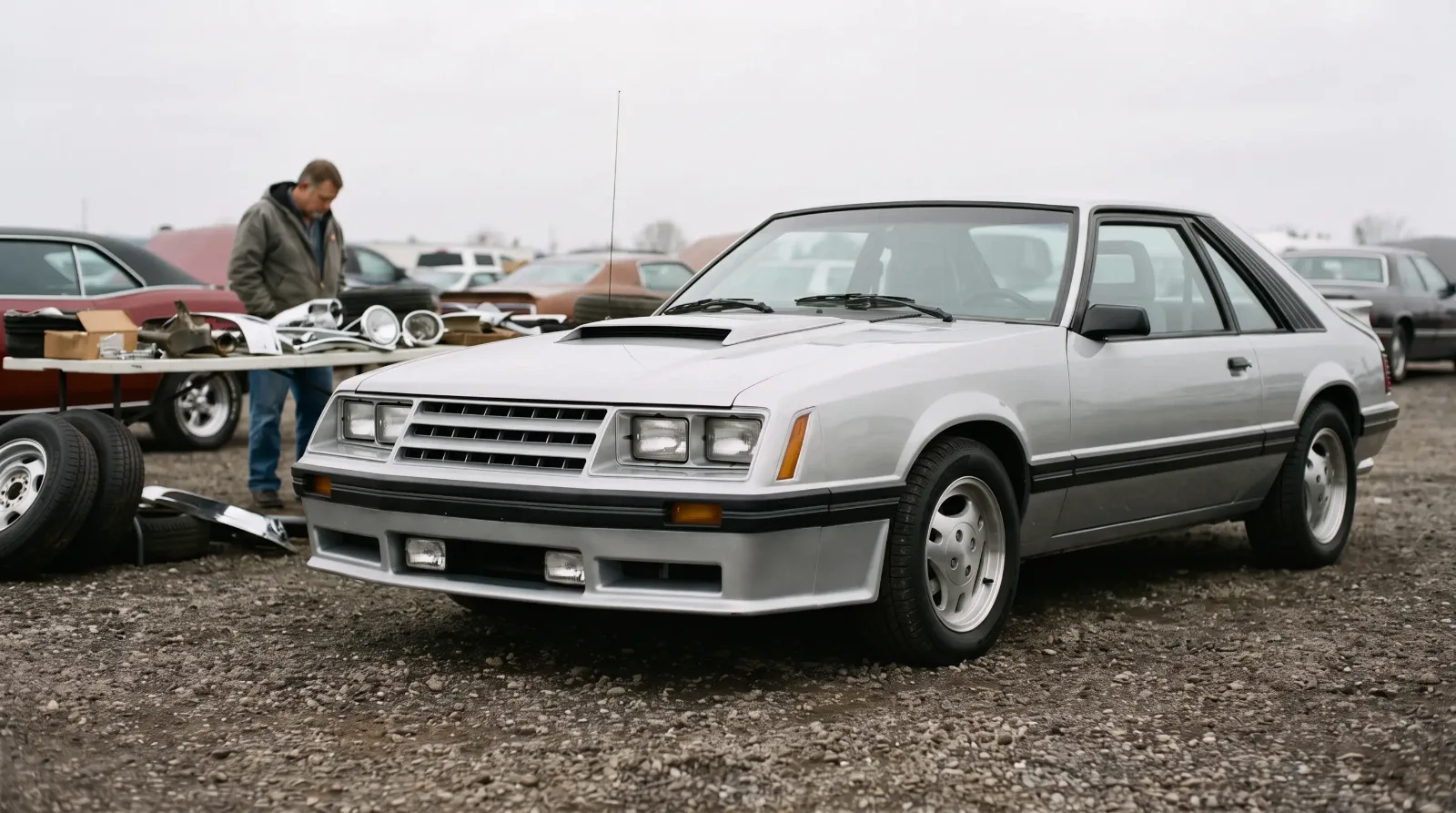
This is the story of that one car and that one model year. Not the whole run of Fox Body Mustangs, just the 1982 GT: why it needed a slogan, what was actually under the hood, what came with the badge, and how quickly Ford made it look old.
Thirteen years without a GT
The GT name had been gone since 1969. That last first-generation GT sold 5,396 copies and then disappeared, and through the Mustang II years and the first Fox cars there was no GT on the order form at all. When the badge came back for 1982, it came back after 13 years.
The bigger problem was the engine bay. The 1979 Fox Mustang still offered the 302 V8, rated at 139 to 140 hp, and the 1979 pace car replica put that engine in a dressed-up hatchback. That car is worth reading next if you want to see where some of the 1982 GT's equipment came from. Then the 302 went away. For 1980 and 1981 the only V8 was the 4.2 liter, the 255, rated at 118 to 120 hp and sold with an automatic only. It was the lowest-rated V8 ever put in a Mustang. The turbocharged 2.3 four was supposed to carry the performance flag in those years, and it was plagued by reliability trouble before Ford dropped it during 1981.
So picture the showroom in 1981. No GT. No manual-transmission V8. A turbo four with a bad reputation. Production fell from 271,322 for 1980 to 182,552 for 1981. Something had to change, and the something was a 302 with an HO tag.
The 1982 Mustang GT and its 5.0 HO
The engine was the 5.0 HO, Ford's high-output version of the 302, fed by a two-barrel carburetor and rated at 157 hp net. Torque is quoted at 235 to 240 lb-ft, depending on which page of the same reference you read. The only transmission Ford put behind it was a four-speed manual with an overdrive top gear, the SROD. A GT ordered with an automatic got the old 4.2 V8 instead, so the HO engine and the clutch pedal came as a pair. After two years of V8s that came only with an automatic, a buyer could once again row the gears in a V8 Mustang, and that mattered more to the people this car was aimed at than any number on the spec sheet.
Keep the ratings in perspective. Those are net figures, measured the way every Mustang was rated by then. The famous numbers from the late 1960s were gross ratings, taken on a stand without the accessories and exhaust a real car carries. Line up 157 net against a 1970 Boss 302's 290 gross and the 1982 car looks feeble. That comparison is not fair to either engine. The fair comparison is the one buyers made at the time: 157 hp against the 118 to 120 hp of the 4.2 it replaced. That is a jump of roughly a third, in one model year, from the same company.
| Item | 1982 Mustang GT |
|---|---|
| Engine | 5.0 HO (302 cu in) V8, two-barrel carburetor |
| Output | 157 hp net; 235 to 240 lb-ft (sources differ) |
| Transmission | Four-speed manual overdrive (SROD) only with the 5.0 HO; automatic GTs got the 4.2 V8 |
| Wheels and tires | Michelin TRX: 390 mm (15.35 in) forged metric wheels, 195/60HR390 tires, specific suspension tune (some sources list 14 in cast aluminum wheels as standard, TRX as an option) |
| Body | Three-door hatchback |
| Colors | Black, Bright Red, Medium Red, Silver |
| GT production | 24,799 |
| All 1982 Mustangs | 130,418 |
TRX wheels, four colors and one body
The GT came as a hatchback and nothing else, and Ford built 24,799 of them. Out of 130,418 Mustangs that year, that is close to one car in five. The color list was short: Black, Silver and two reds, Bright Red and Medium Red. A 1982 GT in a color outside that list deserves a question about when, and why, it was painted.
The handling hardware people remember is the Michelin TRX package. Sources split on how it came: FordMuscle describes it as standard on the GT, while MustangSpecs lists 14-inch cast aluminum wheels as GT equipment, which would make TRX the option. Either way it is the look most surviving cars wear. It used forged metric wheels in a 390 mm size, about 15.35 inches, with 195/60HR390 tires and a suspension tune made for them. Ford had sold the same setup as a $298 option on the 1979 Mustang and made it standard on that year's pace car replica, so the GT was borrowing proven parts. The GT also took the front air dam with fog lamps and the rear spoiler from the 1979 pace car, plus a small forward-facing hood scoop. The TRX setup stayed in the catalog through 1984 and then went away.
Under the badges, the paperwork is where an original car shows itself. From 1981 Mustangs carry a 17-character VIN. The tenth character is the model year, and C is 1982. The eighth character is the engine code, and on a 1982 car an A means the 2.3 four. A car with GT badges and an A in that eighth spot started life as a four-cylinder Mustang, whatever is under the hood now. The eleventh character is the plant: F for Dearborn, R for San Jose, which built Mustangs until 1983. That takes thirty seconds with a flashlight and saves a lot of arguing later.
Was the Boss really back?
Not literally. There was no Boss engine, no Boss badge and nothing in the 1982 GT that a 1970 Boss 302 owner would recognize as kin under the hood. "The Boss is Back" was advertising, and I would not hold a slogan to the standard of a spec sheet.
What came back was the idea. A light car, a V8, a clutch pedal, a GT badge and a price that did not belong to a luxury car. In 1982 the California Highway Patrol, which had been having trouble with its Camaros, asked for a light pursuit car and ordered 400 Mustang notchbacks, of which Ford built 394. That was the start of the SSP police Mustang, and it is a fair sign that people who drove for a living took the new V8 Mustang seriously.
"Everybody wants to laugh at 157 horsepower now. Go drive a 1981 Mustang with the 4.2 and an automatic first, then get in a 1982 GT. You will stop laughing in about two blocks. The slogan was a stretch. The car was a real step."
Mike Sullivan
What 1983 did to the 1982 car
The 1982 GT had one season to itself. For 1983 the 5.0 HO got a Holley four-barrel rated at 600 cfm and went to 175 hp, and the Borg-Warner T-5 five-speed arrived partway through the year. Overnight, the 1982 car was the slow one. That year also brought the convertible's return, the first Mustang convertible since 1973, with a GT convertible added mid-year and only 1,001 built.
The engine kept climbing from there. By 1987 the 5.0 HO was rated at 225 hp, a figure it held through 1992. Next to those later cars the 1982 GT is a small, honest first step: a two-barrel engine, a four-speed, odd-sized metric wheels and a GT badge doing a lot of work.
That is also what makes it interesting today. It is the car where the Fox Mustang's V8 comeback started, built for a single model year, in four colors and one body. If you are looking at 1982 Mustangs, check the VIN, check the color, and ask whether the TRX wheels are still on it. A clean, original one tells the beginning of the 5.0 story better than any later car can.
Sources and notes
- Hagerty: 25 Greatest Mustangs, 1982 Mustang GT 5.0 HO and the "Boss Is Back" campaign
- Over-Drive Magazine archive: the 1982 Ford Mustang GT two-page ad, "The Boss is back"
- Wikipedia: Ford Mustang (third generation), 1982 GT, SROD four-speed and production
- MustangSpecs: 1982 Ford Mustang GT, equipment and colors
- FordMuscle: the Michelin TRX wheel and tire package on Fox Mustangs
- Wikipedia: Ford Mustang SSP, the 1982 California Highway Patrol order
Related Reading
Have a
Ford Mustang
for Sale?
Reach thousands of serious classic car collectors across the US.
Sell It Here →
Selling a classic? Here's how: the best sites to sell a classic car
Are You a Classic Car Dealer?
List your full inventory and connect with targeted classic car buyers.
Join as a Dealer →

About the author
Mike Sullivan
Detroit-area muscle car enthusiast and restoration specialist with three decades of hands-on experience working on American iron.
Related Listings - Ford Mustang
More in Car Features
Comments
Be the first to comment on this article.