
There is a particular kind of drama a car performs when its headlamps are hidden. By day the front is clean, sculptural, uninterrupted by the round eyes that give most cars their face. At night, or with a flick of a switch, panels drop or flip and the lights appear. For decades that trick was a luxury and performance signature, a small piece of theater that said the car was styled to a higher standard than the ordinary sedan beside it.
Car Features
6 min read
Hidden Headlamps: The Secret Luxury Design Signature
From the 1936 Cord to the Corvette Sting Ray, hidden headlights were a classic luxury design signature. The history, the mechanisms, and what to check.

Hidden headlamps were never really about better lighting. They were about the shape of the car and the moment of reveal. The idea shows up again and again across the design vocabulary, and it reads best against how luxury design language evolved through the same decades.
The Cord that started it
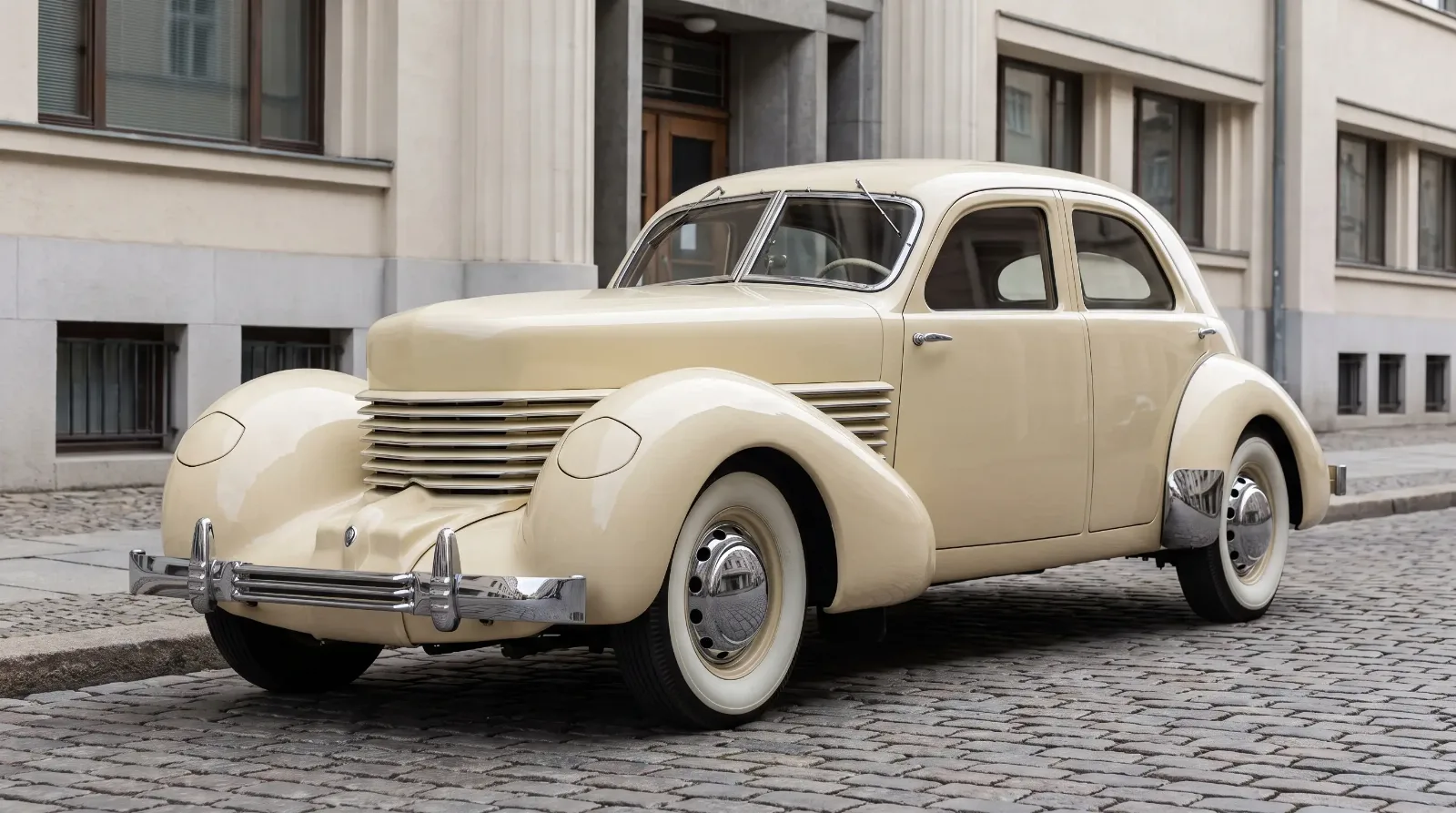
The concealed headlamp arrived on a genuinely advanced car. The 1936 Cord 810, followed by the 1937 Cord 812, hid its headlamps in the front fenders, and the driver raised them with small hand cranks on the dashboard. The lamps came from aircraft landing-light units adapted to the car. That coffin-nosed Cord had no running boards, a wraparound louvered grille, and pop-up lights, and it looked like nothing else on the road.
What makes the Cord matter is that the hidden lamp was part of a fully resolved design, not a gimmick bolted on. The clean front was the whole point of the car's face, and the hidden lamps made that clean front possible. It set the template every later car followed, even the ones that took thirty years to catch up.
DeSoto and the wartime pause
The next serious production use came from DeSoto. The 1942 DeSoto offered concealed headlamps behind pivoting covers, marketed under the Airfoil name, the first American production car after the Cord to hide its lights. The timing was terrible. The 1942 model year was cut short when American car production halted for the war, so very few were built and the feature disappeared from the DeSoto line afterward.
After that the hidden headlamp went quiet for two decades. The mechanisms were complex, the vacuum or mechanical linkages could fail, and postwar styling went in a different direction with exposed quad headlamps becoming a status feature in their own right by the late 1950s. The concealed lamp waited for the 1960s to come back.
"The hidden headlamp is one of the few styling features that changes the car twice, once with the lights closed and once with them open. A designer who used it well was composing two different front ends on the same car, and that is a harder problem than it looks."
Sarah Whitfield
The sixties revival
When it returned, it returned as a signature of the most stylish cars in the American range. The 1963 Chevrolet Corvette Sting Ray used electrically operated rotating headlamps, a clean nose by day that spun the lights into place at night, and it became one of the most recognized examples of the feature. Personal luxury and specialty cars followed. The 1965 Buick Riviera offered concealed headlamps in its clamshell front, and the 1966 Oldsmobile Toronado hid its lamps behind grille panels.
Different makers solved the mechanism differently. Some rotated the lamp on a barrel. Some dropped a vacuum-operated cover. Some flipped the whole lamp pod up from the hood line, the approach that later dominated on sports cars into the 1970s and 1980s. The mechanism was part of the personality. A Corvette that rotated its lamps felt different from a car that raised a soft cover over them.
Why the mechanisms are a collector's worry
The same feature that makes these cars special makes them a headache. Concealed headlamps run on vacuum actuators, electric motors, or mechanical linkages, and all three age badly. Vacuum systems develop leaks in the hoses and reservoirs, so the lamps sag closed or refuse to open, or open unevenly with one side lagging the other. Electric motors and their gears wear and seize. Rubber seals harden and let water into the buckets.
On a car being considered for purchase, the lamps should be cycled several times, watching for both sides to move together and fully. A lamp that opens slowly, stops short, or hunts is a sign of a tired system, and parts for the more obscure mechanisms can be genuinely hard to find. This is one area where a car that looks perfect can hide a frustrating repair, which is why the whole arc of these features is worth understanding through the full classic luxury car story.
| Car | Approx. years | Mechanism |
|---|---|---|
| Cord 810 / 812 | 1936-1937 | Hand-cranked from the dashboard |
| DeSoto (Airfoil) | 1942 | Pivoting covers, short run |
| Chevrolet Corvette Sting Ray | 1963 on | Electric rotating lamps |
| Buick Riviera | 1965 only | Concealed behind front panels |
| Oldsmobile Toronado | 1966 on | Concealed behind grille panels |
A signature worth understanding
The hidden headlamp faded once pop-up designs ran into the same pedestrian-safety pressures that killed the standing hood ornament, and by the 1990s and 2000s the feature was essentially gone. But for the cars that wore it well, it remains one of the most distinctive things a front end can do. It rewarded the buyer who cared about the shape of the car with a face that changed on command.
The way a car managed its lights was only one part of how it presented its front. The grille did the rest of that work, and it evolved through some of the boldest shapes of the era. Read on for next: Grille Design Evolution.
Related Reading

Have a
Classic Car
for Sale?
Reach thousands of serious classic car collectors across the US.
Sell It Here →
Are You a Classic Car Dealer?
List your full inventory and connect with targeted classic car buyers.
Join as a Dealer →

About the author
Sarah Whitfield
Third-generation classic car collector specializing in pre-war American and European coachbuilt automobiles. Researcher and concours enthusiast.




Comments (1)
P
Paul Bergmann
1 month ago
Good reminder that the first year of a new generation often has problems that were sorted by year two or three. Worth considering when choosing between years.