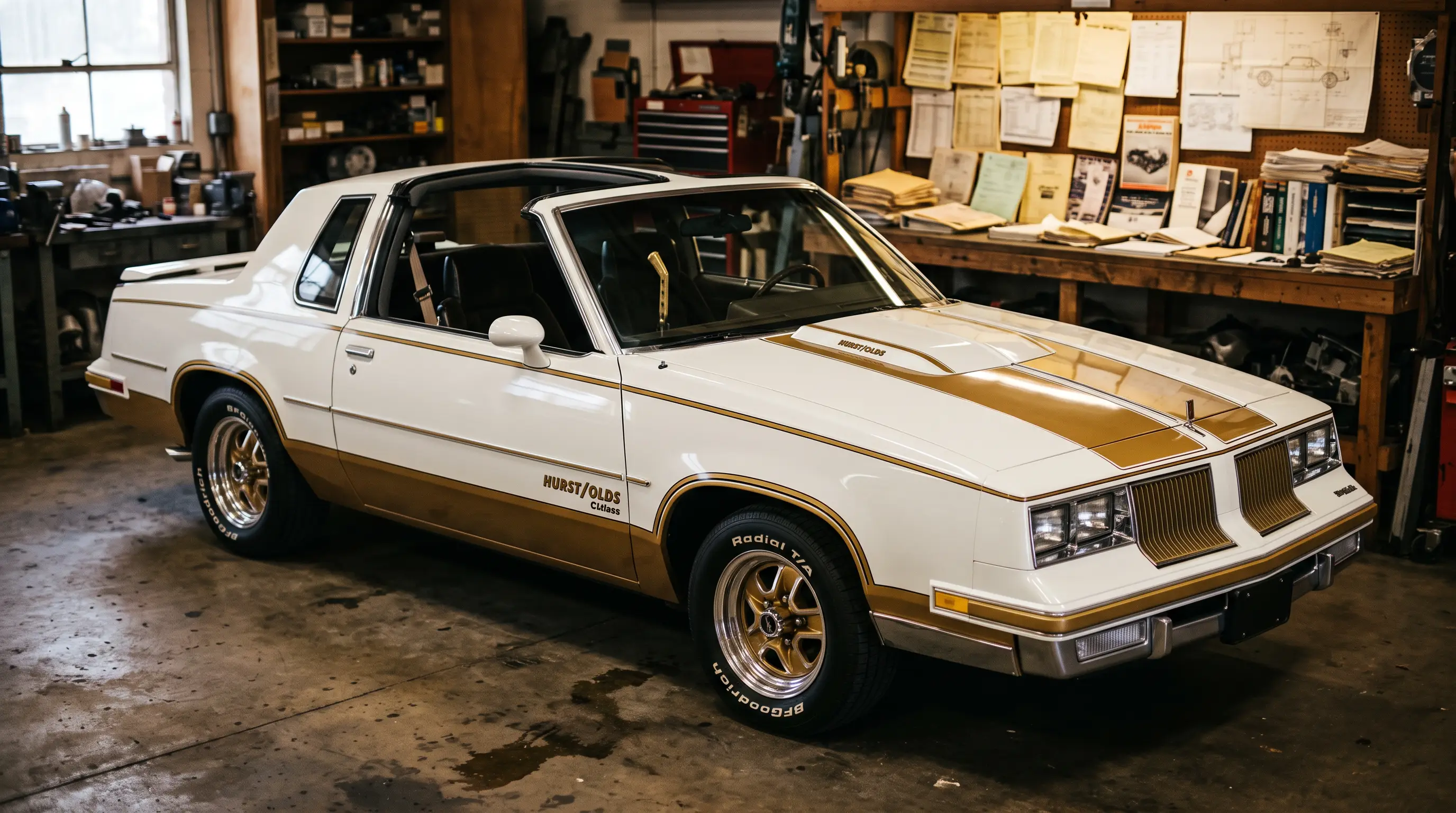
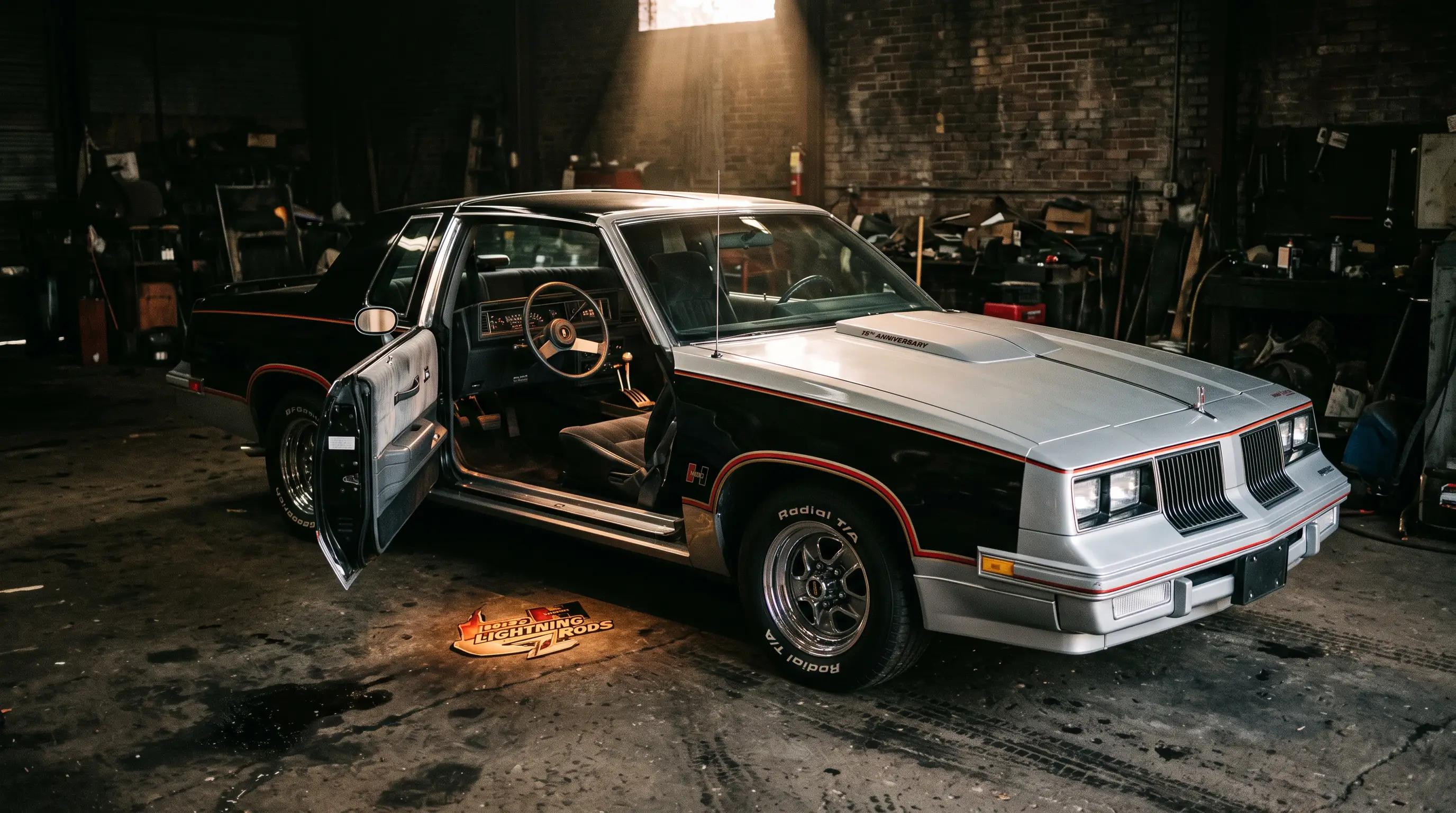
The Lightning Rod shifter is the single detail that makes the 1983 and 1984 Hurst/Olds worth more than a well-optioned Cutlass Calais, and it is also the part buyers most often overlook when they are pricing one of these cars. This was Hurst's answer to a real problem: how do you sell a performance image in the early 1980s when the engines under the hood could not deliver 1970-level numbers. The answer was to put the driver's hands back on something mechanical, even if the powertrain itself was modest.
What the shifter actually did
The setup consisted of a primary shift lever alongside two smaller auxiliary rods mounted on the console, working with the GM 200-4R four-speed automatic overdrive transmission. Rather than relying on the transmission's own logic to decide when to shift, the driver could use the auxiliary rods to manually hold a gear, force a downshift, or lock out overdrive entirely, all without touching a column shifter or shifting into a low gear range the way a conventional automatic driver would. In practice, it let a factory automatic behave with some of the manual control a driver would expect from a stick, which was a genuinely novel idea for a mainstream American V8 coupe in 1983.
The competitive context
Other domestic manufacturers in the early 1980s were leaning on badge engineering and cosmetic trim packages to keep performance nameplates alive without the engineering budget to back them up. The Lightning Rod shifter stands out against that backdrop precisely because it was a real mechanical departure rather than a decal package. Hurst did not simply rename an existing shifter or add a console cover. The company engineered a genuinely new interface for driver control of an automatic transmission, at a time when most of the industry had quietly given up on offering anything mechanically distinctive in this price segment.
Why Hurst built it this way
Hurst had built its reputation on manual shifters for four-speed and three-speed transmissions going back to the 1960s, and by the early 1980s most performance-oriented buyers were still ordering cars with automatics for daily usability. The Lightning Rod design let Hurst apply its shifter expertise to a segment of the market that had moved past manual transmissions without abandoning its core competency. It also gave Oldsmobile a genuine engineering talking point at a moment when raw horsepower numbers were not going to win the conversation against the muscle car era.
Reliability and what fails
Because the Lightning Rod hardware saw real use, the components most likely to show wear on a surviving car are the linkage and the detents inside the console mechanism, along with the auxiliary rods themselves if a prior owner forced them past their intended range. A shifter that feels loose, notchy, or unresponsive is telling you something about how it was used and maintained over four decades, not just about age. Buyers evaluating one of these cars should work every position of all three levers before agreeing on a price, not just confirm the console is physically present.
| Component | Function | Common issue |
|---|---|---|
| Main lever | Standard Park/Reverse/Neutral/Drive selection | Generally reliable if untouched |
| Auxiliary rod 1 | Manual gear hold / forced downshift | Linkage wear from repeated forced use |
| Auxiliary rod 2 | Overdrive lockout | Detent wear, loose feel over time |
| 200-4R transmission | Four-speed automatic with overdrive | Worn TV cable adjustment, weak overdrive planetary and converter clutch solenoid on tired units |
"I have seen buyers pay full price for a 1983 Hurst/Olds without ever touching the auxiliary rods, and that is a mistake. The main lever will always feel fine. The auxiliary rods are where forty years of use actually show up, and they are the reason this car is worth more than the Cutlass Calais it is built on."
— David Mercer
How it compares to a conventional shifter
A standard console automatic shifter from this era gives a driver two practical inputs: a Drive position for normal use and a manually selectable low range for towing or engine braking. The Lightning Rod setup expanded that considerably by isolating overdrive lockout and gear hold into their own dedicated levers, so a driver could hold second gear through a corner, or keep the transmission out of overdrive on a grade, without dropping all the way into a low range that would also limit road speed. It was a genuinely different way of thinking about driver input on an automatic, closer in spirit to a manual valve body than to anything else GM was putting in a showroom car at the time.
That said, this was still fundamentally a 200-4R automatic underneath the console theater. The Lightning Rods changed how the driver interacted with the transmission, not the transmission's core mechanical limits. Buyers should not mistake the shifter for a performance transmission swap. It is a control interface, and a clever one, but it does not turn a 307 V8 Cutlass into something it structurally is not.
Why it still matters to value
The Lightning Rod shifter is not a cosmetic option. It is the mechanical story that separates the 1983 to 1984 Hurst/Olds from every other Cutlass Calais on the road, and cars missing an original, functional console sell at a real discount even when the rest of the specification matches. For the full context of where these two model years fit inside the badge's broader history, see the Hurst/Olds chapter on this site, and for a wider look at how the shifter and this generation compare against every other year Hurst and Oldsmobile partnered on a Cutlass, a related deep-dive tracks the full production picture across the badge's entire run.
Sources and notes
- The Hurst Lightning Rods Shifter System - DrivingLine
- A Cool Idea at the Time: The Hurst Lightning Rods Shifter - Mac's Motor City Garage
- In-Motion Classic: 1984 Oldsmobile Hurst/Olds - Curbside Classic
- 1984 Oldsmobile Cutlass Calais Hurst/Olds - Hagerty Valuation Tools
- Future Collectible: 1983-84 Hurst/Olds - Classics on Autotrader
- 200-4R Identification and Specs - Drivetrain Resource