The 1979 Hurst/Olds W-30 answered a question the market had been asking since 1976: was the Hurst/Olds program actually dead, or just waiting for the right platform. Oldsmobile and Hurst Performance had walked away from the badge after the 1975 model year, and for three seasons there was no Hurst/Olds on any order sheet. The 1979 car changed that, and it did it on the Cutlass Calais body, which is a smaller, tighter package than the Colonnade cars that carried the name in the early 1970s.
I look at cars like this the way I look at any limited run: production number first, drivetrain second, story third. The 1979 W-30 checks the first two boxes cleanly and the third one is genuinely interesting, because this was a comeback built during the worst possible years for factory performance.
Why 1979, and why it worked
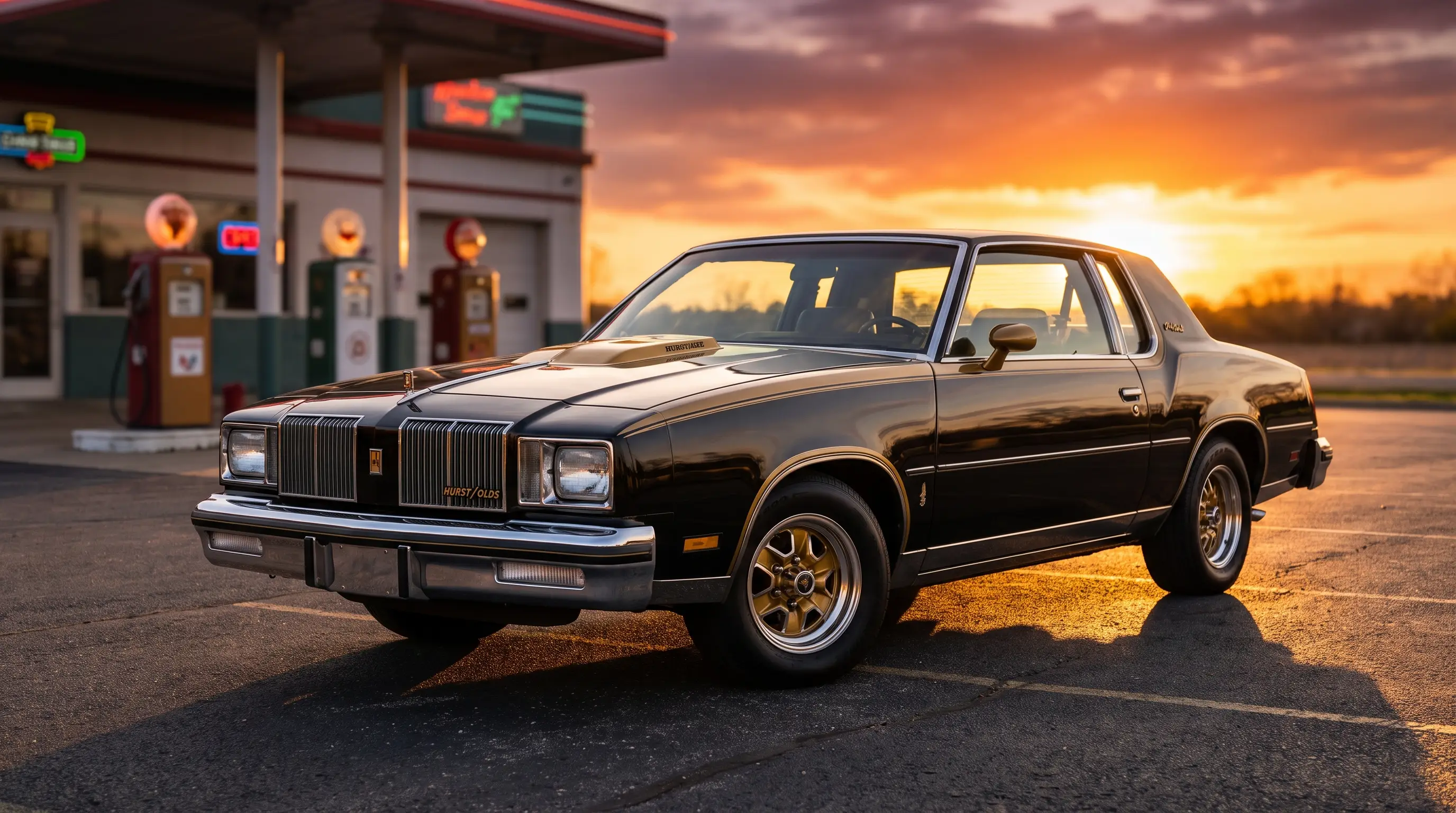
By 1979 the muscle car era had been dead for the better part of a decade. Insurance surcharges, emissions tuning, and a fuel crisis in the middle of the decade had gutted most of the performance nameplates that mattered in 1970. Oldsmobile still had a 350 cubic inch V8 rated at a modest 170 hp, which is not a number that would have impressed anyone in 1970, but against the malaise-era competition it was respectable. Hurst wrapped that drivetrain in one of two factory color schemes, Ebony Black with gold striping or Cameo White with gold striping, and put its name back on the fender.
The build was limited to 2,499 units, split 1,334 in Ebony Black and 1,165 in Cameo White, and Oldsmobile offered a T-top roof option that only 537 cars received. That T-top, combined with the paint scheme, is what collectors point to first when they talk about this car today. It photographs well and it is instantly recognizable at a show field, which matters more for resale than most buyers want to admit.
The drivetrain reality
This is where I have to be blunt with anyone shopping this car as a performance investment rather than a styling exercise. The Oldsmobile 350 under the hood of a 1979 W-30 is not going to embarrass anyone with a stopwatch. Quarter mile times around 17 seconds were typical for this generation of factory performance car, and that is the honest comparison point, not the 1970 W-30's 455. Buyers who come to this car expecting Colonnade-era numbers are shopping the wrong Hurst/Olds.
What the 1979 car does have is a documented factory build, a limited run, and a paint and trim package that Hurst designed specifically to be unmistakable. The W-30 designation carried real weight from the late 1960s and early 1970s, and Oldsmobile was careful about where it applied that badge even in a diminished performance era.
| Spec | 1979 Hurst/Olds W-30 |
|---|---|
| Base platform | Cutlass Calais |
| Engine | Oldsmobile 350 cubic inch V8, 4-barrel |
| Horsepower | 170 hp |
| Production | 2,499 units (1,334 black, 1,165 white) |
| Signature options | T-top roof (537 built), Ebony Black or Cameo White paint with gold striping |
What the auction data says
Documented, unmolested 1979 W-30s trade in a range that reflects their status as a well-regarded but not top-tier collector car. Rough examples needing full restoration can be found in the low five figures. Solid, documented drivers with the correct T-top and paint combination tend to land in the mid-to-high teens, and the cleanest, lowest-mile survivors with build sheet documentation have pushed into the low twenties at specialty auctions. That is a modest range compared to a 1970 W-30 455, but it is also a far more accessible entry point into the factory super Cutlass lineage for a buyer who wants the name and the story without the six-figure exposure of the early cars.
Documentation matters more here than on almost any other Hurst/Olds year, because the W-30 badge and the option codes that go with it are the difference between a genuine limited-production car and a Cutlass that someone dressed up after the fact. Ask for the build sheet before you ask about the paint.
"The 1979 car gets undervalued because people compare it to 1970 instead of comparing it to what else Detroit was building in 1979. Against that field, it was one of the better performance buys on the lot, and the collector market is finally starting to price it that way."
— David Mercer
Options and what actually moves the needle
Beyond the base W-30 package, a handful of options separate a good 1979 Hurst/Olds from a great one in the eyes of buyers who track this segment closely. The T-top roof is the biggest single value driver, since it was not standard equipment and cars without it tend to sell at a discount even when everything else matches. A functioning factory gauge package, correct exhaust, and the original W-30 hood decal set all carry weight too, mostly because they are the details reproduction parts get subtly wrong and that trained eyes catch immediately.
Color combination matters less than most buyers assume. Both factory two-tone schemes offered that year have their partisans, and I have not seen consistent evidence that one commands a real premium over the other once condition and documentation are equal. What does move price is originality of the drivetrain. A numbers-matching 350 backed by a correct build sheet is worth meaningfully more than a car with a period-correct but non-original engine, even if the swapped unit is mechanically identical.
Buying one today
If you are shopping this generation of Hurst/Olds, condition and documentation should carry more weight in your decision than horsepower claims. The 350 is a durable, well-understood engine with a deep parts network, which keeps ownership costs reasonable relative to more exotic muscle-era iron. The T-top cars are more desirable and typically command a premium over the fixed-roof coupes, so budget accordingly if that option matters to you.
For readers following this generation of the badge in sequence, the next story in this set covers the 1983-84 cars, where Hurst brought back the name again with a very different, and much more mechanically interesting, package under the console.