
Most arguments about the fastest IROC-Z start with the engine. The order paperwork tells a quieter story, and it turns on three characters: G92. On the IROC-Z, G92 is printed as "Axle, Performance Ratio," and that plain description hides more than it reveals. Depending on the year and the engine, the IROC-Z G92 code changed the rear gear, added hardware, closed off other options and, in a narrow set of orders, opened a door to a race package that never appeared in a dealer brochure. To read any of the 1985 to 1990 IROC-Z cars properly, you have to read the codes around it as well.
Car Features
7 min read
The G92 Package and the IROC-Z's Option Codes
What the IROC-Z G92 code ordered, the axle ratios it brought by year, the RPO codes around it, and how G92 without A/C produced the 1LE.
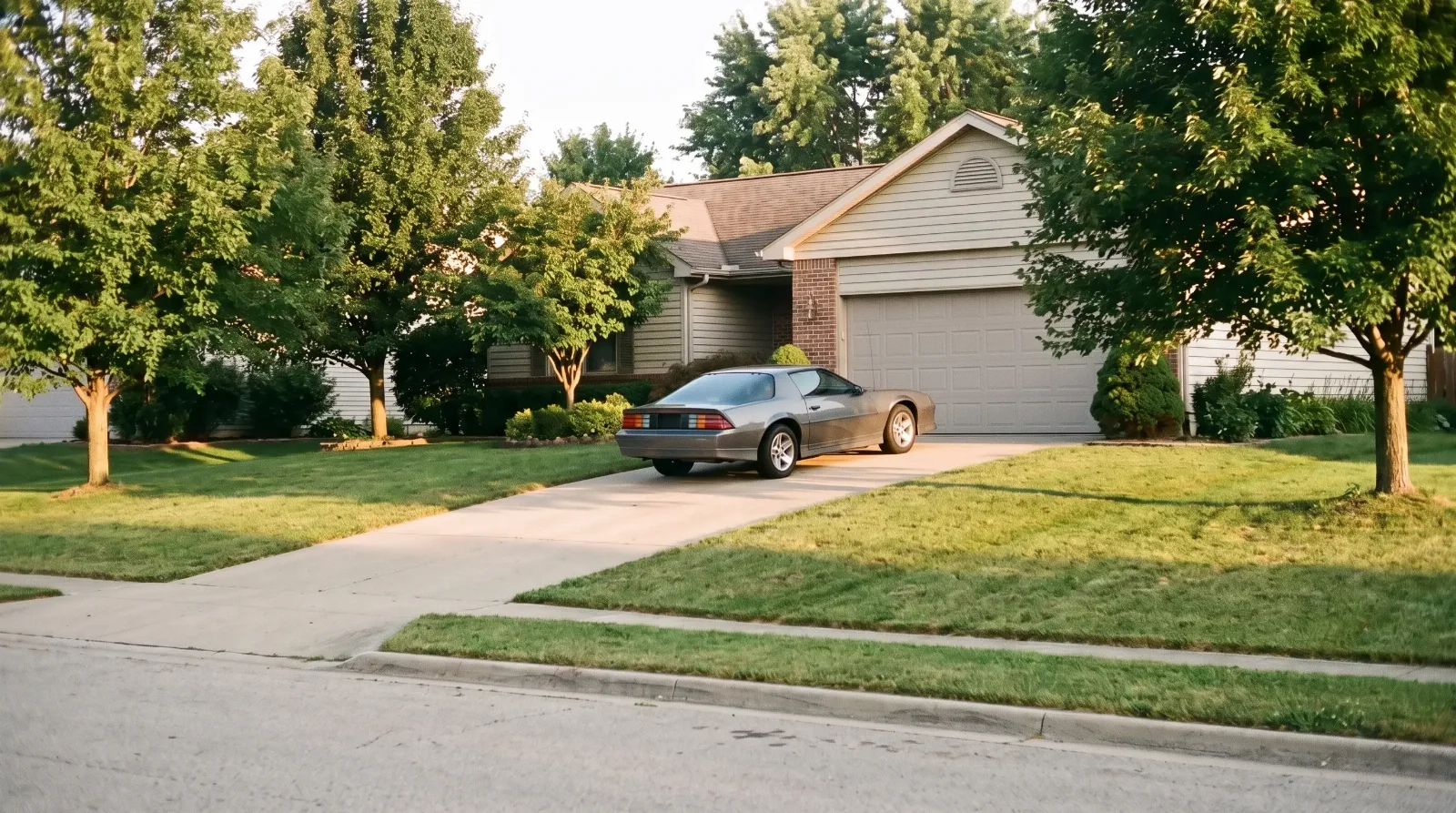
What the IROC-Z G92 code actually ordered
Start with the name. G92 is an axle code. Its first job was a numerically higher rear gear than the one a given engine got as standard, which meant quicker response off the line at the cost of highway rpm. That much is true in every year the code appears.
By 1989 the code had grown. Dealer text for that year lists G92 as a bundle: the performance axle ratio, the N10 dual-converter exhaust, J65 four-wheel disc brakes, an engine oil cooler, P245/50ZR16 Goodyear Eagle tires and a 145 mph speedometer. So a 1989 G92 car is not simply a car with a different gear. It is a car that left the line with a specific group of parts, several of which a buyer could otherwise order on their own.
The 1989 count is the best figure we have: 1,426 IROC-Z coupes with the Performance Axle package. One reference reads that number as G92 cars built without air conditioning. That reading does not survive arithmetic. G92 without air conditioning is the combination that produced the 1LE, and only 111 of those were built in 1989. The 1,426 is the G92 total, air conditioning or not.
The codes around it: B4Z, B2L, LB9 and the rest
G92 never traveled alone. The IROC-Z itself was a code, RPO B4Z, and from 1985 to 1987 it was an option package on the Z28 rather than a separate model. In 1985 the package listed at $659. For 1988 Chevrolet dropped the Z28 name and the IROC-Z became the top Camaro, a role it kept until the Z28 returned for 1991. The B4Z code ran the full span, 1985 to 1990.
The engine codes are where most confusion begins. LB9 is the 5.0-liter tuned port 305. B2L is the order code for the 5.7-liter tuned port 350, the engine most owners call the L98. LG4 was the four-barrel 305, replaced for 1988 by the L03, a 5.0-liter throttle-body engine rated at 170 hp. For 1985 only there was also the L69, a $680 option sold with the five-speed only.
Then come the supporting codes. MX0 is the automatic with overdrive; MM5 is the five-speed manual. G80 is the limited-slip differential, J65 the front and rear disc brakes, KC4 the engine oil cooler and CC1 the removable glass roof most people call T-tops. N10 identifies the dual-converter exhaust from 1989. N96 is the 16-inch aluminum wheel option, priced at $468 from 1988, when 15-inch wheels became standard on the IROC-Z. Two more matter here: C60, air conditioning ($745 in 1989), and C41, the code for no air conditioning.
Rear axle ratios by year and engine
Because G92 is an axle code first, the gear it brought depends on the engine underneath. The table below sets out what the records support. Where a figure rests on a single weak source, it is marked.
| Model year | Engine | Standard ratio | With G92 | Notes |
|---|---|---|---|---|
| 1985 | LB9 305 TPI | 3.23 | 3.42 | Reported on 205 cars, no primary source |
| 1987 | B2L 350 TPI | 3.27 | Not needed for the 3.27 | Automatic only |
| 1988 to 1989 | B2L 350 TPI | 2.77 | 3.27 | Automatic only |
| 1988 to 1989 | LB9 305 TPI, manual | Not confirmed | 3.45 | Five-speed cars; 3.45 documented for 1989 |
| 1990 | B2L 350 TPI | 2.77 | 3.27 | Ratio from a documented G92 car; 4,213 coupes, 2,415 with the 5.7, G92 count unknown |
The 1987 line is the one that explains the market. That year the 350 came with a 3.27 rear as standard. From 1988 the standard 350 gear dropped to 2.77, and getting the 3.27 back meant ordering G92. The 350 was paired only with the TH700-R4 four-speed automatic from 1987 to 1990, so G92 was the main tool an owner had to sharpen the big engine's response.
G92, T-tops and the 1LE back door
G92 also took things away. From 1988 it could not be combined with T-tops. A buyer who wanted the 350, the 3.27 gear and a removable glass roof had exactly one year to get all three, 1987, which is why that year draws collector attention (more on that here). The same restriction raises a question about the IROC-Z convertible, which ASC built by converting T-top cars. None of the sources I checked shows a convertible with G92, and none rules one out, so treat any such claim as unproven until the paperwork says otherwise.
The bigger consequence was the 1LE. Order G92 with G80 and delete air conditioning with C41, and the system set RPO 1LE. The package was meant to make the IROC-Z competitive in SCCA Showroom Stock racing. It brought larger 11.65-inch front rotors with PBR calipers, an aluminum driveshaft, a baffled fuel tank and specific shocks and bushings, while fog lamps, air conditioning and power windows were deleted. Ray Canale, the Camaro and Firebird powertrain manager, and John Heinricy of Chevrolet product engineering are credited with developing it, and Heinricy won SCCA Escort and Firestone Firehawk titles in a 1LE in 1989.
Production was tiny. Sources disagree on 1988, putting it at about 4 or at 6. The figures firm up after that: 111 in 1989 and 62 in 1990. Even this race package was not tied to the 350; it was built with the tuned port 305 and five-speed, or the 350 automatic.
"G92 is an axle code before it is anything else. The extra parts it brought along are the part people copy, so the order paperwork has to carry the claim, not the hardware."
Tom Ramirez
Reading the codes on a real car today
The VIN will not help with any of this. Z28 and IROC-Z are option codes, not VIN content, and from 1987 the series letter is P for every Camaro. The engine digit tells you which engine the car was built with, but the trim and the axle package live in the option list, so original paperwork with that list carries more weight than any badge.
Hardware can support a claim; it cannot prove one. Every part in the 1989 G92 bundle could be bolted on later, and plenty have been during Camaro restoration work done for good reasons. Check the hardware against the paperwork, not the other way around.
Documentation is also where the money sits. A 1989 IROC-Z 1LE in number 2 condition was valued at about $37,000 as of May 2021, roughly 60% more than an IROC-Z without the package. A premium that size rests entirely on proving the codes. A plain G92 car carries a smaller and less documented premium, but the logic is the same: the code is the asset, and the code has to be proven.
Sources and notes
Related Reading
Have a
Chevrolet Camaro
for Sale?
Reach thousands of serious classic car collectors across the US.
Sell It Here →
Selling a classic? Here's how: the best sites to sell a classic car
Are You a Classic Car Dealer?
List your full inventory and connect with targeted classic car buyers.
Join as a Dealer →

About the author
Tom Ramirez
Corvette researcher and historian based in Bowling Green, Kentucky. Two decades documenting Corvette production history from original factory records.
Related Listings - Chevrolet Camaro
Comments
Be the first to comment on this article.