
Ask ten restomod owners if the build was worth it and you will get ten different answers, but almost all of them share one admission: they spent more than they planned, and they would not get it back if they sold tomorrow. That gap between what a build costs and what it returns is the single most important number in this hobby, and it is the one buyers ignore most. The honest way to judge a restomod is not by the finished car. It is by the spread between the money in and the money out, weighed against how much you actually plan to drive it.
Car Features
6 min read
Is a Restomod Worth It
The honest cost-versus-enjoyment math on restomods, why you never recoup a build, and who should buy one anyway.
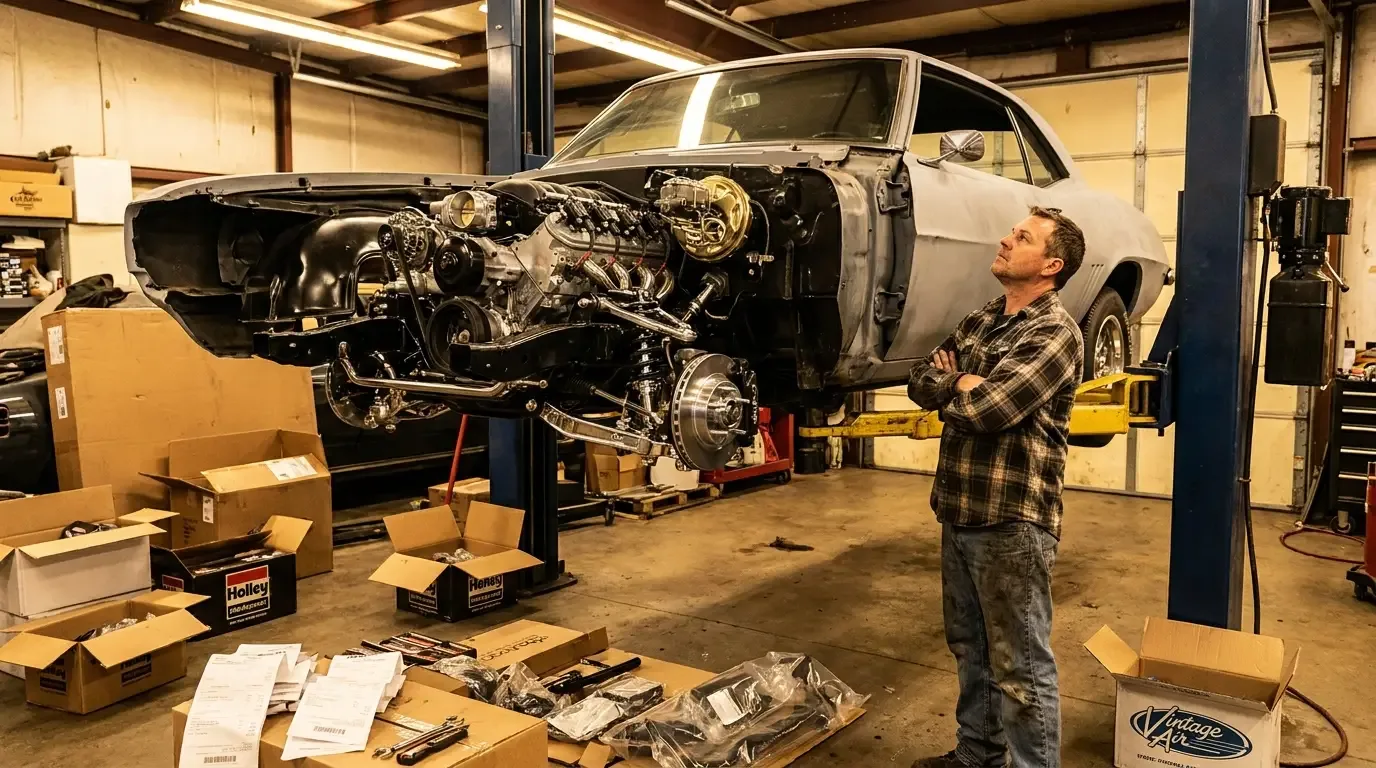
Before going further it helps to be clear on the category. If you are still fuzzy on the definition, start with what is a restomod: a vintage body kept largely stock in appearance but rebuilt underneath with modern drivetrain, suspension, and brakes. That combination is expensive to create and hard to value on paper, which is exactly why the money question is so slippery.
The build math nobody wants to hear
Here is the reality that every builder eventually says out loud: you do not get your money back building one. A ground-up restomod on a popular platform, first-generation Camaro, early Bronco, C10 pickup, routinely lands somewhere around $120,000 to $250,000 by the time the paint is dry and the wiring works, and high-end shop builds run well past that. The receipts add up in a way the finished car rarely reflects at resale.
The trouble is that a build is a stack of individual costs, and the market pays for the car as a single object. Nobody at auction adds a line item for the second time you pulled the engine because the first fitment was wrong. Consider a rough breakdown of where the money goes on a typical mid-tier build.
| Build element | Rough cost range | Resale recovery |
|---|---|---|
| Donor car (running, solid body) | $15,000–$40,000 | Partial |
| Modern crate engine + trans | $12,000–$30,000 | Good |
| Chassis, suspension, brakes | $10,000–$25,000 | Moderate |
| Bodywork and paint | $15,000–$45,000 | Moderate |
| Interior, wiring, A/C | $8,000–$25,000 | Weak |
| Shop labor (if not DIY) | $30,000–$100,000+ | Weak |
Labor is where the spread lives. A crate engine holds value because a buyer can price it independently. The 400 hours a shop spent making everything line up cannot be resold at anywhere near cost, which is why a $200,000 build so often changes hands closer to $130,000. Those figures are directional rather than fixed; a rare platform or a name-brand builder narrows the gap, and an oddball donor widens it.
Buying finished versus building it yourself
If the goal is simply to own and drive a restomod, buying a finished car is almost always the cheaper path. Someone else absorbed the cost overruns, the shakedown miles, and the depreciation on labor. You inherit a sorted car for less than it cost to create, and you skip the two-year wait. Scanning what is available among restomods for sale is a useful reality check before you ever commit to a build, because it shows you the ceiling the market will actually pay.
Building makes sense for different reasons. You want the exact specification in your head. You value the process itself. Or you have the skills to do enough of the labor yourself to close the recovery gap. The decision splits cleanly along whether you want a car or want a project, and that split is really the same one covered in Restoration vs Restomod: Which Path: originality and factory-correctness pull one way, usability and personalization pull the other.
"I tell every first-time buyer the same thing. If you want to save money, buy the finished car and let the last guy's regret be your discount. If you want to spend money, build it, and enjoy every dollar of it, because you will not see most of them again."
David Mercer
Enjoyment is the return most people actually want
Framing a restomod purely as an investment is where buyers get burned. A numbers-matching original can appreciate as a collectible. A restomod is a usability play. It exists to be driven, in traffic, in summer heat, on a long highway pull, without the fragility that keeps a correct-original car parked. The return is measured in miles and grins, not in a resale multiple.
That reframing matters because it changes what "worth it" means. A car you drive 6,000 miles a year for a decade delivers a very different value per dollar than a trailer queen that leaves the garage twice a summer. The modern drivetrain, cold air conditioning, and disc brakes are not vanity items. They are the difference between a car you use and a car you nurse. For the deeper history of why this whole segment grew up around drivability rather than concours accuracy, the restomod story is worth reading alongside this piece.
Who a restomod is actually right for
The buyer who comes out ahead is the one who wanted the experience all along and priced the depreciation in before signing anything. If you plan to drive the car regularly, keep it for years, and value looking vintage while driving modern, the money-in-money-out spread stops being a loss and starts being the cost of the thing you wanted.
The buyer who gets hurt is the one who treated it as an appreciating asset, expected to recoup a shop build, or bought at the top of the market on a niche platform they did not love. For that buyer, the same spread is a straightforward loss, and no amount of quality workmanship changes it.
- Right for you if: you want to drive it hard and often, you keep cars long-term, and you accept the build premium as the price of usability.
- Wrong for you if: you need it to hold or grow value, you expect to sell within a year or two, or originality actually matters to you.
So is a restomod worth it? On a spreadsheet, almost never. As a car you use and keep, frequently yes, provided you buy with the depreciation already priced in and you plan to earn the value back in seat time rather than resale.
Sources and notes
- Collector-car auction results and sold-price records for popular restomod platforms.
- Builder and restoration-shop interviews on labor costs and build-to-resale spreads.
- Marketplace listing surveys for finished restomod pricing.
- Crate-engine and aftermarket chassis supplier price references.
Related Reading
Have a
Classic Car
for Sale?
Reach thousands of serious classic car collectors across the US.
Sell It Here →
Are You a Classic Car Dealer?
List your full inventory and connect with targeted classic car buyers.
Join as a Dealer →

About the author
David Mercer
Classic car market analyst with two decades of experience tracking collector car valuations, auction results, and investment trends.




Comments
Be the first to comment on this article.