
Every project car forces the same fork in the road before you unbolt a single panel. You either bring the car back to what the factory built, or you keep the shape and rebuild everything underneath it for the way you actually drive in 2026. I have watched people sink two years and a small fortune into the wrong choice because they never sat down and answered a few blunt questions first. Restoration and restomod are not better or worse than each other. They answer different goals, and the goal is the thing you have to pin down before the money starts moving.
Car Features
6 min read
Restoration vs Restomod: Which Path Should You Choose
Restoration or restomod? A blunt look at goals, cost, drivability, resale, and reversibility to help you choose before the money starts moving.
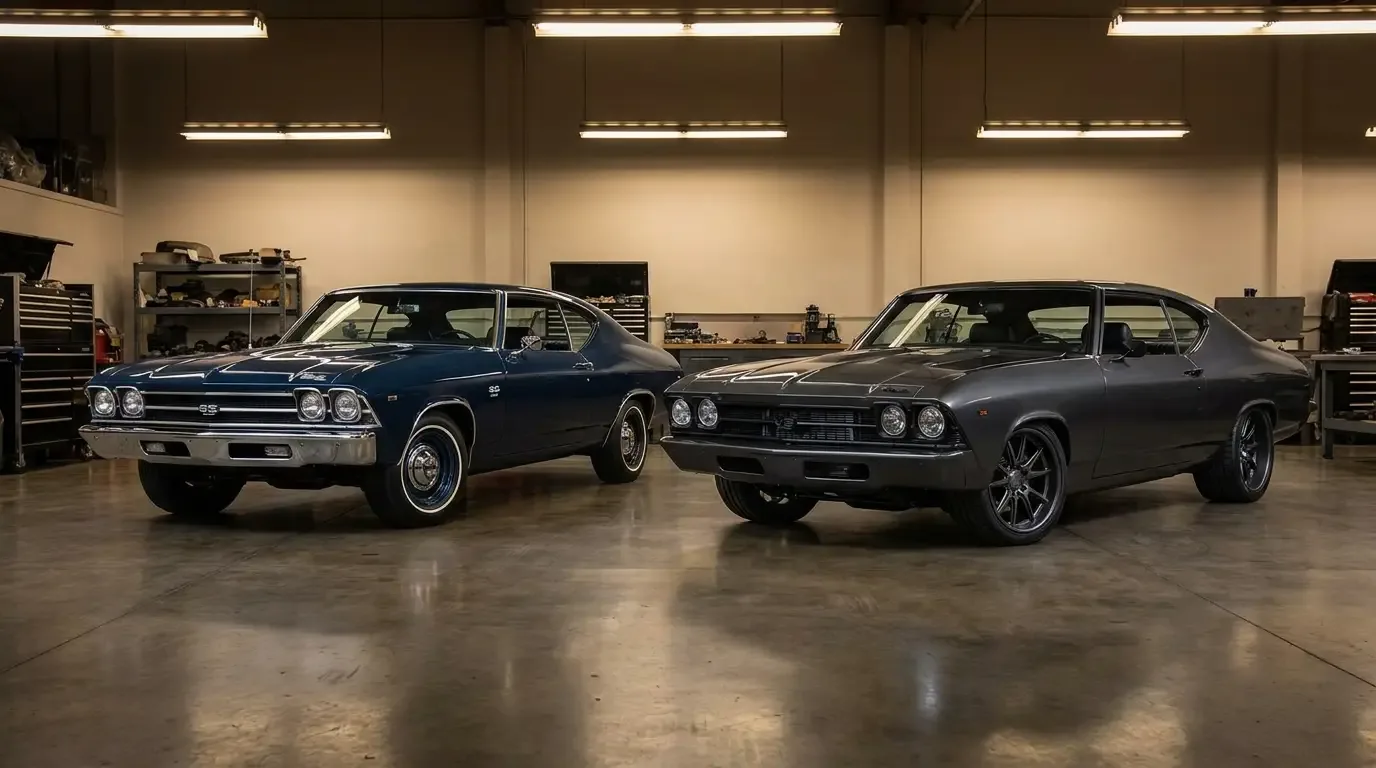
If you are still fuzzy on the terms, it helps to read what is a restomod before you go further, because the line between a period-correct rebuild and a modern one changes almost everything about how the project runs.
Start with the goal, not the parts
A faithful restoration puts the car back to how it left the assembly line. Correct paint code, correct carburetor, correct date-stamped glass, the right hose clamps. The payoff is authenticity. You are preserving a specific car from a specific year, and that has weight at shows, in registries, and with buyers who care about originality. A restomod keeps the body and the look but rebuilds the drivetrain, chassis, brakes, and cabin with modern hardware. The payoff is that it drives like something built this decade while still looking like the car you fell in love with.
So the first question is honest and simple: do you want to own a piece of history, or do you want to drive the thing every weekend without babying it? Neither answer is wrong. But once you know which one you are, most of the other decisions fall in line behind it. This is the same split that runs through the story of the restomod, and understanding where the movement came from makes the choice clearer.
Cost runs differently on each path
People assume restoration is the cheaper road because you are not buying a crate engine or a coilover kit. That is not how it plays out. A correct restoration can cost more than a restomod on the same car, because originality is expensive. Hunting down a date-correct alternator, a matching-numbers block, or NOS trim can eat months and thousands of dollars. Every wrong part is a compromise that shows up later when a judge or a buyer notices.
A restomod spends money differently. The big line items are the modern drivetrain, the suspension, and the brakes, and those are mostly off-the-shelf now. You can budget them. What blows restomod budgets is fabrication, wiring, and the endless small custom pieces to make new parts live inside an old body.
| Factor | Faithful restoration | Restomod |
|---|---|---|
| Biggest cost driver | Sourcing correct/original parts | Fabrication and integration labor |
| Budget predictability | Harder (parts hunt is open-ended) | Easier (most parts are catalog items) |
| Drivability | Period-correct, needs patience | Modern, daily-friendly |
| Reversibility | N/A (already stock) | Depends on how it was built |
| Best resale audience | Originality-focused collectors | Drivers wanting old looks, new feel |
Drivability is where the two really split
This is the part nobody tells you at the start. A correctly restored classic drives like a classic. Drum brakes that need a firm leg, a manual box with a long throw, no air conditioning, steering that wanders a little at highway speed. For a lot of owners that vintage feel is the whole point, and they would not trade it. For others it wears thin by the third summer, and the car sits.
A restomod is built to erase those friction points. Disc brakes that actually stop, a modern overdrive so the engine is not screaming at 70, air conditioning that works, and a suspension that does not toss you around on a back road. If your honest plan is to drive the car often and far, the restomod path removes the excuses. The cabin side of that upgrade, from the seats to the climate control, is worth understanding on its own, and a good restomod interior is often what separates a car people love to drive from one that stays in the garage.
"I tell people to be honest about how they actually drive before they spend a dime. If the car is going to sit under a cover except for two shows a year, keep it correct. If you want to take your kid for ice cream on a Friday night without sweating the brakes, build a restomod and never look back."
Jim Vasquez
Resale and reversibility, the long game
Resale depends entirely on the car. On a rare, desirable model with a documented history, cutting it up for a restomod can cost you real money, and originality is worth protecting. On a common car that was built by the hundreds of thousands, a clean restomod often sells faster and for more than a stock example, because it drives better and there is no shortage of stock ones. Match the build to the car, not to a trend.
Reversibility matters more than most first-time builders think. A restomod that keeps the original drivetrain crated and stored, with minimal irreversible cutting, protects your options and the car's future value. A restomod that welds and hacks its way through the original structure locks you in. If you care about ever going back, tell your builder up front, because it changes how the work is done.
There is a middle question worth chewing on too. If your real hesitation is about keeping a car factory-correct versus modernizing it, the deeper trade-offs live in Restomod vs Numbers-Matching Original. And if you are weighing the restomod against a rawer, period-style build instead, it is worth seeing how a hot rod compares to a restomod, because those two customs answer very different itches.
Sources and notes
- Collector-car auction records and published sale results for comparative pricing of original versus restomod examples.
- Marque and model registries for originality and documentation standards.
- Builder and restoration shop interviews on cost drivers, fabrication labor, and reversibility practices.
- Period and enthusiast press for restoration correctness expectations.
Related Reading
Have a
Classic Car
for Sale?
Reach thousands of serious classic car collectors across the US.
Sell It Here →
Are You a Classic Car Dealer?
List your full inventory and connect with targeted classic car buyers.
Join as a Dealer →

About the author
Jim Vasquez
Southern California hot rod and custom car builder with roots in the traditional kustom kulture scene.




Comments
Be the first to comment on this article.