
An advertisement can only claim so much before a buyer stops believing it, and the companies that sold the classic Jeep CJ from 1945 to 1986 mostly understood that limit. The Jeep CJ culture advertising story is less about slogans and more about a decades long argument that the vehicle could go places other cars could not, made across changing ownership, changing agencies, and a changing American market, but repeated with remarkable consistency from Willys-Overland through Kaiser to American Motors.
Car Features
7 min read
Selling Adventure: The Great CJ Ad Campaigns
From farm tool pitches to adventure driven campaigns, four decades of Jeep CJ advertising built a heritage story the brand still leans on today.
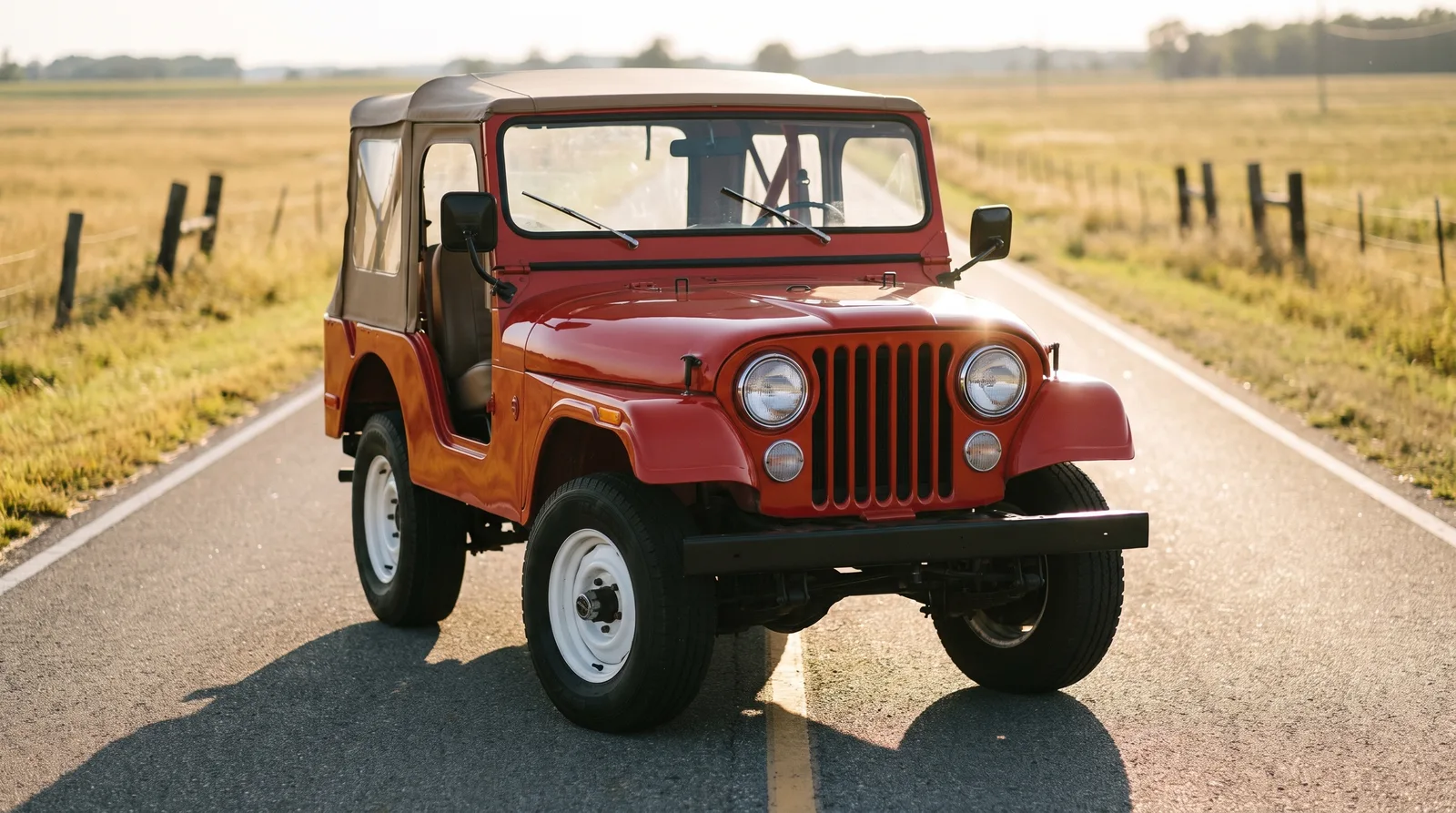
Selling a farm tool to a civilian market
Willys-Overland's earliest CJ advertising, built around the 1945 CJ-2A, leaned almost entirely on utility. Print ads placed in farm journals and general interest magazines showed the vehicle pulling implements, powering a belt driven saw or water pump through its optional power take off, and hauling loads across uneven ground that a standard farm truck would struggle with. The copy was plain and specification heavy, emphasizing what the vehicle could do rather than how it made an owner feel, a style consistent with postwar advertising's broader emphasis on practicality after years of wartime rationing.
That utilitarian pitch made sense given the CJ-2A's origins as a civilian adaptation of the military MB, but it also meant early advertising undersold what would become the vehicle's most durable appeal. Willys was selling a tractor substitute. Buyers, it turned out, were also discovering a recreational and outdoor tool, and advertising took a few years to catch up to what owners were already finding on their own.
The pivot toward adventure
By the early to mid 1950s, as the CJ-3A gave way to the CJ-3B and CJ-5, advertising began shifting noticeably toward outdoor recreation and adventure themes. Hunters loading game into the back, anglers parked beside remote lakes, and families exploring terrain inaccessible by regular car became recurring images, run alongside the continuing farm and utility copy rather than replacing it outright. This dual track approach, utility and adventure running in parallel, let Willys and later Kaiser reach two distinct buyer groups without alienating either one.
The advertising also increasingly leaned on real world proof rather than manufacturer claims alone. Photographs and stories from organized events, most notably the Rubicon Trail crossings associated with the Jeepers Jamboree starting in 1953, gave copywriters genuine, documented examples of CJs succeeding on terrain that looked almost impossible in a photograph. That shift, from manufacturer assertion to demonstrated fact, gave CJ advertising a credibility that pure slogan driven campaigns of the era often lacked.
AMC and the maturing of the pitch
When American Motors Corporation took over Jeep production in 1970, CJ advertising entered a more polished, more consciously lifestyle oriented phase, aligning with broader shifts in American automotive marketing toward image and identity rather than pure specification. The CJ-5 and later CJ-7, introduced in 1976, were positioned less as farm equipment successors and more as a distinct recreational vehicle category, sold to buyers who wanted the outdoor and off road association as a primary reason to purchase rather than a secondary bonus discovered after the fact.
This era's advertising also had to work harder to differentiate the CJ from a growing field of competitors entering the recreational four wheel drive market through the 1960s and 1970s. AMC leaned into the CJ's long history and established reputation, running campaigns that referenced the vehicle's wartime and postwar origins explicitly, using heritage as a competitive advantage in a market where newer entrants had none. That strategy, selling authenticity and lineage against newer competitors, is a thread that runs through our complete history of how the CJ's cultural identity was built and defended across its full production run.
"The best CJ ads never had to exaggerate. They just pointed a camera at a Jeep going somewhere it had no business going, and let the picture do the convincing. That is a much harder thing to fake than a slogan, and buyers could tell the difference."
- Nora Beckett
Advertising that borrowed from its own owners
One of the more distinctive traits of CJ advertising across its four decade run is how often it drew directly from real owner behavior rather than inventing scenarios from scratch. Trail events, hunting and fishing use, farm applications, even the vehicle's screen appearances in film and television, all fed back into advertising imagery and copy, creating a loop where the culture around the vehicle shaped the marketing nearly as much as the marketing shaped the culture. That feedback loop is part of why CJ advertising from different decades still reads as consistent in spirit, even as the visual style and target demographics shifted considerably from the 1940s to the 1980s.
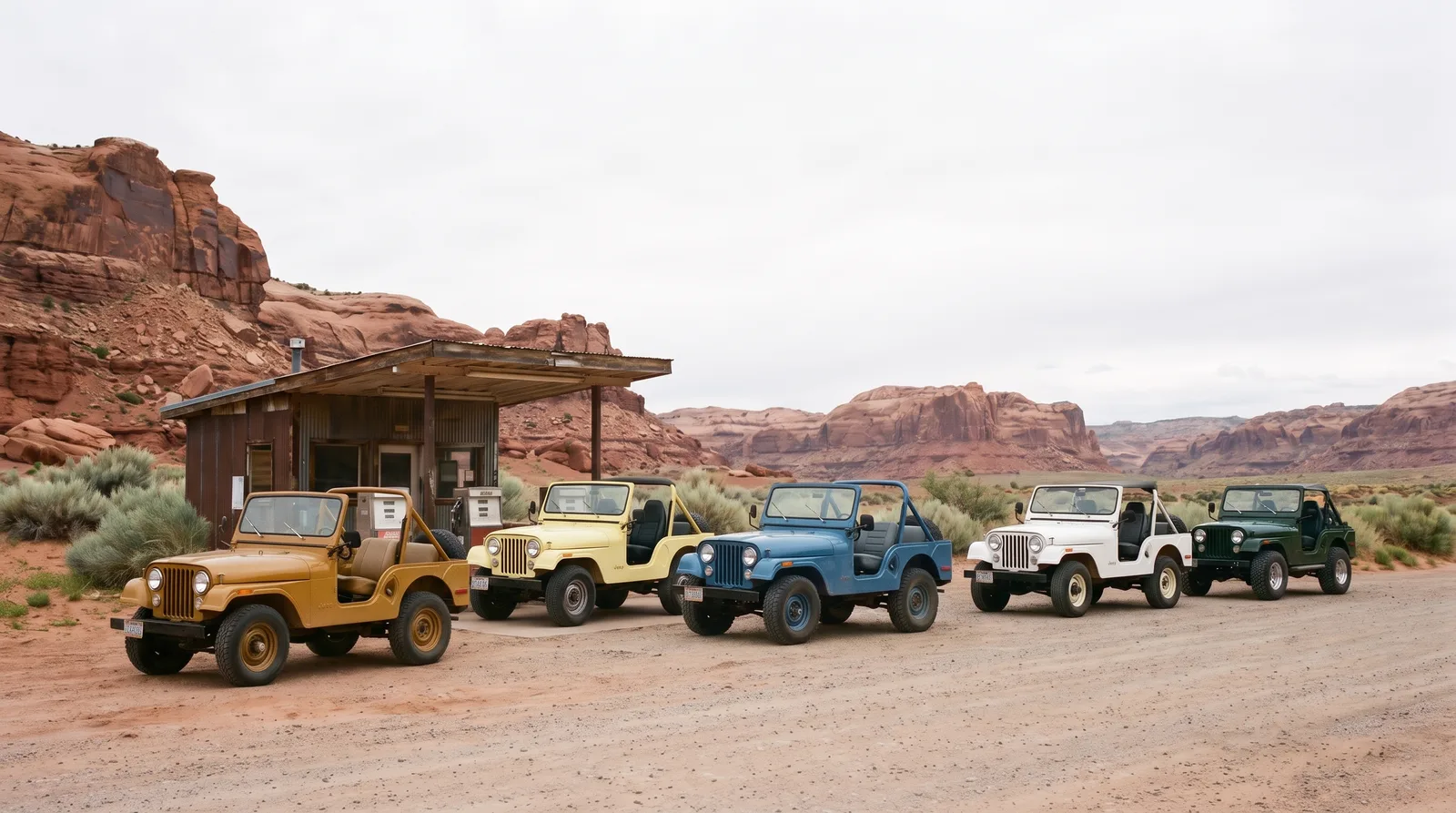
That consistency also meant advertising rarely needed to reinvent the CJ's core promise. Whether the copy of a given decade emphasized farm utility, trail capability, or outdoor recreation, the underlying claim, that this vehicle would go where others could not, stayed essentially unchanged from the CJ-2A's 1945 launch through the CJ-8 Scrambler's final years in the mid 1980s. Readers curious about the broader visual and cultural identity built alongside this advertising history can keep exploring how period color choices reinforced the same themes on the showroom floor.
What the campaigns left behind
The CJ's advertising legacy outlived its production run in a fairly literal sense, since much of the visual language and messaging Jeep uses today for the Wrangler traces directly back to campaigns built around the CJ decades earlier. Heritage, provable capability, and a documented history of real world trail success remain central to how the brand markets its vehicles, a strategy first proven effective by the CJ's own long running advertising story.
The role of dealer level marketing
National print and eventually television campaigns get most of the historical attention, but a substantial share of the CJ's advertising reach through the 1950s, 1960s, and 1970s happened at the dealer level, through local newspaper advertisements, regional radio spots, and printed brochures handed across a showroom counter. These materials rarely survive in the same volume as national magazine campaigns, but they mattered enormously to how buyers in a specific region actually encountered the vehicle, often tailored to emphasize whichever use case, farm work, hunting access, or general recreation, resonated most with local buyers.
Dealer brochures in particular tended to be more specification driven than national lifestyle advertising, listing engine options, gearing ratios, and available accessories in detail for buyers who had already decided a CJ was the right general category of vehicle and needed help choosing a specific configuration. Collectors of CJ paper memorabilia today often value original dealer brochures precisely because of that specificity, treating them as a more reliable record of what was actually offered in a given model year than national advertising, which tended to feature idealized or promotional configurations that were not always representative of what a typical buyer drove off the lot.
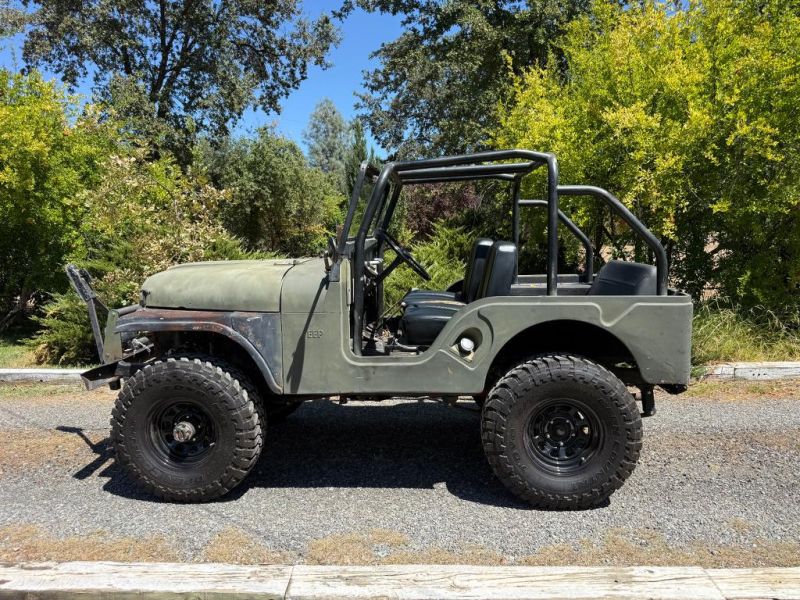
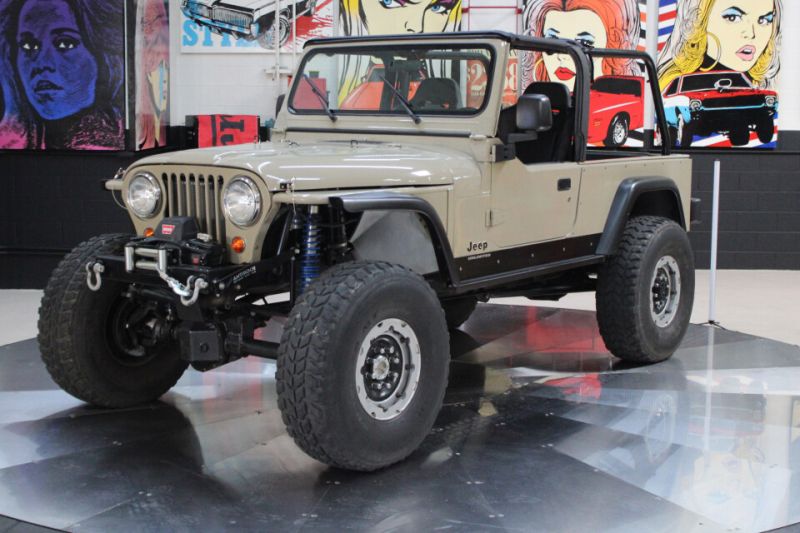
For collectors, original CJ advertising material, print ads, dealer brochures, promotional photographs, has become its own small but genuine collecting category, valued both for its nostalgia and for what it documents about how the vehicle was actually sold to the buyers who kept it in production for four decades. Anyone drawn to that history alongside the vehicles themselves can look at a classic CJ for sale and consider how closely a given example still matches the promise its original advertising made.
Sources and notes
Related Reading
Have a
Jeep CJ
for Sale?
Reach thousands of serious classic car collectors across the US.
Sell It Here →
Selling a classic? Here's how: the best sites to sell a classic car
Are You a Classic Car Dealer?
List your full inventory and connect with targeted classic car buyers.
Join as a Dealer →

About the author
Nora Beckett
Automotive features writer and photographer who tells the human stories behind the cars, from show fields to cross-country road trips.
Related Listings - Jeep CJ

Comments
Be the first to comment on this article.