
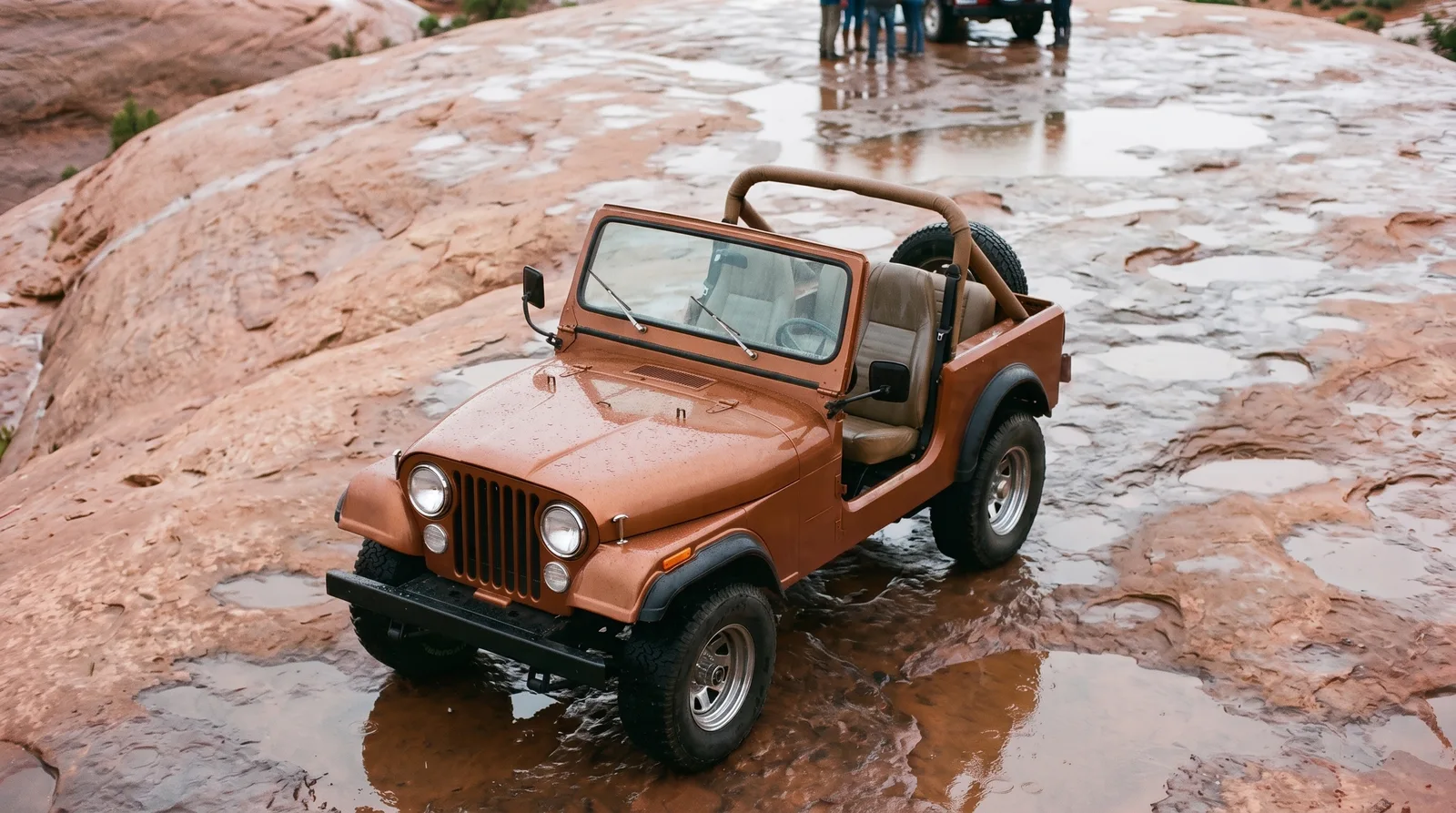
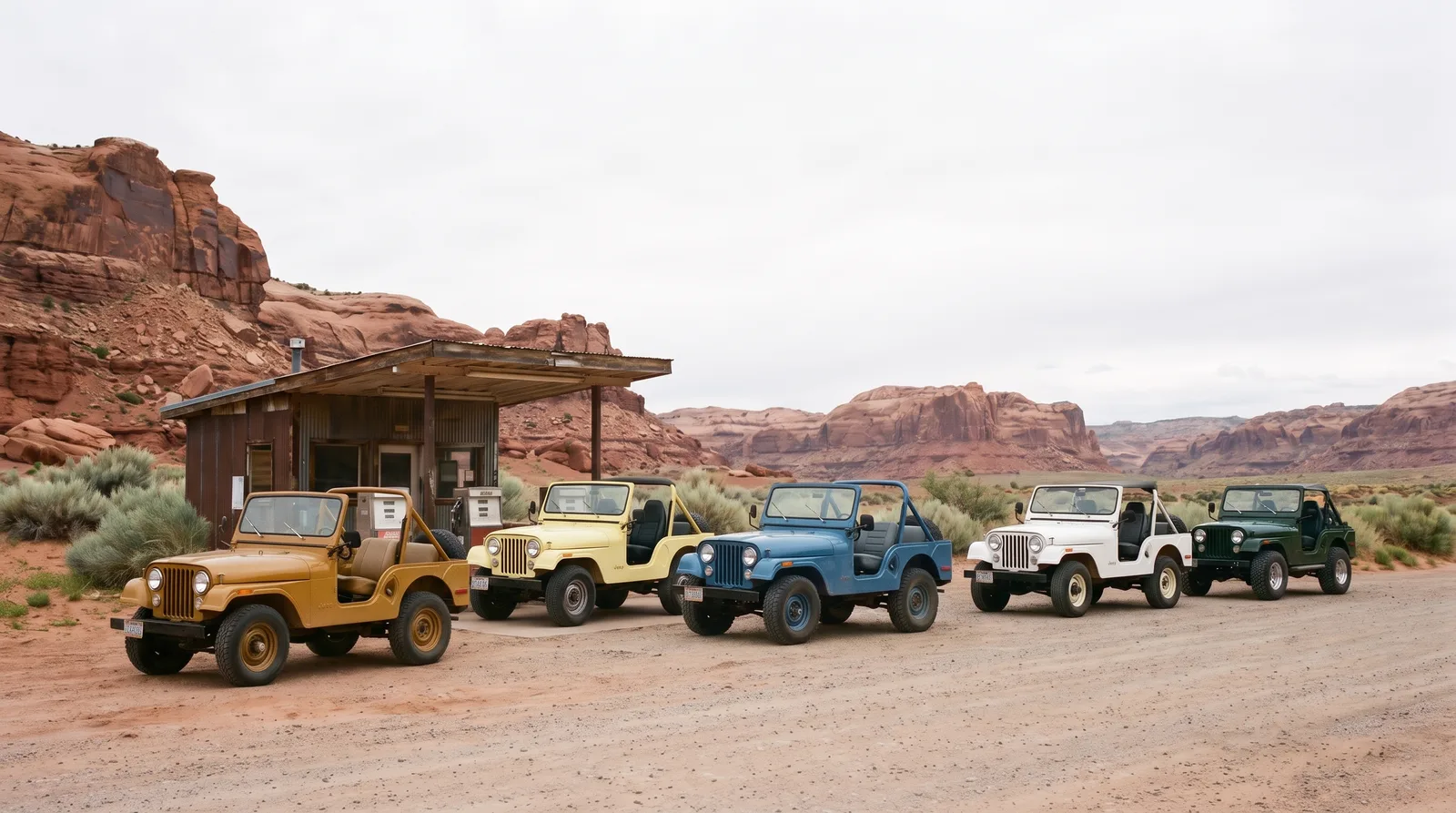
Moab, Utah is red rock and sandstone rather than the Rubicon's granite, but the Jeep CJ's fingerprints are just as deep there. The Moab Easter Safari, later renamed the Easter Jeep Safari, began in 1967 as a small local gathering and grew into one of the most important events in American off road culture, and for its first two decades the CJ was the vehicle that most reliably got a driver up the region's slickrock and through its canyons.
Car Features
7 min read
Moab and the CJ: The Making of a Wheeling Mecca
The Easter Jeep Safari began in 1967 as a small Moab gathering, and the classic Jeep CJ's climb up the region's slickrock helped turn the town into an off road institution.
A town built on the same terrain the CJ was built for
Before Moab became synonymous with recreational off roading, it was a uranium and potash mining town, and the roads that later became famous trails, Hell's Revenge, Poison Spider, and others, started life as mining and exploration routes carved into sandstone. That terrain, slickrock domes, narrow ledges, steep drop offs, demanded the same combination of short wheelbase, solid axles, and low range gearing that had already made the CJ useful on the Rubicon and on ranches across the West.
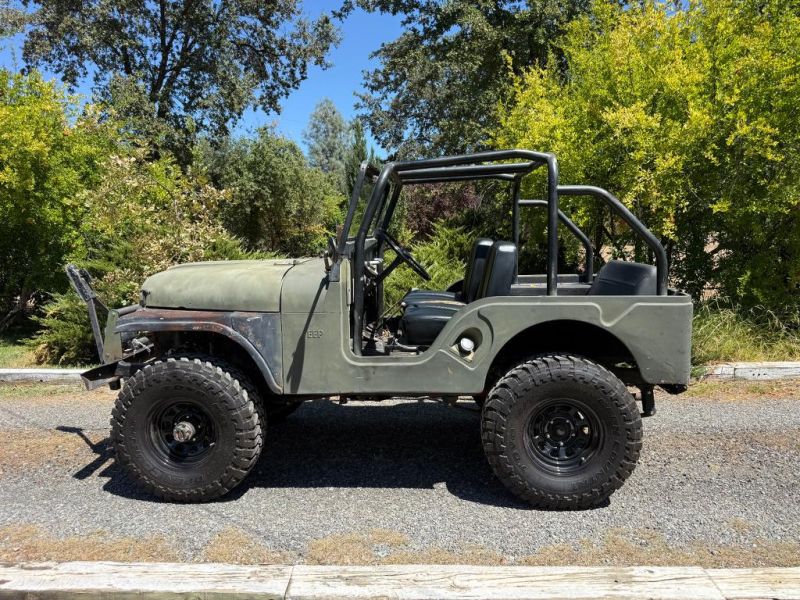
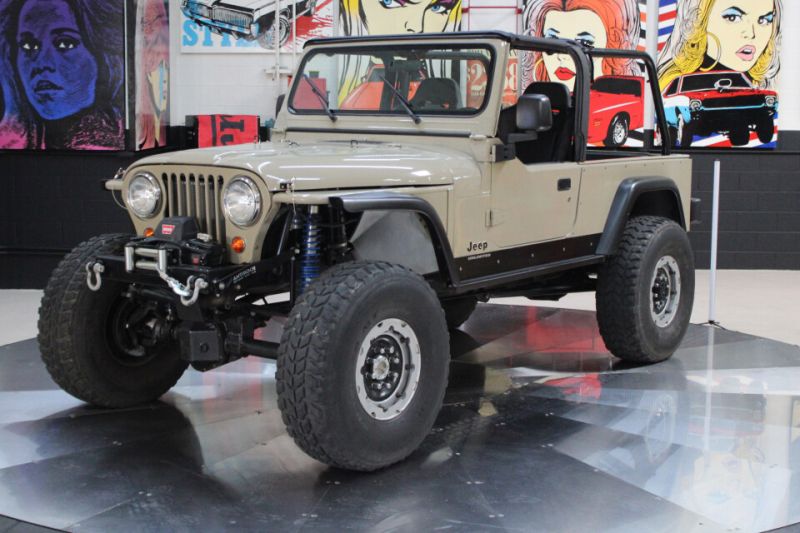
The Moab Chamber of Commerce, looking for a way to draw visitors during the slow season the way Georgetown, California had done with its own Jeepers Jamboree, organized the first Easter gathering in 1967. A relatively small group of local Jeep owners, many of them driving CJ-5s and CJ-6s pressed into service from ranch and mining work, ran a handful of trails around town over the Easter weekend. It was modest compared to what the event would become, but the formula, local terrain, a CJ owning community, and a holiday weekend with slow tourist traffic, proved just as durable in Utah as it had in California.
Slickrock changes the calculation
Sandstone slickrock behaves differently from granite. It offers extraordinary traction when dry, enough that a CJ could climb angles that looked impossible from the trailhead, but it becomes treacherous when wet, and its domed, undulating surface hides drop offs that are not visible until a driver is committed to the line. Moab's terrain rewarded a driver's nerve and a vehicle's articulation in roughly equal measure, and the CJ's flexible, solid axle suspension let its tires stay planted on uneven rock in a way that stiffer, independently sprung vehicles of the era could not match.
Local ranchers and miners had used Jeeps on this terrain for utility purposes since shortly after the CJ-2A's 1945 introduction, but it was the organized Easter event that turned that practical use into a recreational draw with national visibility. By the 1970s, four wheel drive clubs from across the western United States were making the trip to Moab specifically for the Easter weekend, and the event's growth tracked closely with the CJ-5's own two decade production run.
A proving ground parallel to the Rubicon
Moab and the Rubicon Trail developed somewhat independently of each other through the 1950s and 1960s, but both fed the same broader culture, one where a stock or lightly modified CJ was expected to prove itself on genuinely difficult natural terrain, in front of other owners, as a matter of course. Drivers who attended both events over the years often compared notes on which terrain was harder on a vehicle, granite's sharp edges and boulder fields against sandstone's deceptive traction and exposure, without ever reaching a real consensus. What both places agreed on was that the CJ, when properly maintained, could do it.
That shared reputation is part of a broader pattern worth reading in full through jeep cj renegade history, where the CJ's cross country trail reputation, built simultaneously in California and Utah, became central to how the brand and the vehicle were understood by owners and by the manufacturer itself. Jeep did not need to invent a capability story for the CJ. Moab and the Rubicon were writing it independently, year after year, and dealers were happy to let the photographs do the marketing.
"Standing at the edge of a slickrock dome for the first time, watching a CJ that looked far too small for the job simply walk up and over it, changes how you think about what a vehicle is supposed to be capable of. Moab did that to a lot of people over the years, quietly, one Easter weekend at a time."
- Nora Beckett
What the safari left behind
The Easter Jeep Safari outlasted the CJ's production run by decades and has grown considerably beyond what it was in the CJ era, now closely tied to modern Jeep marketing and concept vehicle debuts. But the trails themselves have not changed much, and the CJs that still make the trip, restored, patient, driven by owners who understand the vehicle's limits, remain a visible reminder of where the event's credibility originally came from. A related account of how that off road identity spread across the culture can be found in a related story about the CJ's broader image as an outdoor vehicle.
For collectors, a CJ with documented Moab or Easter Safari history occupies the same category of provenance as one with Rubicon history, evidence that the vehicle was used exactly as intended rather than simply preserved. Those interested in that kind of history behind the wheel can look at CJs for sale now and weigh how much of that trail heritage has survived alongside the sheet metal.
Two trails, one reputation
Moab and the Rubicon were never in direct competition so much as parallel proving grounds, each reinforcing the same idea on different terrain. Together they did more to establish the classic CJ's off road credibility than any single advertisement or dealer brochure could have managed, because the proof was public, repeated annually, and entirely dependent on the vehicle actually doing what its reputation claimed.
How the town itself changed alongside the event
Moab's transformation from a struggling mining town to a recreation destination did not happen overnight, and the Easter gathering was only one piece of a longer economic shift that also included the growth of nearby Arches and Canyonlands as national park destinations. But the CJ owning crowd that showed up every spring gave local businesses a reliable, recurring source of visitors during a season that had previously been quiet, and that reliability mattered enormously to a town whose mining economy was already beginning to decline by the late 1960s.
Local guides and outfitters who got their start showing CJ owners around the area's back roads and slickrock formations in the 1960s and 1970s often built the foundations of businesses that still operate in Moab today, now serving a much wider range of vehicles and visitors. That continuity, a tourism economy built originally around the CJ's specific capabilities and later expanded to serve an entire off road recreation industry, is easy to miss in the town's current identity as a mountain biking and adventure sports hub, but the CJ owning club members of the 1960s were doing much of the early groundwork, one Easter weekend at a time, well before the wider industry existed to build on it.
Sources and notes
Related Reading
Have a
Jeep CJ
for Sale?
Reach thousands of serious classic car collectors across the US.
Sell It Here →
Selling a classic? Here's how: sell my classic car
Are You a Classic Car Dealer?
List your full inventory and connect with targeted classic car buyers.
Join as a Dealer →

About the author
Nora Beckett
Automotive features writer and photographer who tells the human stories behind the cars, from show fields to cross-country road trips.
Related Listings - Jeep CJ

Comments
Be the first to comment on this article.