
A vehicle does not need dialogue to become a character, and the classic Jeep CJ proved that on screen for decades before most audiences could have named its model number. From black and white postwar features to the network television series that made it a Friday night fixture, the Jeep CJ culture tv and film history is a long list of supporting roles that quietly built the vehicle's public identity as much as any advertisement did.
Car Features
7 min read
The CJ on Screen: A Star of Film and Television
From background war films to Friday night television, the classic Jeep CJ built a recognizable screen identity that quietly shaped how America saw the vehicle.
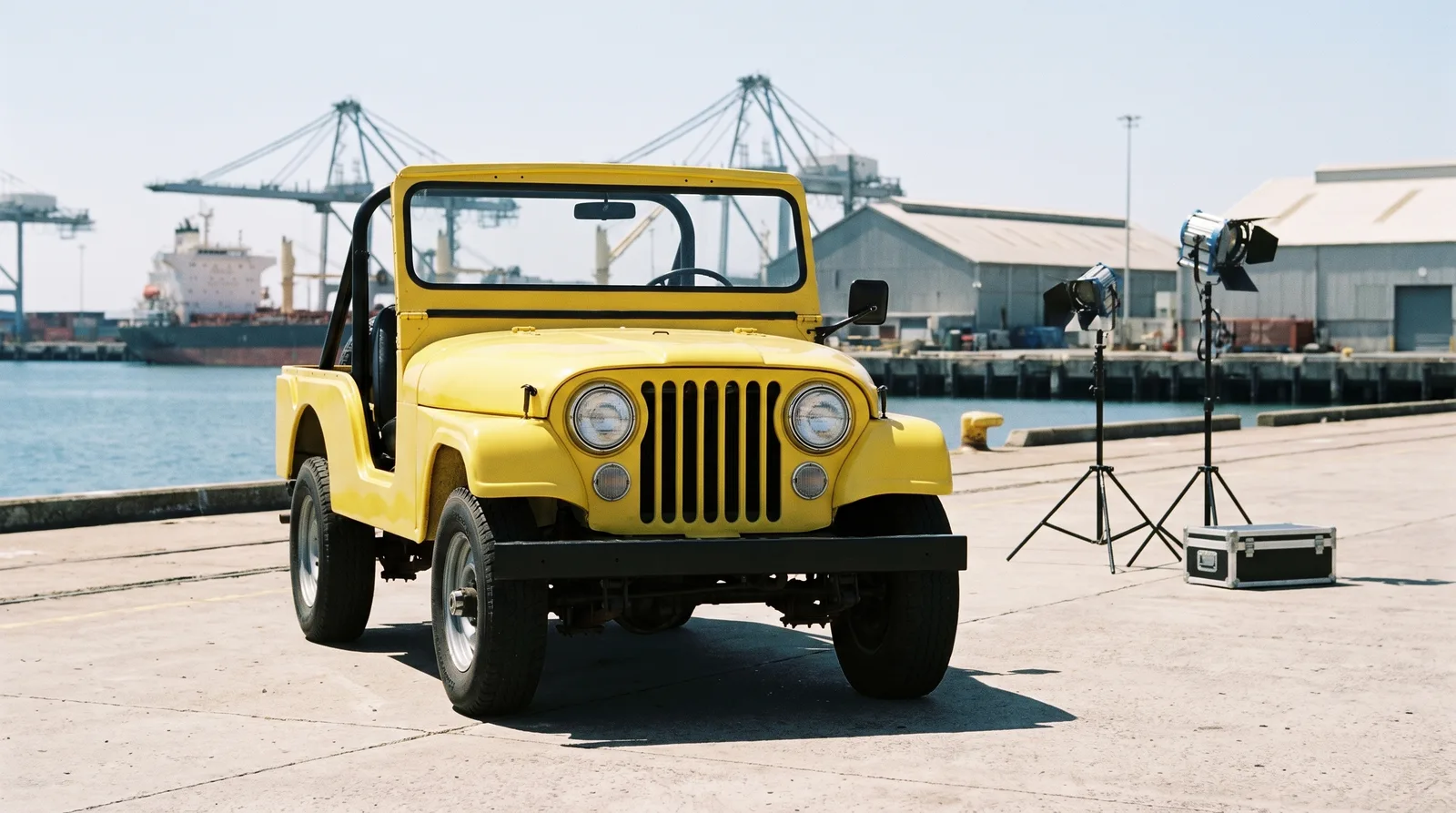
An early, practical kind of stardom
The CJ's first screen appearances were rarely credited and rarely intentional in a marketing sense. War films made throughout the late 1940s and 1950s used surplus military Jeeps and their close civilian cousins simply because they were available, affordable, and authentic looking for the period. Studios did not need to dress a set with a CJ to suggest military or rural authenticity; the vehicle already carried that association naturally, a direct inheritance from its wartime origins as the Willys MB.
That practical, background casting continued through the 1950s in westerns and adventure pictures, where a CJ-3A or CJ-3B might appear as a ranch vehicle, a forest ranger's transport, or a means of getting characters into difficult terrain the plot required. These were not glamorous roles. The Jeep rarely got a close up. But the accumulation of appearances, film after film, decade after decade, built a visual shorthand: when a character needed a vehicle that could go anywhere without explanation, a CJ was the answer, because audiences already understood what it was for.
Television finds its own use for the CJ
Television, with its constant appetite for location footage and its smaller budgets compared to feature films, leaned even harder on the CJ through the 1960s and 1970s. Adventure and rural drama series regularly used CJ-5s as background vehicles or minor plot devices, valued for the same reasons real owners valued them: reliability, simple maintenance, and the ability to be filmed convincingly crossing rough terrain without a stunt coordinator needing to worry about a fragile vehicle failing mid take.
The CJ's television presence was rarely the centerpiece of a show's marketing, but it was consistent, appearing across genres from rural comedies to detective series that needed a character with an outdoorsman's edge. That consistency mattered more than any single starring role would have, because it meant a large national television audience saw the CJ regularly, in ordinary use, without the vehicle ever needing to be explained or introduced. It simply belonged in the scene.
From background prop to cultural signal
By the late 1970s and into the AMC-era CJ-7's production run, the vehicle's screen appearances had shifted subtly from purely functional to genuinely symbolic. Filmmakers and television producers increasingly used a CJ on screen as visual shorthand for a character's values: independence, a preference for rural or wilderness settings over urban life, a certain rugged self sufficiency. Putting a character behind the wheel of a CJ told the audience something about them before a line of dialogue was spoken.
That symbolic weight did not develop in a vacuum. It grew directly out of the same cultural associations built by real world CJ ownership, the hunting and fishing crowd, the off road trail culture centered on events like the Jeepers Jamboree, and the vehicle's agricultural roots going back to the CJ-2A. Screen writers and directors were drawing on an image audiences already recognized from their own lives or their neighbors' driveways, which is part of a broader pattern covered in where this started, the full arc of how the CJ's cultural identity took shape across multiple, overlapping communities of owners.
"Nobody wrote a scene explaining what kind of person drove a CJ. They didn't have to. Audiences already knew, because half of them had an uncle or a neighbor with one parked in the yard, mud still on the tires from the weekend before."
- Nora Beckett
Why the CJ photographed well
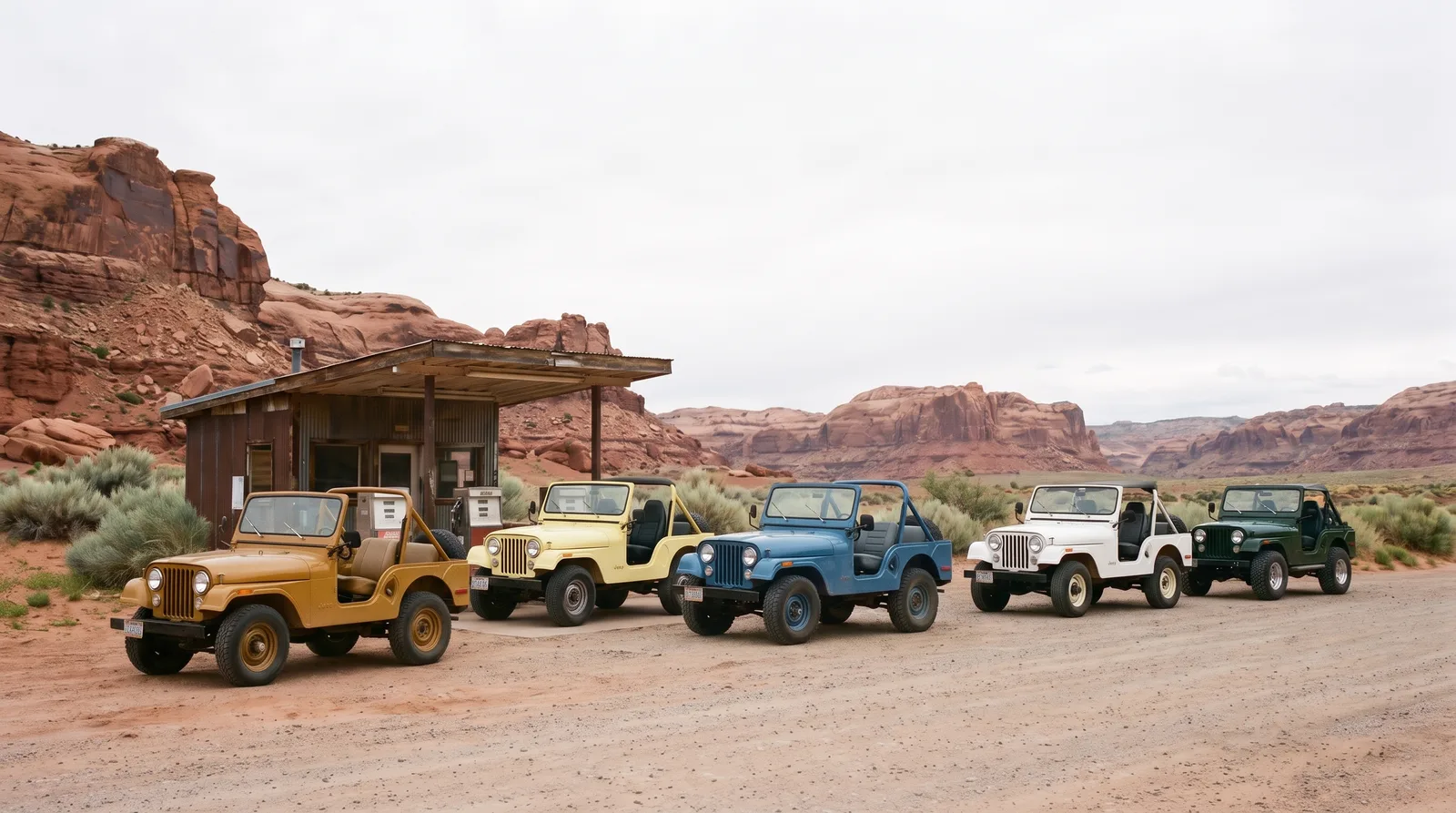
Part of the CJ's durability on screen was simply practical. Its open body, removable doors, and folding windshield gave cinematographers flexibility that a closed sedan could not offer, allowing actors to be filmed clearly from multiple angles without a roof or door pillar interrupting the shot. Its compact size made it easy to frame against dramatic scenery without dwarfing the human subjects in a scene, and its distinctive silhouette, round headlights, flat hood, exposed grille slats, remained instantly recognizable even in wide shots or brief cutaways.
Those same qualities that made the CJ useful to real off road drivers, simplicity, visibility, a compact footprint, translated directly into practical advantages for film and television production. It is a rare case where a vehicle's functional design and its photogenic qualities lined up almost perfectly, and that alignment is a large part of why the CJ appeared so consistently across so many different productions over such a long stretch of decades.
A legacy that outlasted the production run
The CJ went out of production in 1986, but its screen appearances did not stop overnight, and reruns of the television series that featured it kept the vehicle in front of audiences for years afterward. That extended visibility helped cement the CJ's identity for viewers who never owned one and might never have encountered it otherwise, turning a discontinued utility vehicle into a recognizable piece of American visual culture.
For collectors and enthusiasts today, that screen legacy adds another dimension to an already layered history. A restored CJ from this era carries not just its mechanical and off road heritage but a visual familiarity built by decades of appearances that most owners can recall from childhood television without necessarily being able to name the show. Those drawn to that history can shop classic CJ listings and consider how much of that recognizable silhouette survives in an original, unmodified example.
The specific vehicles that got remembered
A handful of individual, named on screen CJs have achieved a kind of secondary fame beyond the vehicle's general background presence, becoming reference points that enthusiasts still discuss and, in some cases, attempt to replicate for their own restorations. These specific screen vehicles tended to receive more deliberate customization than the background examples used purely for location filming, since a recurring character vehicle needed to be visually distinct enough for audiences to recognize it episode after episode or scene after scene.
Replica building around these specific screen examples has become a modest but persistent niche within CJ restoration circles, with builders researching paint codes, roll bar configurations, and period correct accessories in an effort to match a particular on screen vehicle as closely as possible. That level of dedication says something about how deeply certain screen appearances embedded themselves in viewers' memories, enough that decades later, someone is still willing to spend considerable time and money chasing an exact visual match to a vehicle that was, after all, only ever a prop.
Sources and notes
Related Reading
Have a
Jeep CJ
for Sale?
Reach thousands of serious classic car collectors across the US.
Sell It Here →
Selling a classic? Here's how: the best sites to sell a classic car
Are You a Classic Car Dealer?
List your full inventory and connect with targeted classic car buyers.
Join as a Dealer →

About the author
Nora Beckett
Automotive features writer and photographer who tells the human stories behind the cars, from show fields to cross-country road trips.
Related Listings - Jeep CJ

Comments
Be the first to comment on this article.