
Ask most American jeep owners where the mahindra jeep cj connection comes from and you'll get a blank look. Ask a mechanic who's worked on imports and you might get a nod, because the arrangement between Willys and a small Indian company is one of the longest-running licensing deals in automotive history, and it's still paying off decades after most people assumed it had quietly ended.
Car Features
7 min read
Mahindra and the Jeep CJ: The Indian-Built Civilian Jeep
The Mahindra Jeep CJ connection is a decades-long licensing story that saw India build CJ-3B derived jeeps long after Willys itself had been absorbed into Kaiser and AMC.
How an Indian firm ended up building American jeeps
Mahindra and Mohammed, later renamed Mahindra and Mahindra, started out assembling Willys jeeps under license in India not long after the country's independence, importing complete knock-down kits and putting them together locally for a market that badly needed a durable, simple utility vehicle. This wasn't a knockoff operation or a gray-market copy job. It was a legitimate licensing agreement, the kind Willys cut with several overseas partners in the postwar years as it looked for ways to expand the CJ platform's reach without building and shipping finished trucks across the globe. India's roads, climate, and agricultural economy suited the jeep's simple mechanicals about as well as anywhere on earth, and the relationship stuck around long after most of Willys' other overseas licensing deals had wound down.
What made the CJ-3B such a good fit for licensing
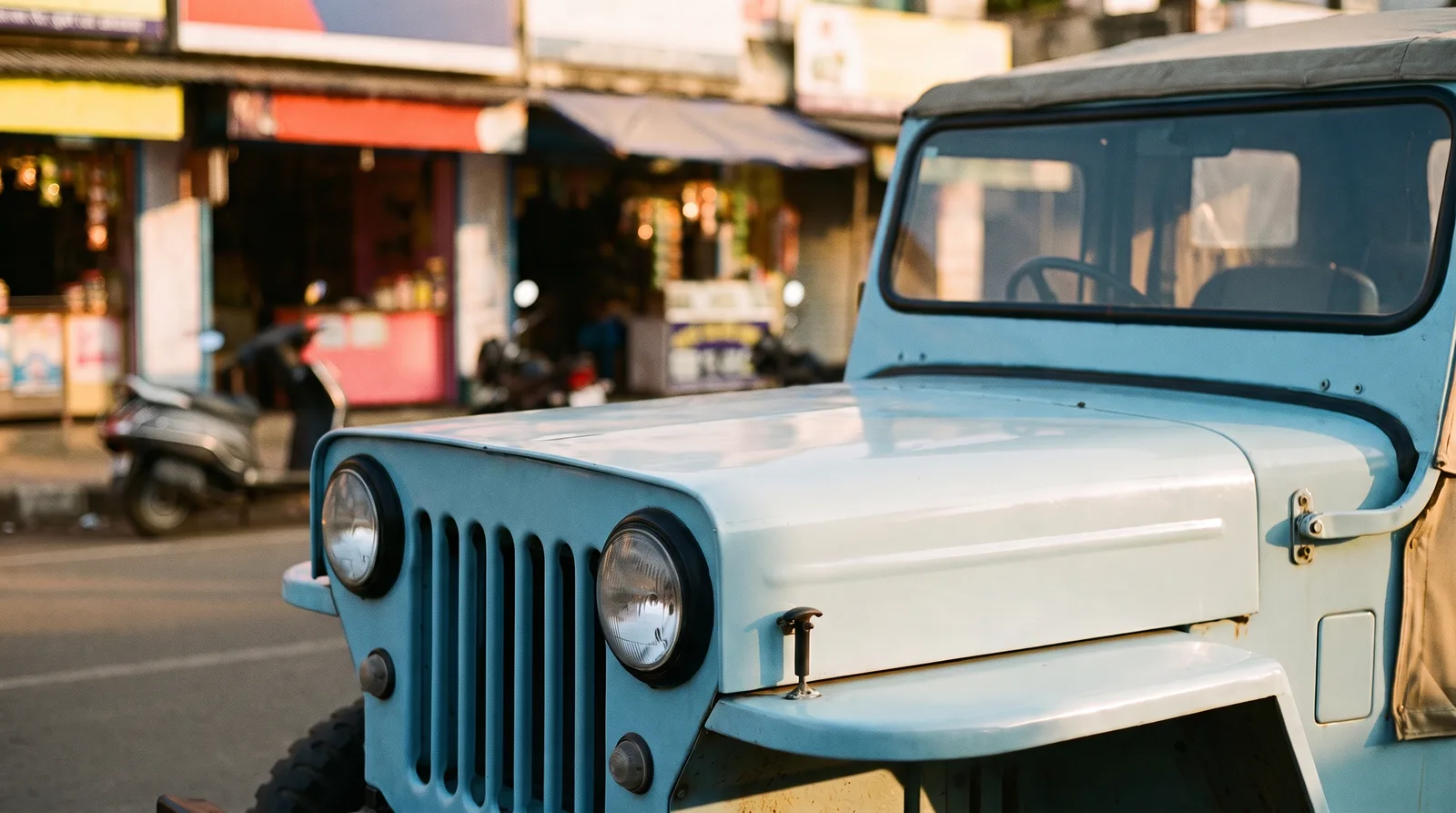
The specific model at the heart of this deal was the CJ-3B, a taller-hooded evolution of the CJ-3A built to clear a new overhead-valve engine. That taller hood is the giveaway if you're trying to spot a Mahindra-built jeep in old photographs, since the basic shape carried straight through the licensing agreement with minimal changes. From a manufacturing standpoint, the CJ-3B was about as forgiving a design as a licensee could ask for. No unibody stampings requiring massive dedicated presses, no complex electronics, just a ladder frame, a simple body, and a drivetrain that a modestly equipped factory could assemble and eventually build components for locally as tooling investment grew. That's not a small thing when you're setting up vehicle production in a country that, in the late 1940s, had almost no domestic auto industry to build on.
| Detail | Note |
|---|---|
| Base model licensed | CJ-3B, tall-hood overhead-valve variant |
| Licensee | Mahindra and Mohammed (later Mahindra and Mahindra) |
| Market served | India, agricultural and utility use |
| Production span | Continued in India until about 2010, decades after CJ-3B production ended in the US |
Why this isn't just a footnote for parts guys
I've had customers bring in trim pieces and small components pulled off Mahindra-built vehicles thinking they'd found something exotic, and honestly, the fit is close enough on a lot of parts that it's worth knowing this history exists before you assume every oddball piece on a flat-fender jeep is either NOS or a bad reproduction. The CJ-3B's mechanical simplicity meant Mahindra's Indian-built versions and the American originals shared enough underlying design that cross-reference confusion still trips people up at swap meets. It's not a restoration shortcut I'd recommend leaning on blind, but it's good to know the history behind why some parts look almost right and not quite right at the same time. For the broader story of how the CJ platform got to this point in the first place, the full story covers the earlier Willys years that set up everything Mahindra eventually built on.
"You want to know how good a design is, don't ask the guy who built it. Ask the guy who's still building it seventy years later on the other side of the planet."
- Mike Sullivan
What kept the deal going so much longer than most
Plenty of postwar licensing arrangements between American manufacturers and overseas partners fizzled out within a decade or two, either because the licensee developed its own competing designs or because the parent company decided the arrangement no longer served its interests. The Mahindra deal kept going because both sides kept getting something out of it. Mahindra built genuine manufacturing expertise, supplier relationships, and brand trust in a domestic market that badly needed reliable utility vehicles, while the underlying jeep design proved durable and simple enough that it did not need constant re-engineering to stay relevant to Indian buyers. That's not something you see very often in the auto industry, where most licensed products get replaced or redesigned within a few product cycles. This one just kept working, decade after decade, because nobody involved had a strong reason to fix something that wasn't broken.
A lesson in how good engineering travels
There's a broader point buried in this story that goes beyond parts identification and swap meet trivia. The CJ-3B's design, simple enough for a shop with limited tooling to build, rugged enough to survive punishing conditions, and useful enough that farmers and small businesses actually wanted to buy one, turned out to be exportable in a way a lot of more sophisticated vehicles never manage. You don't license a complicated unibody sedan to a fledgling manufacturer halfway around the world and expect it to work smoothly for decades. You do it with a simple ladder-frame truck built from parts a modest factory can actually produce, and that's exactly what happened here.
The wartime roots underneath it all
None of this licensing story happens without the original military jeep the CJ line descended from in the first place. The CJ-3B's overhead-valve engine and taller hood were evolutions of a formula that traced straight back to the wartime MB, and readers curious about that earlier chapter, before civilian jeeps existed at all, will find it worth a look too. It's a good reminder that the jeep's basic recipe, simple frame, simple body, simple drivetrain, was durable enough to get exported, licensed, and rebuilt on the other side of the world without losing what made it work.
What American shops learned by accident
A surprising number of the mechanics and restorers who first bumped into this history did so the hard way, ordering a part they assumed was a standard CJ-3B component only to discover a slight dimensional mismatch or a different casting mark once it arrived. Those small surprises, repeated often enough across enough shops over enough decades, eventually built a kind of informal, word-of-mouth awareness within the restoration community that a parallel production line existed on the other side of the world. Nobody sat down and wrote a definitive guide to sorting Mahindra parts from genuine Willys parts. The knowledge spread the way most useful shop knowledge spreads, through mistakes, corrections, and the occasional grumbling phone call to a parts supplier asking why the part they sent didn't quite fit.
What it means for today's buyers
None of this changes how you should shop for a genuine American-built CJ, but it's a good piece of context to carry around, especially if you ever run into a jeep with slightly unfamiliar badging or trim while traveling. The core mechanicals stayed close enough across both production lines that the CJ's reputation for durability really was earned twice over, once in Toledo and once in India. If you're looking for the real thing built stateside, shop classic CJ listings to see what's currently on the market.
Sources and notes
Related Reading
Have a
Jeep CJ
for Sale?
Reach thousands of serious classic car collectors across the US.
Sell It Here →
Selling a classic? Here's how: the best sites to sell a classic car
Are You a Classic Car Dealer?
List your full inventory and connect with targeted classic car buyers.
Join as a Dealer →

About the author
Mike Sullivan
Detroit-area muscle car enthusiast and restoration specialist with three decades of hands-on experience working on American iron.
Related Listings - Jeep CJ


Comments
Be the first to comment on this article.