
The photograph is nothing special at first glance. A driveway in Ohio, 1978, two trucks parked nose to nose like they are sizing each other up. A squarebody K5 Blazer on the left, full doors, boxy fenders, chrome bumper catching the afternoon sun. A second-generation Bronco on the right, shorter, chunkier, its round headlights giving it a face the Chevrolet does not have. Somebody's father stands between them with his hand on each hood, grinning like he cannot decide which one he loves more. That photo, tucked into a shoebox for four decades before a grandson scanned it for a Facebook group, is the whole k5 blazer vs bronco squarebody era argument in one frame. Two families, two trucks, one driveway, and no consensus.
Car Features
7 min read
Squarebody K5 Versus the Second-Gen Bronco
The real K5 versus Bronco rivalry only started in 1978, when Ford finally built a full-size Bronco to match Chevrolet's squarebody Blazer.
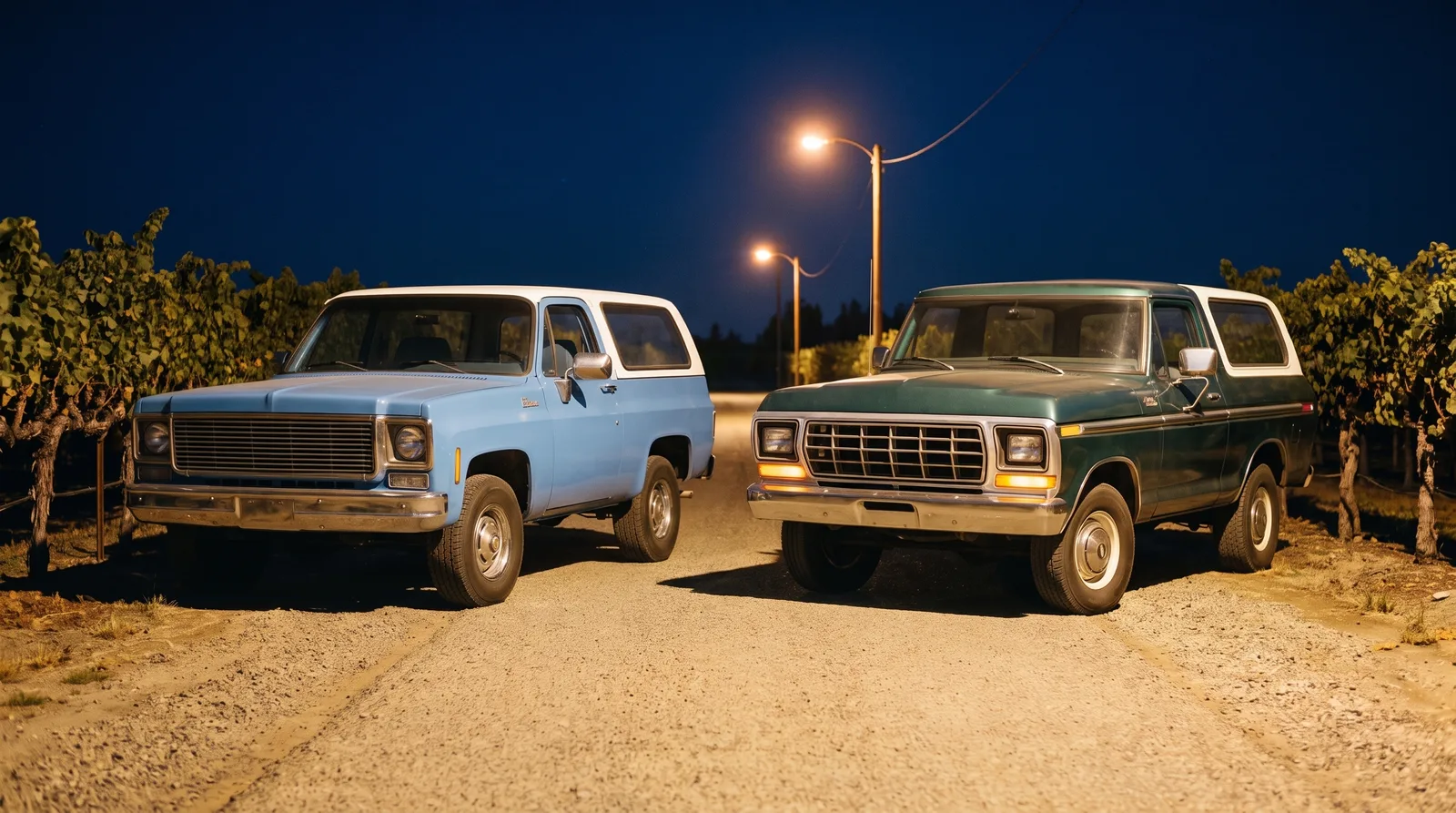
By the time that photo was taken, both trucks had already changed shape once. The first Bronco arrived in 1966 as a tidy little thing built on its own chassis, closer in spirit to an International Scout than to a full-size pickup. The original K5 Blazer showed up in 1969 wearing a removable fiberglass top and full-size Chevrolet truck bones underneath. For a few years the two trucks were not really rivals in the way people remember them. They occupied different weight classes.
When Ford grew up to meet Chevrolet
Everything changed in 1978, when Ford finally replaced the small first-generation Bronco with a truck built on the F-150 platform. Suddenly the Bronco was full-size too, with a removable hardtop of its own and a straight-up fight for the same buyer who had been cross-shopping a K5 for a decade. The rivalry people argue about at truck shows today, the one with real stakes and real bragging rights, only runs from 1978 to 1991, when both trucks were squarebodies competing for the same driveway, the Bronco still wearing its removable hardtop and the K5 by then wearing a fixed half-cab roof of its own.
That is a narrower window than most people assume, and it matters. The 1969-72 K5 with its rounded fenders was a different animal entirely, more a running mate to the small Bronco than an ancestor of the fight that mattered. If you want the fuller lineage, read the background on how these two trucks first crossed paths before either one wore squared-off sheet metal.
Two ways of solving the same problem
Ford's engineers gave the second-generation Bronco a swing-out tailgate and a spare tire mounted on the inside, which some owners loved for keeping the tire out of the weather and others hated because it ate into cargo room. Chevrolet stuck with a drop-down tailgate and hung the spare underneath the frame, simpler, more familiar to anyone who had owned a pickup, and easier to service on the side of a road. Neither solution was wrong. They were just different answers written by different engineering cultures, one leaning toward novelty, the other toward what the parts bin already had.
Interior space told a similar story. The K5's frame was a touch longer between the axles, which gave rear passengers marginally more knee room, a detail that mattered to families cross-shopping both trucks as a second vehicle rather than a toy. The Bronco countered with a tighter turning circle and a reputation, deserved or not, for feeling nimbler on tight trails. Neither truck won every category. That is exactly why the argument never fully resolved itself, then or now.
What the driveways actually looked like
Sales figures from the era show Chevrolet holding a modest edge most years, helped by dealer networks that were simply larger and by Blazer buyers who often already owned a Chevy half-ton and wanted something that felt familiar. But Ford buyers were rarely apologetic about their choice. Bronco loyalty in the late 1970s and 1980s tended to run in families and in regions, thick in parts of Texas and the Mountain West where a Ford dealer had been the only game in town for a generation. Brand loyalty, more than any spec sheet, decided a lot of these driveway standoffs.
What nobody was thinking about in 1978 was resale value forty years later. Buyers picked based on which dealer treated them fairly, which truck their neighbor already owned, which color was on the lot that Saturday. The rivalry we talk about now, with auction results and Instagram debates, is something collectors built retroactively out of what were originally two very ordinary purchasing decisions.
"Nobody in 1980 thought they were buying a future collectible. They were buying whichever truck the dealer down the road had in stock with a good interest rate. The romance came later, and it came from us, the people who kept them running."
- Nora Beckett
Why the argument still has teeth
Part of what keeps this rivalry alive is that both trucks aged into the same role at roughly the same pace. Neither the K5 nor the Bronco was built with collectibility in mind, and both spent the 1990s and 2000s as cheap, capable trucks that people worked hard and modified without much sentiment. It was only in the last fifteen years or so that both climbed out of that phase together, which means the market has forced them into a head to head comparison that neither generation of buyer originally intended. Engine choices added another layer to the argument that dealers loved to exploit. Chevrolet buyers in the squarebody era could step up through a range of small and big block V8s, with the 350 becoming the default choice for most K5 buyers by the early 1980s. Ford countered with its own 351 and 400 cubic inch options before eventually settling into the 302 and 351 lineup that carried the Bronco through the rest of the decade. Neither company had a clear horsepower advantage most years, and the real difference buyers noticed was in how the trucks sounded and idled rather than in any number on a window sticker. A mechanic who grew up around both trucks could usually tell one from the other with his eyes closed, just from the exhaust note drifting through an open garage door. Fuel economy was never the point of either truck, but the two companies advertised around the subject differently. Chevrolet leaned on the K5's carryover reputation from the pickup line, implying reliability through familiarity. Ford leaned harder on capability claims, publishing approach angles and wading depths that most Bronco owners never once tested outside a dealer brochure. Both companies understood that nobody cross-shopping these trucks in 1980 was reading spec sheets closely. They were reading the truck itself, walking around it in a parking lot, deciding by feel. Walk any truck show today and you will still find the same argument playing out that started in that Ohio driveway, just with better lighting and higher stakes. If you are chasing one of these squarebody-era trucks for yourself rather than just the debate, it is worth taking a look at what is actually available before picking a side. You can browse classic K5 Blazer listings and get a feel for real-world condition and pricing rather than relying on nostalgia alone.
The photograph in that shoebox never settled anything, and neither will this piece. That is fine. Some rivalries are healthier left unresolved, kept alive by people who genuinely love both answers to the same question and just cannot bring themselves to admit it out loud.
Sources and notes
Related Reading
Have a
Chevrolet Blazer
for Sale?
Reach thousands of serious classic car collectors across the US.
Sell It Here →
Selling a classic? Here's how: compare the places to sell classic cars
Are You a Classic Car Dealer?
List your full inventory and connect with targeted classic car buyers.
Join as a Dealer →

About the author
Nora Beckett
Automotive features writer and photographer who tells the human stories behind the cars, from show fields to cross-country road trips.
Related Listings - Chevrolet Blazer
More in Car Features
Comments
Be the first to comment on this article.