
I met a guy named Duane at a trailhead outside a state forest a few years back, the kind of place where half the vehicles in the lot are lifted and the other half wish they were. He had a 1976 K5 Blazer with mud still caked to the rocker panels from the weekend before, and parked next to him was a buddy in an early Bronco that looked like it had been washed that morning out of spite. Neither one would shut up about which truck actually deserved to be there. That argument, K5 Blazer vs Bronco off road, has been running since before either truck had earned a speck of the mud it wears today.
Car Features
7 min read
K5 Blazer or Bronco on the Trail
The K5 Blazer's truck-derived strength and the early Bronco's short-wheelbase agility make this an argument that terrain, not spec sheets, ultimately settles.
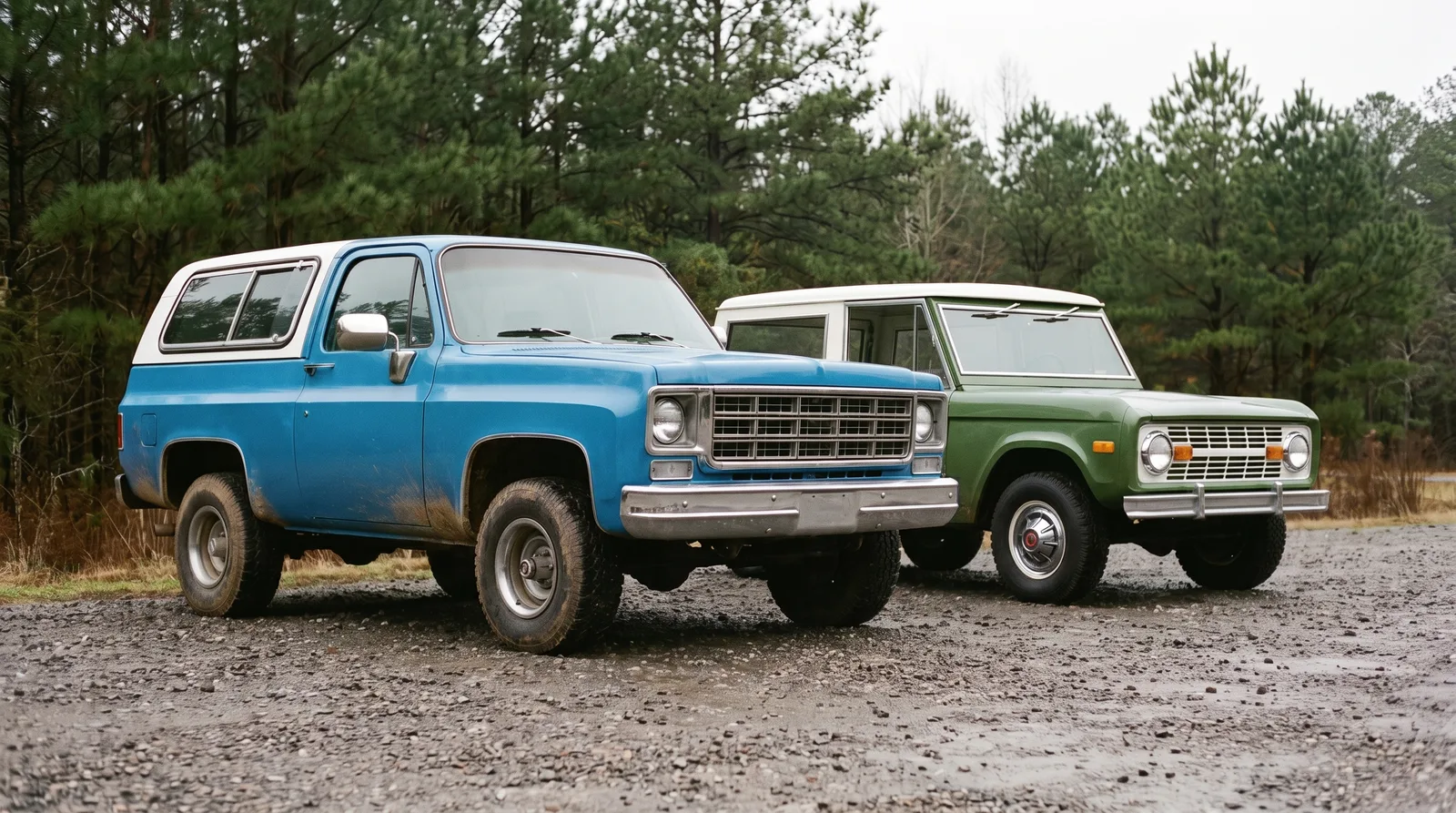
The Bronco's case: small, light, and eager
Ford built the first Bronco on its own dedicated frame, short and light compared to a full-size truck, with a wheelbase around 92 inches. On a tight, technical trail, that shorter wheelbase is a genuine advantage. It lets the truck twist through switchbacks and clear obstacles that a longer vehicle has to work harder around. Early Broncos also carried less overall weight than their K5 counterparts, which matters when you are trying to keep momentum over loose rock or sand without digging a hole for yourself. Duane's buddy was not wrong that his Bronco felt more nimble picking through the technical sections of that trail. It is built to feel that way.
The K5's case: leverage, wheelbase, and a truck's worth of grunt
Duane's answer, delivered with the confidence of a man who had just spent a weekend proving it, was that the K5's longer wheelbase and heavier-duty running gear pay off exactly where it counts most, on the kind of long, rough climbs where momentum and stability matter more than tight-radius agility. Built on a shortened half-ton pickup platform, the K5 carried more low-end torque potential from its available V8 options and a stouter set of axles borrowed straight from Chevrolet's truck line. Where the Bronco threads a needle, the K5 muscles through, and on longer or more washed-out trails that difference shows up as fewer moments of doubt behind the wheel.
Where the terrain decides the winner
Neither Duane nor his buddy actually settled anything that day, because the honest answer depends entirely on the trail. Rock crawling through a tight canyon with sharp turns favors the Bronco's shorter wheelbase and lighter overall mass. A long climb up loose scree, or a muddy forest road that demands sustained torque rather than nimbleness, tends to favor the K5's truck-derived strength. Enthusiasts who have wheeled both trucks extensively will generally tell you the same thing in different words: pick your terrain first, then pick your truck.
There is also a durability angle that rarely gets its due in these arguments. Because the K5 shared so much hardware with Chevrolet's pickup line, parts availability and mechanical toughness in the field were never much of a mystery to anyone running one hard. A broken part on a trail could often be limped home or improvised around using knowledge and components familiar from any full-size Chevy truck of the era. The early Bronco's more bespoke chassis, while excellent on the trail, meant its owners were working with a smaller, more specialized parts universe when something went wrong far from home.
"Duane's Blazer looked like it had been through a war and his buddy's Bronco looked like a showroom photo, and somehow they had both driven the exact same loop that weekend. That tells you everything about how differently these two trucks handle the same ground."
- Patrick Walsh
Geometry matters as much as raw dimensions once you are climbing over an obstacle rather than just driving toward one. A shorter wheelbase generally improves breakover angle, the clearance a truck has climbing over a sharp rise, which is part of why the early Bronco can crest terrain that would leave a longer truck hanging up on its own frame rail. The K5, longer between the axles, gives up some of that breakover advantage but gains stability on side slopes and washed-out ruts where a shorter truck can feel twitchier under the same conditions. Ground clearance itself was broadly comparable between the two once lifted, since both platforms responded well to the era's aftermarket suspension work, so the real geometry story is about breakover and departure angle rather than raw height off the dirt.
Tire and wheel fitment followed a similar logic. Because the K5 shared axles and brake components with Chevrolet's pickup line, owners had an easier time sourcing wider wheels and taller tire combinations without hunting down specialty parts. Bronco owners built a strong specialty aftermarket of their own over the decades, but in the era these trucks were new, a K5 owner chasing a bigger tire had an easier path simply because the parts already existed for the pickup it was built alongside.
What decades of trail use actually settled
What the off-road argument between these two trucks has settled, after more than fifty years of enthusiasts hashing it out at trailheads exactly like the one where I met Duane, is that there is no universal winner, only a better fit for a given trail and a given driver's priorities. That is a less satisfying answer than either camp wants, but it is the honest one, and it is a big part of why this rivalry has stayed alive for so long instead of getting settled once and forgotten.
If you want the fuller story behind how this whole rivalry got started, where this started is worth reading in full. And if Duane's mud-caked K5 has you leaning toward the truck-based side of this argument, there is usually a classic K5 Blazer for sale not too far from wherever your own trailhead happens to be.
Weight distribution front to rear plays into this too, and it is often overlooked in favor of the simpler wheelbase argument. The K5's engine and drivetrain, sized for pickup duty, sit over a chassis built to handle real payload, which means the truck tends to keep its footing on loose climbs where a lighter vehicle can lose traction the moment weight shifts unexpectedly. The Bronco's lighter overall package rewards a driver willing to manage momentum and line choice carefully rather than relying on sheer mass to power through. Both approaches work. They just ask different things of the person behind the wheel.
Bring your own trail
Ask a hundred owners which truck wins on the trail and you will get close to a hundred answers, most of them shaped less by engineering fact than by whichever truck got them through their favorite loop without drama. That is not a dodge, it is the actual lesson of the K5 Blazer vs Bronco off road debate. Both trucks were built to go where pavement ends, they just took different routes to get there.
Sources and notes
Related Reading
Have a
Chevrolet Blazer
for Sale?
Reach thousands of serious classic car collectors across the US.
Sell It Here →
Selling a classic? Here's how: sell my classic car
Are You a Classic Car Dealer?
List your full inventory and connect with targeted classic car buyers.
Join as a Dealer →

About the author
Patrick Walsh
Automotive journalist covering classic car shows, events, and the enthusiast community across North America.
Related Listings - Chevrolet Blazer
Comments
Be the first to comment on this article.