
I have spent enough hours parked in the driver's seat of both a K5 Blazer and an old Bronco, waiting on parts stores to open or just cooling off after a job, to have opinions about which one I would rather sit in for a long haul. The K5 Blazer vs Bronco comfort question does not get talked about as much as the off-road stuff, but for anyone who actually drove these trucks daily back in the day, it mattered plenty. A truck you fight with for two hours on the way to a job site gets old fast, no matter how good it looks parked.
Car Features
7 min read
Comfort and Space: Where the K5 Beat the Bronco
A hands-on look at why the K5 Blazer's pickup-derived cabin gave it more room and a calmer ride than the early Bronco, and what that means for daily driving today.
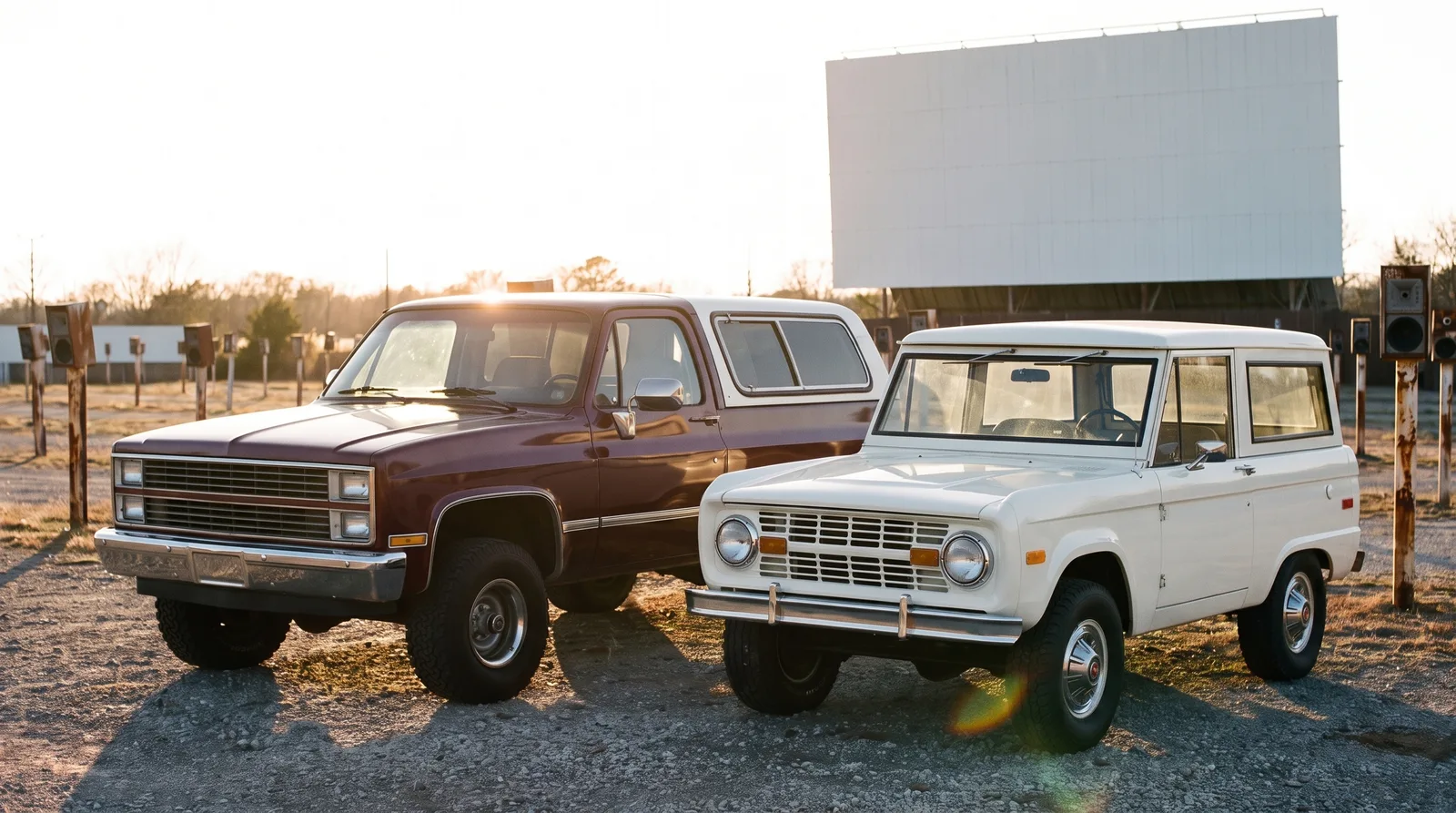
Room to actually move around
The K5's cabin benefits directly from being built on a full-size half-ton pickup platform. More wheelbase and a wider stance translate to more shoulder room and more legroom up front than the early Bronco offers, plain and simple. I have watched a six-foot-two friend fold himself into a first-generation Bronco's front seat and immediately start negotiating with the steering wheel for space. Put the same guy in a squarebody K5 and he stops complaining within about ten seconds. That is not a small thing if you are the one driving to work every day rather than just wheeling on weekends.
The tradeoff, and there always is one, is that the K5's extra size means it does not tuck into a parking spot or thread a narrow alley the way a Bronco can. Comfort inside the cab and comfort maneuvering the vehicle are two different arguments, and the K5 wins the first one while giving up a little on the second.
Ride quality, not just seat room
A longer wheelbase does more than free up legroom. It settles the ride over rough pavement, because the axles are spread out enough that the truck does not pitch and buck the way a shorter vehicle will over the same bumps. The K5, riding on that stretched pickup-derived frame, rides noticeably calmer on a washboard gravel road or a patched-up city street than the early Bronco's tighter chassis does. That firmness in the Bronco is part of what makes it sharp on a trail. It also means a long highway stretch in one wears on your back a lot faster than the same drive in a K5 does.
Heat, noise, and the parts of comfort nobody photographs
Nobody puts a photo of a heater core on a magazine cover, but anyone who has actually daily-driven one of these trucks through a real winter knows the cabin heat and noise levels matter as much as legroom. Both trucks, being body-on-frame vehicles from an era before serious sound deadening was standard, are loud at highway speed compared to a modern truck. That part is close to a wash between them. Where they differ is in how much of that noise and vibration gets telegraphed straight into the seat through a shorter, stiffer chassis versus a longer one that has more frame length to absorb it before it reaches you. My back has a strong opinion on which one wins that argument, and it is not the shorter truck.
Interior trim and equipment availability tell a similar story. Chevrolet, selling the K5 out of the same catalog as its pickup line, could offer a full range of comfort options, better seats, more sound insulation packages, plusher trim levels, because the tooling and supply chain already existed for the truck line it shared a body with. The Bronco's more bespoke chassis meant Ford had a narrower path to offering the same breadth of comfort options, at least until the platform-sharing redesign arrived in 1978.
"A truck that is fun for two hours on a Saturday and a truck you can stand driving five days a week are not automatically the same truck. The K5 was built to be both, because it never stopped being a pickup underneath."
- Mike Sullivan
Seat design itself played a role too. The K5's front bench, and later its available bucket seat options, were sized for a truck cab that already had to accommodate a full-size pickup's driver population, which skews toward a broader range of body types than a compact SUV's original design brief needed to cover. That is a subtle point, but it shows up the moment you put a larger driver behind the wheel of each truck back to back. The Bronco's seats are perfectly comfortable for a shorter stretch behind the wheel. They were simply never engineered against the same broad-shoulders, long-haul benchmark the K5's cab inherited from its pickup sibling.
What this actually means if you are buying one
None of this makes the Bronco a bad truck to own, it just means comfort was not the priority Ford was solving for with that first generation. If your plan for a classic K5 or Bronco involves regular daily driving, long highway stretches, or hauling passengers who complain about legroom, the K5's roomier cabin and calmer ride are worth weighing seriously against the Bronco's trail manners. If your plan is mostly weekend trail runs with short drives in between, the comfort gap matters a lot less than people assume.
We have covered how this whole rivalry unfolded generation by generation in the full story, worth a read if you want the complete picture beyond just the comfort angle. And if the roomier cabin has you leaning toward the Chevrolet side, you can go browse classic K5 Blazer listings and sit in one yourself before you decide anything.
Loading and unloading passengers is another area where the size difference quietly shapes daily comfort. A K5's wider door openings and taller cab give a driver room to swing in and out without contorting, something older passengers or anyone dealing with groceries and gear appreciates more than they will ever mention out loud. The Bronco, compact by design, asks a little more of anyone climbing in and out repeatedly through a workday, a small cost that adds up over months of regular use in a way it never does on a single weekend outing.
The seat-of-the-pants verdict
I am not going to pretend either truck rides like anything built in the last twenty years, because it does not. But between the two of them, the K5 Blazer is the one that lets you finish a long day behind the wheel without your shoulders and knees filing a complaint. That is not glamorous, but it is real, and it is exactly the kind of thing you only appreciate after you have actually spent the hours in the seat. Ask around any parking lot full of both trucks and you will find the same pattern, owners who love their Bronco for a Saturday trail run and owners who reach for their K5 without a second thought when the drive is longer than an afternoon.
Sources and notes
Related Reading
Have a
Chevrolet Blazer
for Sale?
Reach thousands of serious classic car collectors across the US.
Sell It Here →
Selling a classic? Here's how: sell my classic car
Are You a Classic Car Dealer?
List your full inventory and connect with targeted classic car buyers.
Join as a Dealer →

About the author
Mike Sullivan
Detroit-area muscle car enthusiast and restoration specialist with three decades of hands-on experience working on American iron.
Related Listings - Chevrolet Blazer
Comments
Be the first to comment on this article.