
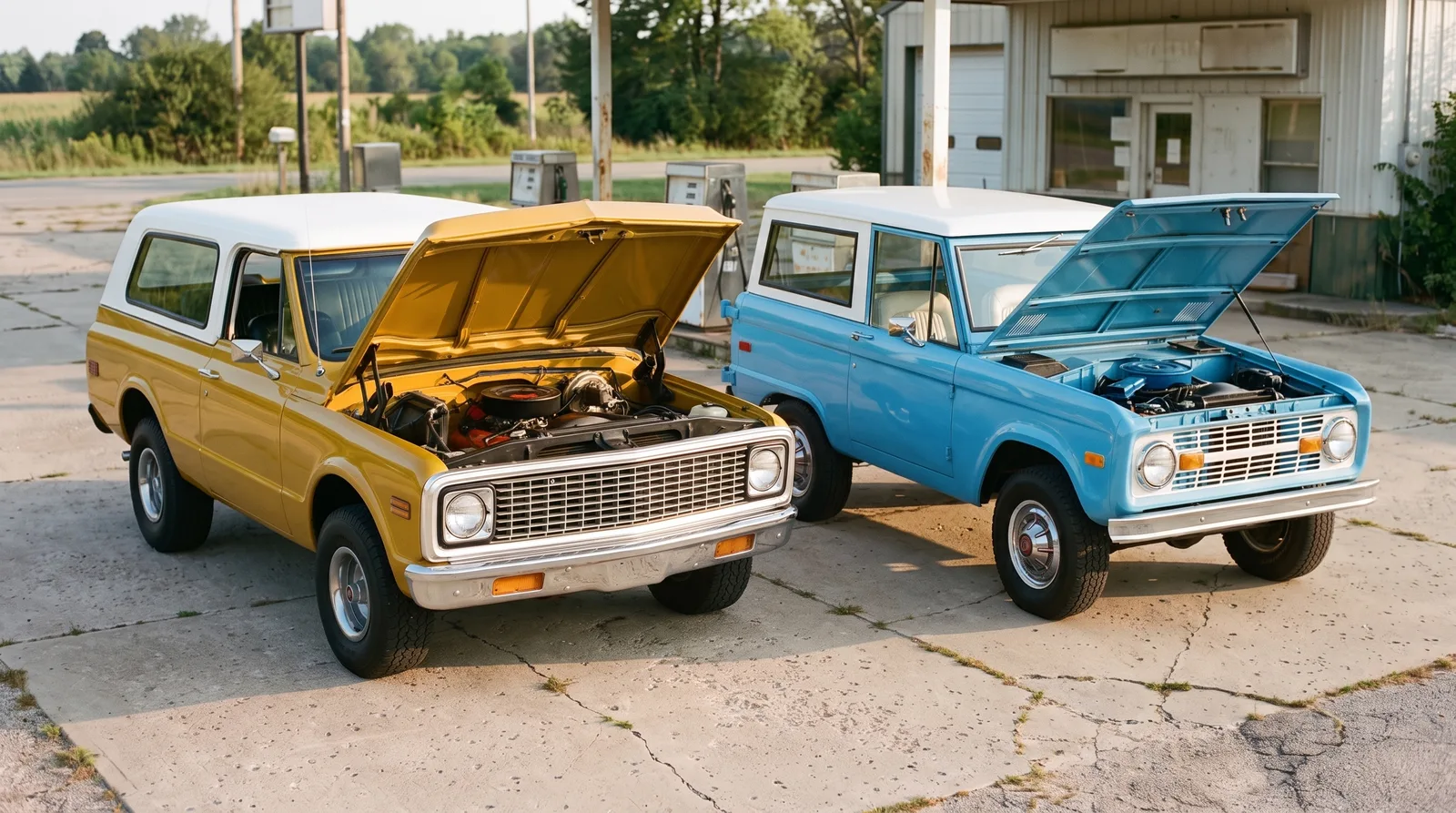
Ask a truck guy who was there and the k5 blazer vs scout argument gets loud fast. International Harvester had a full decade's head start on the whole idea of a small, tough, removable-top 4x4 by the time Chevrolet's K5 Blazer showed up in 1969. International built the original Scout starting in 1961, and it built the bigger Scout II starting in 1971 specifically to compete with the Blazer and the Bronco. That is a different story than most of the K5's rivalry pieces, because here Chevrolet was the one playing catch up on concept, even if it eventually won the war on sales.
Car Features
7 min read
K5 Blazer Versus International Scout: Who Actually Invented the Segment
International's Scout beat the K5 Blazer to market by nearly a decade, then stopped production in 1980. Here is how the two trucks actually compare.
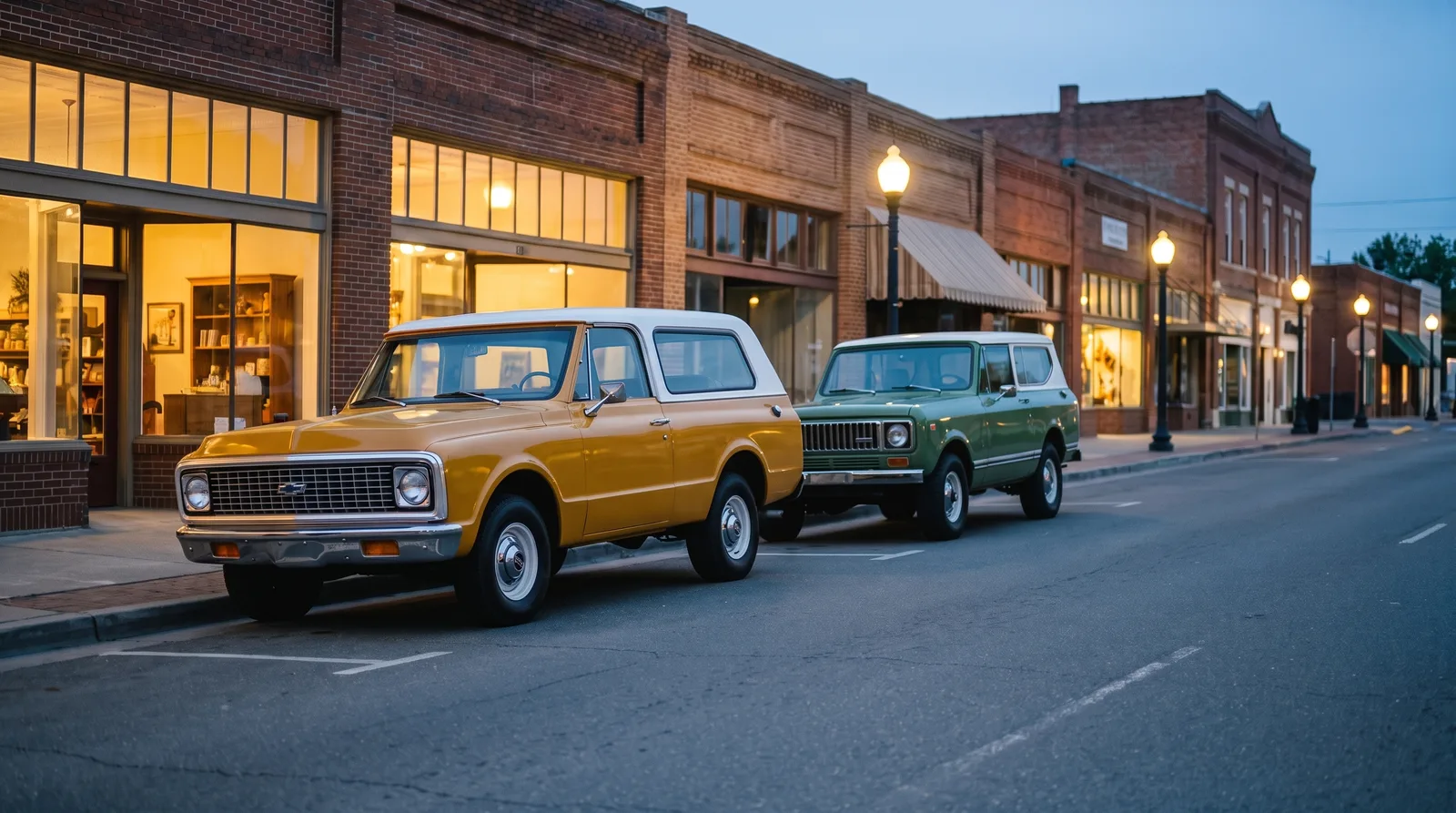
International invented the segment, then got outbuilt
The original Scout 80 was a small, boxy utility vehicle built more like a Jeep than a full-size truck, and it proved there was real demand for a compact 4x4 that could work a farm during the week and go hunting on the weekend. Chevrolet's K5 Blazer took the concept and scaled it up onto a proper half-ton pickup frame, giving it a bigger cabin, a smoother ride, and enough engine choices to include a genuine V8. That size difference is the whole story of why the K5 pulled ahead. The Scout stayed closer to its compact roots even after the Scout II arrived in 1971, and buyers who wanted a full-size 4x4 with real towing capacity increasingly looked at Chevrolet instead.
International's engineering was never the weak point. The Scout's drivetrain earned a reputation for being simple to work on and hard to kill, and that reputation still holds up with owners today. What International lacked was Chevrolet's dealer network and manufacturing scale. A company that built farm equipment and medium duty trucks was never going to out-produce General Motors, and by the time the squarebody K5 Blazer hit its stride in the mid-1970s, the production gap between the two trucks had become impossible to close.
Under the hood, two very different philosophies
The Scout II ran International's own four cylinder and V8 engines for most of its run, engines built by a company that also made engines for combines and dump trucks. That gives Scout engines a reputation for being overbuilt and durable, sometimes at the cost of refinement. The K5 Blazer leaned on Chevrolet's small block V8 family, engines that were already proven in millions of passenger cars and pickups, with parts sitting on shelves at nearly every auto parts store in the country. That accessibility, not raw durability, is what actually kept K5 Blazers on the road longer as a fleet, because a broken Scout sometimes meant a longer wait for the right part.
The end of the Scout changed the whole conversation
International shut down Scout production in 1980, right in the middle of the K5 Blazer's long squarebody run. That single decision handed Chevrolet a rival's entire remaining customer base with nowhere else to go. Some of those buyers moved to the Blazer, some moved to the Bronco, and some moved to the Ramcharger, but International was done making the choice for them. For the fuller picture of how Chevrolet handled the truck that actually stayed in the fight the longest, our complete history covers that rivalry from 1969 all the way to 1996.
The Scout's early exit is also why it commands a specific kind of respect today that has nothing to do with sales figures. It was gone before it had a chance to get soft, before emissions rules and safety mandates forced the compromises that changed every other truck of its era. Owners who wrench on Scouts talk about that unfinished quality like it is a feature, not a flaw.
What the collector market says now
A clean Scout II, especially a Traveler wagon body, brings real money today, often trading close to or above comparable K5 Blazer prices depending on condition and originality. Part of that is scarcity from the shorter production run, and part of it is that International never diluted the Scout with a decade of cost-cutting the way some full-size trucks were diluted through the emissions-choked years of the early 1980s. A buyer chasing an early, unmodified Scout II is chasing something that stopped being made before it had time to get watered down.
"I've had guys tell me the Scout was better engineered than the Blazer, and I don't argue with them. I just point out that better engineered doesn't always mean it survives the decade."
- Mike Sullivan
Two very different ownership experiences today
Owning a Scout II in the current market means joining a smaller, tighter community than K5 Blazer ownership does. International Harvester enthusiast clubs tend to be more specialized, often overlapping with the broader International farm equipment and truck collector world, which gives Scout owners access to a surprising depth of technical knowledge for a brand that stopped building 4x4s over four decades ago. It is a community built on necessity as much as passion, since finding the right person to answer a question about a specific Scout part sometimes matters more than finding the part itself.
K5 Blazer ownership, by contrast, sits inside a much larger ecosystem. General forums, regional clubs, national Chevrolet truck organizations, and a steady stream of reproduction parts manufacturers all support the platform, which makes day to day ownership considerably less demanding for someone who wants to drive the truck regularly rather than treat it as a weekend project. That difference in support infrastructure is worth weighing as heavily as any comparison of horsepower or towing capacity, because it shapes how much of an owner's free time actually goes into keeping the truck on the road.
Which one to actually buy
If parts availability and daily usability matter most, the K5 Blazer remains the easier truck to own long term, with a bigger community, more reproduction parts, and mechanics in nearly every town who already know the small block V8. If the goal is owning something that stopped evolving before it compromised, and a buyer is willing to hunt for parts and pay a premium for condition, the Scout II earns its reputation. Either way, start by looking at real inventory. Current browse classic K5 Blazer listings show what the more common, better supported option costs today, which makes it easier to judge whether a Scout's rarity premium is worth paying.
Whichever direction a buyer leans, it helps to remember that both trucks earned their reputations honestly. International built a genuinely tough, purpose-driven machine that never had time to soften, and Chevrolet built a truck that succeeded precisely because it kept adapting, decade after decade, to whatever buyers actually needed next. That is not really a contest between better and worse. It is a contest between a company that stood still at its peak and a company that kept moving, and both outcomes still have plenty of admirers on the show field today.
Sources and notes
Related Reading
Have a
Chevrolet Blazer
for Sale?
Reach thousands of serious classic car collectors across the US.
Sell It Here →
Selling a classic? Here's how: compare the places to sell classic cars
Are You a Classic Car Dealer?
List your full inventory and connect with targeted classic car buyers.
Join as a Dealer →
#collector trucks
#classic 4x4 comparison
#International Scout
#K5 Blazer
#Chevrolet truck history
#Scout II

About the author
Mike Sullivan
Detroit-area muscle car enthusiast and restoration specialist with three decades of hands-on experience working on American iron.
Related Listings - Chevrolet Blazer
More in Car Features
Comments
Be the first to comment on this article.