
For nineteen years a Ford had no gearshift. You worked the gears with your feet, through a two-speed planetary box, and the hand lever on the floor was a brake and a neutral, not a shifter. The Model A ended that. Its transmission was a three-speed sliding-gear manual with a floor shift and a conventional clutch pedal, the same basic layout Chevrolet was already selling. The model a transmission was not clever. It was normal, and for Ford in 1927 normal was the radical part.
Car Features
8 min read
The Model A Three-Speed: Ford Learns to Shift Gears
The Model A transmission swapped the Model T's pedal planetary for a three-speed sliding-gear box. How it works, how to shift it, what owners add.
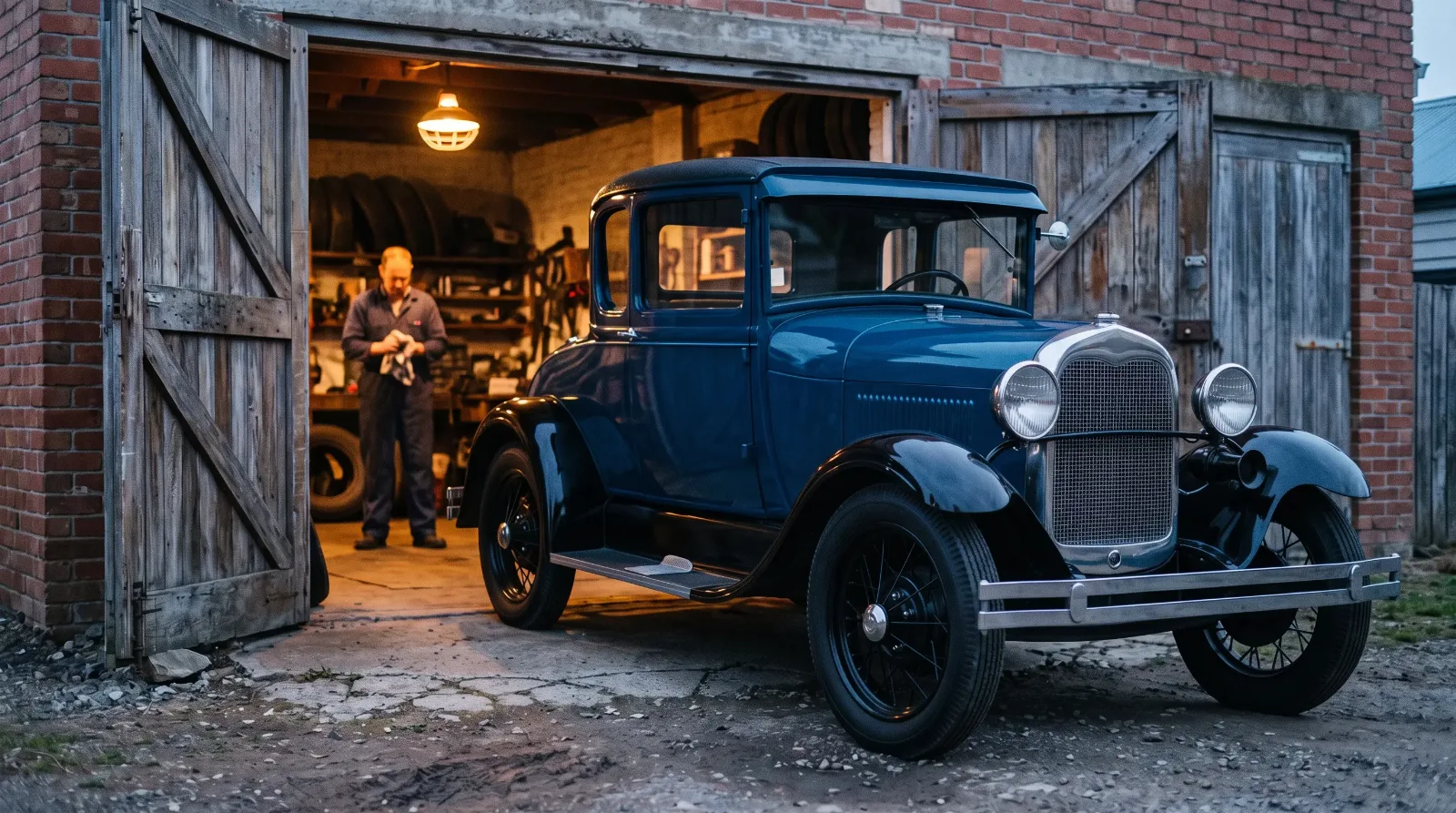
This piece covers what the box was, how it worked, how you drive it without grinding your way down the street, and what owners bolt on to make it live with modern traffic. The engine that feeds it is a separate subject, and so is the Model T engine story.
Why the Model A transmission was a big change
The Model T used a planetary transmission with two forward speeds and reverse. Bands inside the case did the work. Press the left pedal and you were in low. Let it out, with the hand lever forward, and you were in high. The center pedal was reverse, the right pedal was a band brake inside the transmission. Low was 2.75:1, reverse 4:1. It was simple to build and easy for a beginner, once the beginner forgot everything learned on any other car.
By the mid-1920s that was a problem. Chevrolet's 1927 Capitol AA already had a three-speed sliding-gear transmission, and buyers who drove both noticed. Ford's answer in the Model A was an unsynchronized three-speed sliding-gear manual with a single reverse. Accounts of Edsel Ford's role credit him with persuading his father to accept the sliding-gear box, along with four-wheel brakes. Henry Ford had built his reputation on the planetary. Giving it up was not a small concession.
There is also a story that when the first Model A came off the line, Henry declined to drive it for the photographers because he had never driven a standard-shift car, and Edsel did the honors. The site that tells it admits it does not know if the story is true, and I could not find a contemporary account that backs it. It is a good story. That is all it is until somebody finds a source.
| Item | Model T | Model A |
|---|---|---|
| Transmission type | Two-speed planetary plus reverse | Three-speed sliding-gear, unsynchronized, one reverse |
| How you select gears | Foot pedals (low and reverse bands) | Floor gearshift with a clutch pedal |
| Low gear ratio | 2.75:1 | 3.12:1 |
| Second gear ratio | None (high is direct drive) | 1.85:1 |
| Reverse ratio | 4:1 | About 3.75:1 |
| Standard rear axle | 3.64:1 | 3.78:1 (3.70:1 early 1928, 4.11:1 optional) |
| Pedals, left to right | Low/neutral/high, reverse, transmission brake | Clutch, brake, gas |
| Engine feeding it | 20 hp | 40 hp at 2,200 rpm |
How a sliding-gear box works
The principle is plain. Inside the case, gears on one shaft slide along it to mesh with gears on another. Each pair gives a different ratio. Move the shift lever and you physically push a gear sideways into mesh with its partner. In third, the drive goes straight through. That is the high gear, and it is where the car spends most of its life.
Unsynchronized means there is nothing inside to match the speed of the two gears before they meet. Synchromesh is a small clutch that does that job for you, and Ford did not add it until the 1932 Model B's three-speed got synchronizers. On a Model A, if the gears are turning at different speeds when you push them together, they clash. You hear it. Everyone on the sidewalk hears it.
Behind the box, the Model A kept a torque-tube drive to the rear axle, the same concept as the Model T. The standard axle ratio was 3.78:1. Very early 1928 cars used 3.70:1, which Ford dropped by a March 1929 service bulletin, and a 4.11:1 set was optional for owners who wanted more pull and less top end. Inside the box, hobby references give the stock gears as 3.12:1 in low, 1.85:1 in second and direct drive in third, with reverse at about 3.75:1. A 1962 Motor Sport profile of the car came at it another way, putting second at 54% and low at 32% of top gear, which works out to the same figures. I have not seen them in a Ford document, but two independent sources line up.
Driving it: double-clutch and listen
The controls look modern. Clutch on the left, brake in the middle, gas on the right, gearshift on the floor. There is a floor starter button to the left of the gas pedal, and the spark lever and hand throttle sit on the steering column. A driver who learned on a manual car can get a Model A moving in a few minutes. Shifting it well takes longer.
Owner driving guidance recommends double-clutching, and shifting to second at about 10 mph. Starting off, you push the clutch, select low, and pull away. Going up, you clutch, pull to neutral, let the clutch out for a moment, clutch again and slide into the next gear. The pause in neutral lets the gears slow toward matching speed. Going down, you blip the throttle in neutral to bring them back up. Get the timing right and the lever just drops in. Get it wrong and the box tells you.
"The Model A box does not punish you for being slow. It punishes you for being in a hurry. Wait for it and it shifts fine. Rush it and you buy gears."
Mike Sullivan
Overdrives, trucks and what owners change
A stock Model A will cruise all day at 45 to 50 mph. That was fine on a 1930 road. It is slow on a modern one, and that is why overdrives are the most common change owners make. With an aftermarket overdrive, a Model A will hold 60 mph or more. The Ruckstell Dual High was the period answer. The modern units named in club rules fit in the torque tube behind the transmission.
The clubs have a rule for that. Under MAFCA's touring class, a torque-tube overdrive is one of up to ten listed non-original parts that can be fitted, with the affected component capped at half its points. So an overdrive is accepted on a driver, not hidden. If you want full points in a judged class, the stock box stays.
The trucks went further. Early Model AA trucks used the three-speed box, but a four-speed with a very low "granny" first gear became standard during the 1929 model year, with a reverse lock-out on the shift knob. A loaded truck needed the extra low gear more than a car ever did.
Where the three-speed fits in the Ford story
The transmission is one piece of a larger change. The Model A also got four-wheel mechanical brakes, and anyone used to a Model T's transmission band will appreciate the brakes as much as the gearbox. Together they made a Ford that drove like other cars, which was the point. Ford's lead in sales came back in 1929, and a buyer no longer had to learn a Ford-only way of driving to get one.
Early 1928 cars, the ones collectors call "AR," can be spotted partly by their smooth clutch and brake pedals, used on roughly the first 70,000 to 80,000 cars. Small details like that are how restorers date a car, and they show how quickly Ford was revising the design. For the full picture of the move from Model T to Model A, the gearbox is the change you feel first, every time you pull away.
After 1931 the three-speed carried on. The four-cylinder Model B of 1932 kept a three-speed and added synchronizers to make shifting easier. That is the epilogue. The real change happened in 1927, when Ford finally put a shift lever in the floor.
Sources and notes
- Fordgarage: Model A and Model B transmission gear ratio table
- Motor Sport, April 1962: the Model A Ford
- Fordgarage: Model A rear axle ratios and part numbers
- Fordgarage: Ruckstell Dual High transmission for the Model A
- MAFCA: judging procedures, including the touring class
- Old Cars Weekly: 1930 Ford Model AA, car of the week
Related Reading
Have a
Ford Model A
for Sale?
Reach thousands of serious classic car collectors across the US.
Sell It Here →
Selling a classic? Here's how: the best sites to sell a classic car
Are You a Classic Car Dealer?
List your full inventory and connect with targeted classic car buyers.
Join as a Dealer →
#automotive history
#manual transmission
#ford model a
#ford model t
#Model A transmission
#Model A driving

About the author
Mike Sullivan
Detroit-area muscle car enthusiast and restoration specialist with three decades of hands-on experience working on American iron.
Related Listings - Ford Model A




Comments
Be the first to comment on this article.