
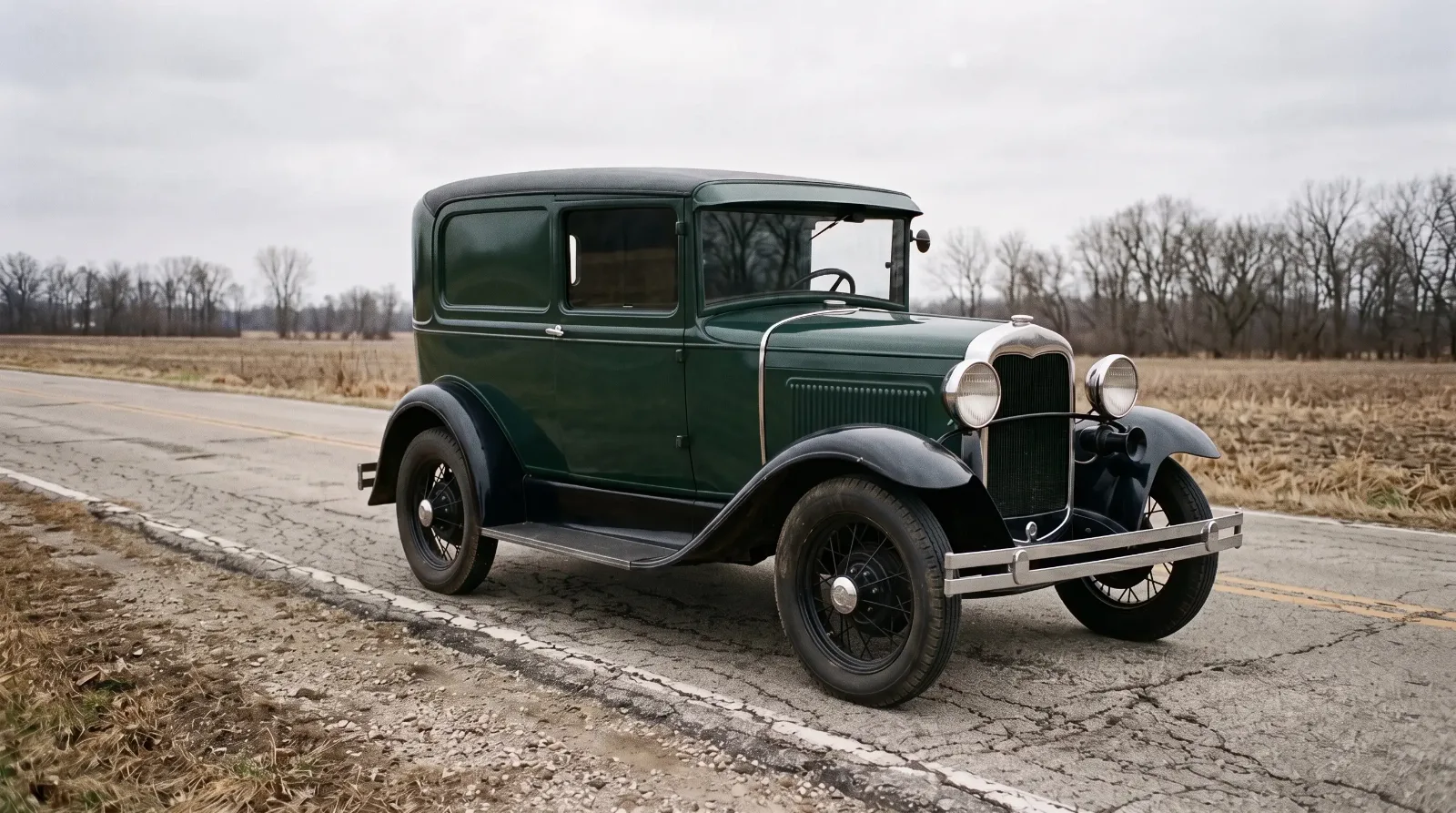
The baker, the florist and the dairy route man did not want a pickup. They wanted a box that kept the rain off the bread, locked at the back, and still looked respectable parked at the curb. Ford answered with two light delivery bodies on the Model A car chassis: the panel delivery, a plain working box, and the Model A sedan delivery, a dressed-up commercial car built to look like it belonged on a showroom floor. Both are rare now, both are expensive to restore properly, and most people mix them up.
Car Features
7 min read
The Model A Panel Delivery and Sedan Delivery
Ford's two light delivery bodies on the Model A chassis: the plain panel and the 130-A sedan delivery, who built them and what restoration costs.
The heavy trucks and the pickups are covered here. This piece sticks to the two enclosed delivery bodies: what they were, who built them, how to tell them apart, and what one costs to put right in 2026.
Ford's commercial line for 1929
From 1929 Ford offered commercial bodies on the Model A chassis, "no fewer than eighteen body styles" by one count. Ford did not build most of them in its own body shops. The light commercial bodies came from Murray and Briggs, the same Detroit firms that built so many of the passenger bodies, with Budd and Baker-Raulang supplying others.
Underneath, the delivery cars were Model A cars: the 103.5 inch wheelbase, the 40 hp four, the three-speed gearbox. That matters to anyone buying one today. The running gear is the most common Model A hardware there is, and the parts supply for it is deep. The body is the hard part.
The line was broad. Across its car and truck chassis Ford's commercial bodies ran from ambulances and school buses to garbage trucks and "police patrols"; the patrol and radio cars have their own story under the police cars. Most of those rode on the bigger AA. The panel and the sedan delivery were the small end, sized for a man running a shop rather than a fleet.
The panel delivery: a box with doors
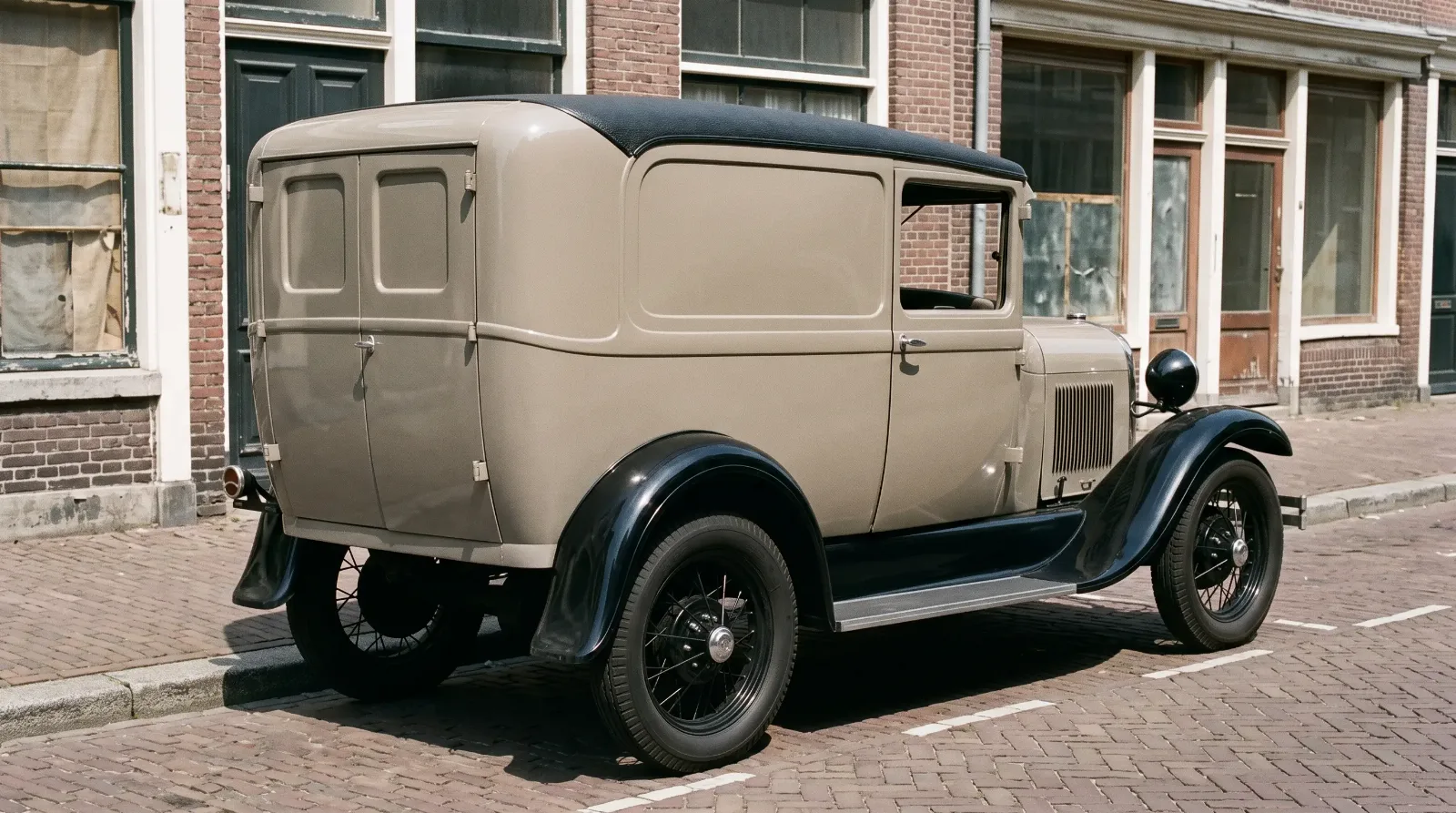
The panel delivery is the plainer of the two. No side windows behind the doors, solid blind side panels, and cargo doors at the rear. It suited exactly the trades you would guess: bakeries, dairies, florists, anyone who wanted a load kept clean and out of sight and wanted the side panels for sign painting. The car-chassis panel was in fact older than the wider commercial line: a museum example built in March 1928 carries the body code 79-A, and dealer listings give 79-B for the updated 1930 and 1931 body.
Do not confuse it with the AA panel. The heavier Model AA truck had its own panel delivery bodies, 85-A from August 1928 to June 1930 and 85-B after that. Same idea, bigger truck, different parts. When someone advertises "a Model A panel," the first question is which chassis it sits on, and the second is whether the body code agrees with it.
Murray built some of the panel deliveries and Briggs others, and nearly a century of working life and repair has done the rest. That is one reason survivors vary so much in detail, and why a stock-looking panel deserves a closer look at its framing and tags before anybody calls it original.
The Model A sedan delivery: the 130-A
The sedan delivery was Ford's answer for the merchant who wanted a car, not a truck. Ford called its version the Deluxe Delivery, body 130-A. Budd in Philadelphia supplied the body as a framed, assembled steel unit, less cowl and gas tank, so it took the passenger car's cowl and tank at assembly. Budd plant photos of the body date to late 1928, but the exact introduction date is not confirmed; club accounts put the first production cars in the spring of 1929. For 1931, the last Model A year, the body became the 130-B, with a base price of $540, and Old Cars Weekly credits both Budd and Briggs with building Deluxe Delivery bodies.
What you get is the front of a Model A car with a closed, steel rear body behind the doors and a door at the back. It looks like a passenger car until you walk around it. That was the point. A dress shop or a pharmacy could make deliveries without parking a truck out front.
Early production counts for the 130-A and the panel are not documented in anything I would stake a valuation on, so I will not quote one. The 1931 car is better recorded: the Standard Catalog of Light-Duty Ford Trucks gives 9,906 Deluxe Deliveries for the 1931 model year. Survivors are still thin on the ground, which the auction record bears out: a 1931 DeLuxe Sedan Delivery brought $25,850 at RM Sotheby's Hershey in 2019 (lot 411).
"The engine and the gearbox will never be your problem on one of these. Every swap meet in the country has them. The body is your problem, and nobody is stamping out new sedan delivery rear panels on a Saturday morning."
Robert Halloran
| Body | Code | Chassis | Builder | Notes |
|---|---|---|---|---|
| Panel delivery | 79-A, later 79-B | Model A car | Murray, Briggs | Blind sides, rear doors; 1928 to 1931 |
| Deluxe Delivery (sedan delivery) | 130-A; 130-B for 1931 | Model A car | Budd (steel body less cowl and tank); Budd and Briggs by 1931 | Passenger car front; from 1929; a 1931 DeLuxe Sedan Delivery sold $25,850 in 2019 |
| AA panel delivery | 85-A, then 85-B | Model AA truck | Not documented | 85-A August 1928 to June 1930; 85-B from June 1930 |
| Town Car Delivery | 295-A | Model A car | Briggs (aluminum body) | About 192 built in 1930 and 1931 |
| Special Delivery | 255-A | Model A car | Baker-Raulang | Rare; builder also made Ford wood bodies |
The rare cousins: Town Car Delivery and Special Delivery
Two more delivery bodies sit at the top of the rarity list. The Town Car Delivery, style 295-A, had an aluminum body by Briggs, with about 192 built in 1930 and 1931. It is often called the rarest Model A body style of all. The Special Delivery, 255-A, came from Baker-Raulang, the firm that also built some of Ford's wood bodies. If one of those turns up, the paperwork and the body tags matter more than the paint, because a convincing copy is easier to build than an original is to find.
Buying and restoring one in 2026
Here is the practical side. The chassis, engine, transmission, rear end, brakes and front sheet metal on a panel or sedan delivery are standard Model A parts. They are cheap by old-car standards and easy to get. The rear body is where the money goes. Original panels rust from the inside out where cargo floors held water, and reproduction sheet metal for these low-volume bodies is limited, so a lot of the work is fabrication by hand.
Run the numbers before you buy a project. The two documented sales above sat in the mid twenty thousands for finished 1931 cars. A rough panel that needs a new floor, new lower panels and rear doors can eat a big share of that in body labor alone, before upholstery and paint. A solid, honest car at a fair price is usually the better deal than a cheap one that needs the box rebuilt.
Sources and notes
- 1931 Ford Model A Panel Delivery, Hershey 2021 (RM Sotheby's)
- 1931 Ford Model A DeLuxe Sedan Delivery, Hershey 2019 (RM Sotheby's)
- Budd and the 1929 Model A Deluxe Delivery 130-A (Ford Garage)
- 1928 Ford Model A Panel Delivery, body 79A (Owls Head listing on ClassicCars.com)
- NYPD parade of 1931 Model A roadsters and Ford commercial bodies (The Henry Ford)
- A Model delivery: the 1931 Deluxe Delivery 130-B (Old Cars Weekly)
Related Reading
Have a
Ford Model A
for Sale?
Reach thousands of serious classic car collectors across the US.
Sell It Here →
Selling a classic? Here's how: the best sites to sell a classic car
Are You a Classic Car Dealer?
List your full inventory and connect with targeted classic car buyers.
Join as a Dealer →
#classic trucks
#ford model a
#Model AA
#Model A sedan delivery
#Model A panel delivery
#Ford commercial vehicles
#Budd

About the author
Robert Halloran
Texas-based classic truck enthusiast with decades of experience buying, restoring, and writing about American pickups from the 1940s through the 1980s.
Related Listings - Ford Model A


Comments
Be the first to comment on this article.