
Ask anybody who grew up around these cars what they remember about a Model A, and sooner or later the conversation lands on the back deck. Somebody's uncle rode back there in a thunderstorm. Somebody's grandmother claimed she was courted back there, which explains a great deal about that side of the family. The Ford Model A rumble seat is the part of the car people tell stories about, and it sits on the cheapest Model A Ford ever sold: the Roadster. This is the story of that body and that little folding seat, and of what the records do and don't tell us about them.
Car Features
7 min read
The Model A Roadster and Its Rumble Seat
The cheapest Model A had the best seat in the house. How the Roadster and its folding rumble seat worked, what they cost and what changed in 1930.
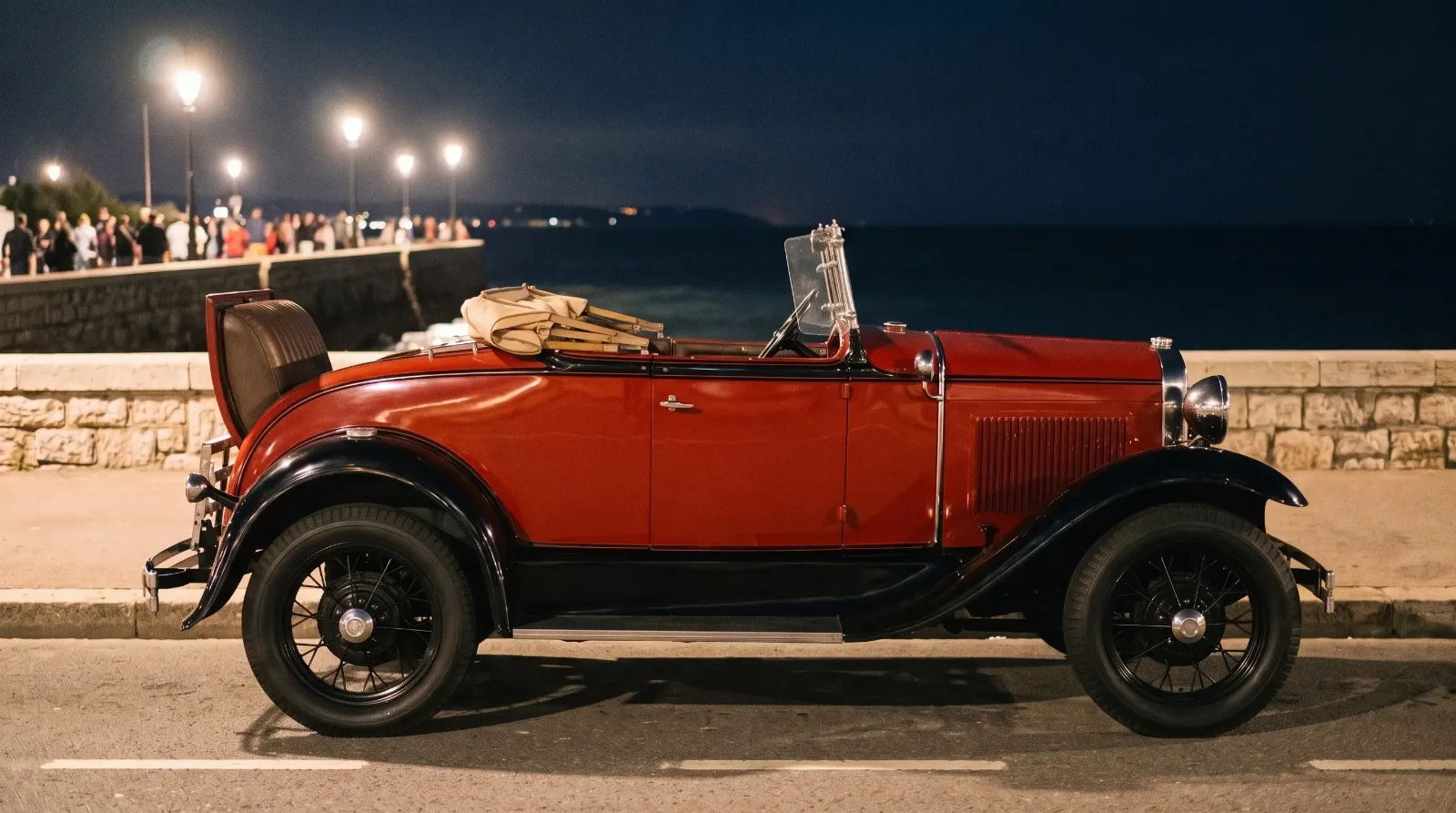
The cheapest ticket in the Ford showroom
When the Model A arrived in late 1927, the Roadster was the price leader. It listed at $385 f.o.b. Detroit for 1928, the lowest number on the whole Model A sheet, ten dollars under the Phaeton and $185 under the Fordor. That made it the car for the young fellow with a job, a girl and not much else.
Ford called it body style 40-A, and the first ones carried panel assemblies from Budd. For 1930 the body was redone as the 40-B, and from August 1930 it came in two flavors, Standard and DeLuxe. The way to tell them apart is up top. The DeLuxe has a shorter windshield and a lower, racier top; the Standard stands taller on both counts. If you want the full family tree of closed and open bodies, there is more on that here.
The prices moved around a little over the four years, and they tell you the Roadster never lost its place at the bottom of the ladder by much.
| Year | Body | Roadster list price | DeLuxe Roadster |
|---|---|---|---|
| 1928 | 40-A | $385 | Not offered |
| 1929 | 40-A | $435 | Not offered |
| 1930 | 40-B | $450 | $520 |
| 1931 | 40-B | $430 | $475 |
Those are U.S. list prices without accessories. One footnote for the price hunters: a Hagerty listing puts the 1930 DeLuxe at $495, but the club table and Mac's both say $520, and two against one wins this round.
How the Ford Model A rumble seat works
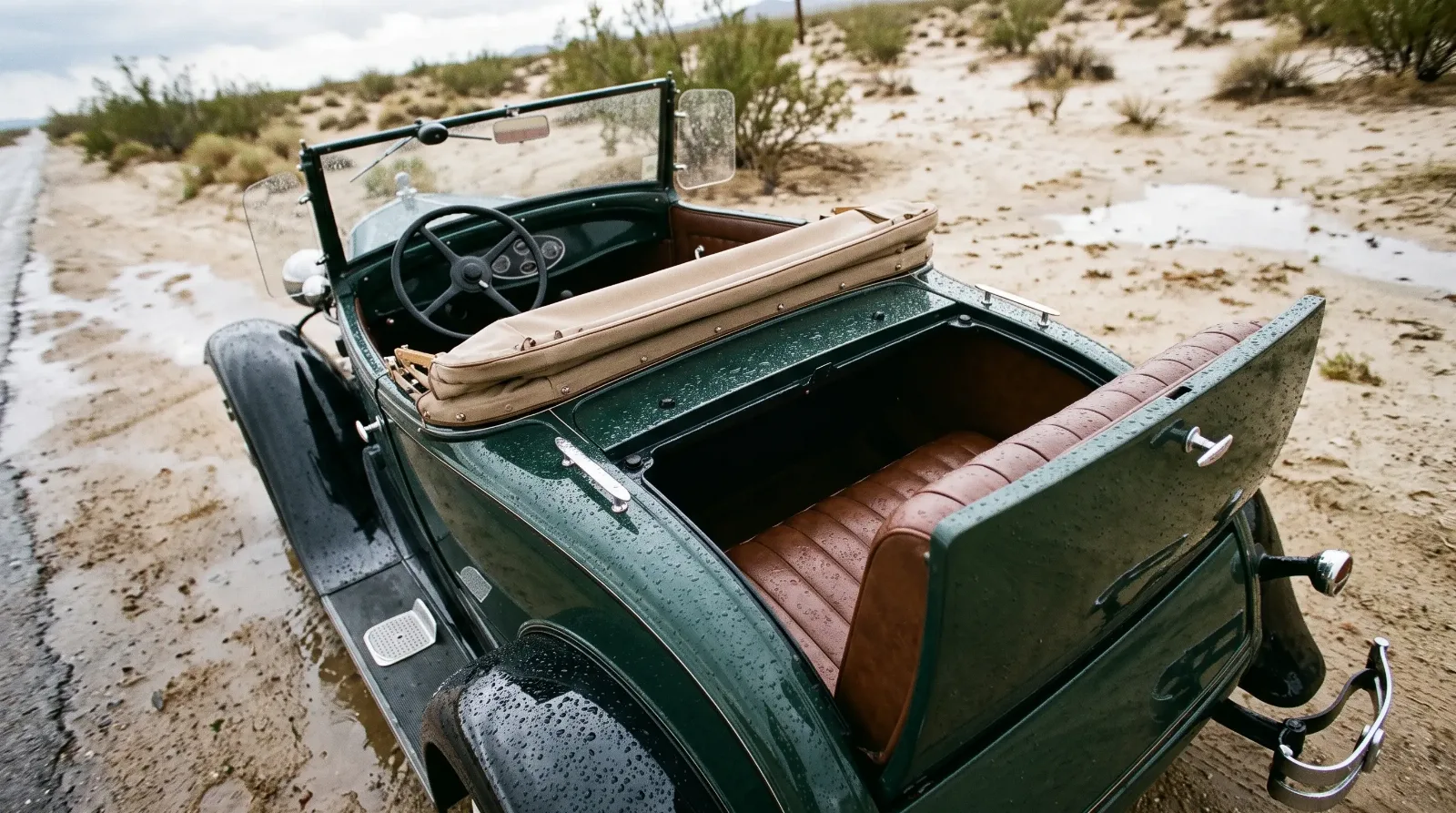
A roadster is a two-seater. One bench, one door on each side, a folding top and side curtains for the rain. The rumble seat is how Ford and every other maker of the period squeezed two more people into the thing without building a bigger car.
The idea is simple. Where a sedan would have a trunk, the rumble-seat roadster has a deck lid hinged so it swings open rearward. The underside of that lid is upholstered, and when it opens it becomes the backrest. A cushion sits in the well below. Your passengers climb up from the outside, sit down in the open air and ride behind the driver with nothing overhead but sky. Close the lid and it is a deck again, and nobody can tell from across the street.
Getting in was the hard part. Riders went up over the rear fender and the bumper, which is why step plates show up on so many of these cars. Parts suppliers date the round style, which sits on the rear fender and on the bumper bracket, from February 1929 to 1931. Plenty of the plates on cars today are reproductions, and nobody has shown me factory paper on which ones came from the dealer as extras. If you see a set on a Roadster, don't assume anything. Go looking for paper.
The Roadster was not the only Model A with a rumble seat. The Sport Coupe, with its fabric-covered fixed roof and decorative landau irons, had one too, and so did the Cabriolet, which seated two up front plus two in the rumble. If you are trying to sort out which closed two-door got what, start with the coupes.
Standard equipment or option?
Here is where the old-timers start arguing over the pie, and here is where I have to be honest about the record.
For the 1930 to 1931 40-B, the evidence is fairly clear. The Roadster "could be had with or without sidemounts, or with or without a rumbleseat." So on the later cars the rumble seat was a choice. A buyer who needed a place for a toolbox or a suitcase could skip it and have a plain rear deck.
For the 1928 to 1929 40-A, I have not found factory paper that says whether the rumble seat was standard or optional. An RM Sotheby's catalogue for a 1928 Roadster calls it "the optional, iconic rumble seat," but an auction description is not a Ford price list. You will hear both from people who sound very sure. The men who wrote the judging standards spent decades on questions like this one, and if it matters to your car, their published rules and the factory literature are where you settle it, not a swap-meet table.
"Every Model A Roadster at a car show has a rumble seat full of grandkids. That tells you what people wanted. It doesn't tell you what Ford built, and those are two different questions."
Gary Nowak
What changed for 1930 and 1931
The 1930 restyle touched every Model A, and the Roadster got its share. The hood and radiator went up, the radiator shell went to stainless steel, the cowl rose and made room for a bigger fuel tank, and the wheels dropped from 21 inches to 19 with wider tires. The car sat lower and looked longer, though nobody has shown me a source saying the body itself grew. On the Roadster and the Phaeton, the windshield now folded down.
The Roadster kept selling. Ford built 124,214 roadsters for 1930, and 11,313 of those were DeLuxe models, according to a single catalog source. That is a lot of rumble seats, or a lot of plain decks. The production figure doesn't say which, and I'm not going to guess.
The Roadster also went to work. In December 1931 the New York police paraded 244 of the 1931 Model A roadsters in their fleet. A cop on patrol had no use for two extra passengers in the open air, unless he was giving somebody a ride they didn't want.
Underneath, the Roadster was the same car as every other Model A: a 103.5-inch wheelbase and a 200.5 cubic inch four rated at 40 hp at 2,200 rpm in the gross rating of the day. Light body, same engine, so the Roadster was a lively one by the standards of its time.
Buying and riding in one today
A rumble-seat Roadster is a car you use with people. That is the whole point of it. When you go looking at Model A roadsters for sale, check that seat the way you'd check the engine.
Riding back there in 2026 is the same as riding back there in 1929. Wind in your face, the exhaust somewhere below, the driver's conversation lost to the road. Kids love it. Adults love it for about twenty minutes, then start asking how much longer.
Not every Roadster stayed stock, of course. The light body and simple frame have long made the Model A Roadster a favorite starting point for hot rodders. If you want to see what builders do with one today, the street rod world has plenty to show you, rumble seat and all.
For my money, though, the best Roadster is the one that still has its original rumble lid, a few scuffs on the bumper where the shoes went up, and a family that knows who sat back there first.
Sources and notes
- MAFCA: Model A new car prices, 1928 to 1931
- RM Sotheby's: 1931 Ford Model A DeLuxe Roadster (40-B with or without rumble seat)
- RM Sotheby's: 1930 Ford Model A DeLuxe Rumbleseat Roadster (DeLuxe windshield and top)
- RM Sotheby's: 1928 Ford Model A Roadster
- The Henry Ford: NYPD vehicle parade, December 1931
- Belchers: Model A round step plate, 1929 to 1931
Related Reading
Have a
Ford Model A
for Sale?
Reach thousands of serious classic car collectors across the US.
Sell It Here →
Selling a classic? Here's how: where to sell your classic car online
Are You a Classic Car Dealer?
List your full inventory and connect with targeted classic car buyers.
Join as a Dealer →

About the author
Gary Nowak
Lifelong Midwest rodder who has been building and driving traditional pre-war hot rods since the 1970s.
Related Listings - Ford Model A




Comments
Be the first to comment on this article.