
Most Model A owners meet the carburetor the hard way: the car won't start, or it starts and then dies at the first stop sign. The Model A carburetor is a simple thing. It is a single-throat updraft unit, fed by gravity from a tank in the cowl, and on most cars it is a Zenith design. It is also the one part of the engine you can adjust from the driver's seat while the car is moving. That rod on the dash is not decoration. Learn what it does and the car gets a lot easier to live with.
Car Features
8 min read
The Model A Zenith Carburetor and Its Dash Controls
How the Model A carburetor works, who made it, and how the dash rod runs both the choke and the gas adjusting valve.
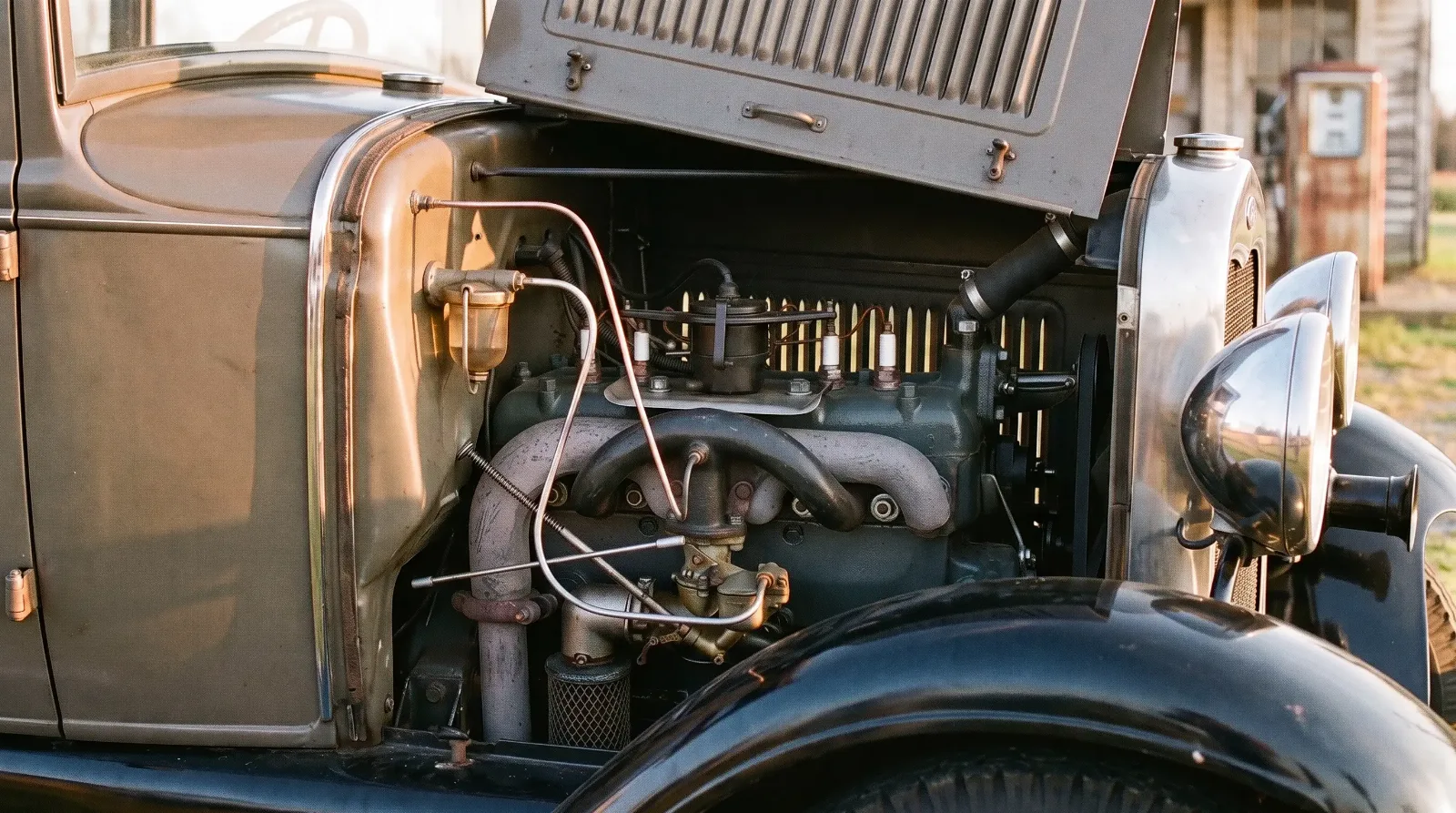
This piece stays with the fuel side: what the carburetor is, who made it, how the dash control works and what goes wrong. For the bigger picture of both four-cylinder Fords there is more on the engines cars elsewhere in the series.
What the Model A carburetor actually is
An updraft carburetor sits below the intake manifold and air comes in at the bottom, moving up through the venturi and into the engine. Fuel arrives from a float bowl. The float keeps the bowl at a set level, the venturi drops the air pressure as air speeds through the narrow section, and that pressure drop pulls fuel out of the jet. There is one throat, one venturi and one barrel. Mac's lists the venturi at .846 inch.
The fuel gets there without a pump. The Model A kept the Model T's habit of gravity feed, with the tank in the cowl between the firewall and the dash. It held 10 gallons on 1928 and 1929 cars and 11 gallons on 1930 and 1931 cars, after the restyle raised the cowl. The gas gauge sits in the tank itself, so you read it right in front of you. Gravity does not care about engine speed or vacuum. As long as the tank is higher than the carburetor and the line is clear, fuel flows.
The engine it feeds is the 200.5 cubic inch L-head four: 3-7/8 inch bore, 4-1/4 inch stroke, 40 horsepower at 2,200 rpm on the period gross rating, 4.22:1 compression on 1929 to 1931 heads (4.3:1 for the 1928 head). A slow-turning engine like that is a forgiving customer.
Zenith, Holley, Tillotson: who made yours
Ford bought carburetors from more than one maker, the same way it bought bodies and other parts. The design belonged to Zenith, but Ford's old Model T supplier Holley built many of them under licence, and from 1931 Ford made its own version, cast "Zenith-3", with noticeably thinner and more fragile castings. Tillotson units also turn up on Model As, though owners still argue over whether any left the factory that way. Wikipedia goes further and says another 19 brands were fitted to various Model A engines, a count that surely includes decades of replacements.
Why does it matter? Two reasons. First, parts. A Zenith kit fits a Zenith. Order by maker, not by "Model A carburetor," or you will be returning a box. Second, judging. The club preliminary check for an original-type car lists the carburetor as Holley, Zenith or Ford. A modern replacement or a carburetor from another engine is a deduction, and for some events a disqualification.
The Model A Zenith is a cast iron unit mounted on the passenger side of the engine. It rusts on the outside, but a Zenith that has sat for decades usually comes apart. The question is what you find inside.
The dash rod: choke and gas adjusting valve in one
Here is the clever bit. On the Zenith cars a single control rod runs from the driver's compartment to the carburetor and does two jobs. Pull it and it closes the choke. Turn it and it works the gas adjusting valve, which owners call the GAV. One knob, two functions, and both of them matter every time you drive.
The choke is simple. Closing the plate at the bottom of the throat cuts the air, the engine pulls harder on the jet, and you get a rich mixture for a cold start. Push it back in once the engine catches, or you will soak the plugs.
The GAV is the part people skip. It is a needle that meters fuel into the main jet. Turn it one way and the mixture goes richer, turn it the other and it goes leaner. On a cold morning you run it a little rich. Once the engine is warm you lean it back until the engine runs smooth and pulls clean. On a long grade or a hot afternoon you may touch it again.
"Half the Model As I see that run badly have nothing wrong with them. The owner just never touches the GAV. It's there to be used. Set it warm, set it by ear, and stop blaming the carburetor."
Mike Sullivan
The other hand controls are the spark and hand throttle levers under the steering wheel. Spark retarded for starting, advanced once it runs. The hand throttle holds a fast idle while the engine warms. Put those together with the dash rod and you have the whole starting routine: fuel on, spark back, rod turned a little rich, choke pulled as you press the starter on the floor. The car will tell you when to push the choke in.
What goes wrong with a Model A carburetor
Gravity feed is reliable, but it has a weakness. Anything in the tank ends up in the carburetor. Rust flakes, old varnish and dirt from a tank that sat dry for decades will all find the float needle sooner or later. When the needle cannot seat, the bowl overfills and fuel runs out. When dirt blocks the jet, the engine starves.
- Flooding at rest. A dripping carburetor with the engine off usually means a stuck float or a dirty needle seat. Fix it quickly. Fuel dripping near a hot manifold is a fire.
- Won't idle, runs fine on the road. Check the idle adjustment and look for an air leak at the manifold gasket before you buy anything.
- Stumbles when warm. Probably too rich. Lean the GAV before tearing anything apart.
- Dies on hills. Check the fuel level and the line. With 10 or 11 gallons in a cowl tank the head height is good, but a partly blocked line will show up under load first.
Should you rebuild or replace? Rebuild. A cast iron Zenith is a simple thing with few moving parts, and kits are cheap and easy to find because so many million were made. Take it apart on a clean bench, soak it, blow out every passage, set the float level, and put it back with new gaskets. The parts the kit replaces are the parts that wear. The body rarely does.
Replacement carburetors exist, and some owners like them. That is a choice for a driver, not a show car. For anyone headed for judging, an original Zenith, Holley or Ford unit is the right answer, and a good one is not hard to find.
One more thing before you condemn the carburetor. Plenty of fuel problems are ignition problems in disguise. Weak spark makes a rich mixture look like flooding. Check the points and the timing first. The Model A's distributor and coil setup is a big step up from the Model T's magneto and coil box, but it still wears.
Model T versus Model A: what Ford changed at the carburetor
The Model T used a single side-draft carburetor from Holley, Zenith or Kingston, depending on year, with one adjustment, a gasoline needle valve worked from the dash. Ford's manual called it the "automatic float feed type, having but one adjustment." The Model A switched to an updraft unit and gave the dash rod a second job, the choke. Both cars rely on gravity. Both put the driver in charge of mixture.
| Item | Model T | Model A |
|---|---|---|
| Carburetor type | Single side-draft, single venturi | Single-throat updraft |
| Main makers | Holley, Zenith, Kingston | Zenith design (reportedly about 3.5 million cars), also built by Holley and, from 1931, Ford |
| Dash control | Gasoline needle valve | One rod: choke (pull) and gas adjusting valve (turn) |
| Fuel feed | Gravity, 10 gallon tank | Gravity, cowl tank, 10 gallons (1928 to 1929), 11 gallons (1930 to 1931) |
Behind the carburetor, the rest of the drivetrain changed just as much, with the three-speed replacing the Model T's planetary gears. If you want the T's engine numbers side by side with this one, read more here. For the Model A owner, though, the lesson is short. Keep the tank clean, learn the dash rod, and the Zenith will start the car every morning.
Sources and notes
Related Reading
Have a
Ford Model A
for Sale?
Reach thousands of serious classic car collectors across the US.
Sell It Here →
Selling a classic? Here's how: sell my classic car
Are You a Classic Car Dealer?
List your full inventory and connect with targeted classic car buyers.
Join as a Dealer →
#ford model a
#vintage car maintenance
#Model A engine
#Model A carburetor
#Zenith carburetor
#gas adjusting valve

About the author
Mike Sullivan
Detroit-area muscle car enthusiast and restoration specialist with three decades of hands-on experience working on American iron.
Related Listings - Ford Model A




Comments
Be the first to comment on this article.