
A farmer in 1917 did not buy a Model T to admire it. He bought it to work, and if it could haul cream to town on Saturday and saw firewood on Monday, so much the better. Model T farm use came in three flavors: plain hauling, belt power off the engine, and full tractor conversions sold as bolt-on kits. This piece is about the last two, because that is where the farm got creative and where a lot of the surviving hardware came from.
Car Features
7 min read
The Model T on the Farm: Tractor Kits, Belt Power and Conversions
Belt power, the 1917 tractor kit boom and the Pullford conversion: how farmers put the Model T to work, and what to know about a kit tractor today.
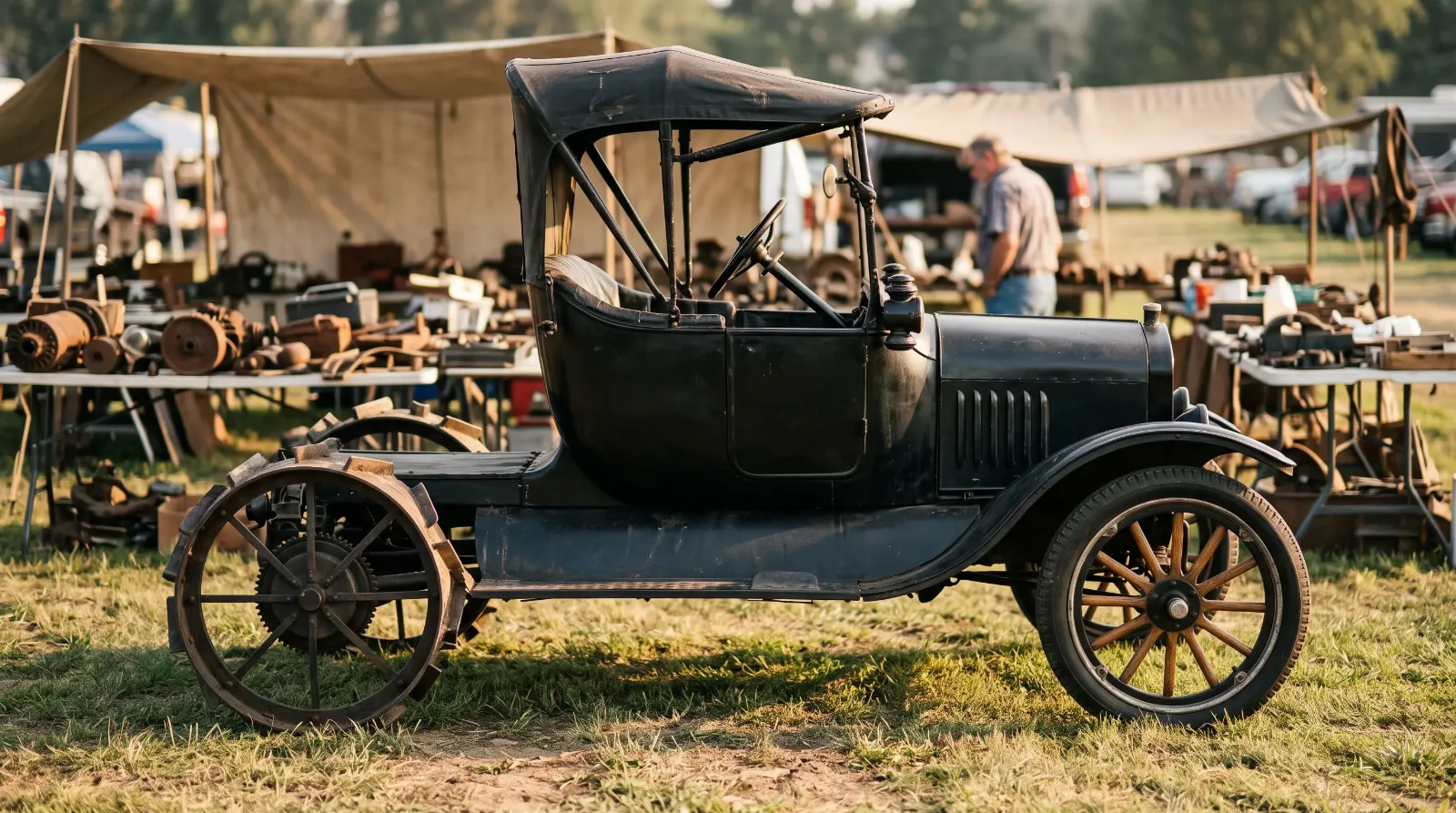
The bigger picture of how the car spread across the country, from 1908 to 1927, is laid out in the parent history, and there is more on that here. What follows stays in the barnyard.
Model T farm use on the belt: one engine, a dozen jobs
Before the car showed up, a farm that wanted stationary power bought a gas engine, kept a steam rig, or hired a threshing crew. The Model T put a 20 horsepower four under the hood of something the family already owned. Farmers ran belts off it to drive threshers, saws, pumps and generators. That is a long list of chores for one machine that also took the kids to school.
The rig was simple in principle. You got power off the car, ran a flat belt to the machine, and let the engine idle along at a steady speed. Makers sold belt-power attachments for exactly this job. One, built by the E-Z Power Mfg. Co. of Atchison, Kansas, had a clutch so the engine could be cranked before the pulley was put to work. A buzz saw on a frosty morning or a water pump in August did not care what was turning it.
There was a catch, and anyone who has run a T hard on a hot day already knows it. The Model T engine had no water pump. It relied on thermosiphon cooling, where hot water rises to the radiator and cooled water sinks back, and the 1919 manual says circulation starts around 180 degrees. On the road, the car moves air through the radiator. Parked in a barnyard under a steady load, it does not. Overheating was the price of a long day on the belt, and owners learned to watch it.
The 1917 tractor kit boom
Tractors were rare on American farms. In 1920 only about 4 percent of farms had one, and about 2 percent had a truck. The Model T, by contrast, was everywhere. So a small industry sprang up selling kits that turned the family car into a light tractor.
About a dozen companies made them. In 1917 several of those makers met in Chicago and formed the National Tractor Attachment Association. The kits had catchy names and confident advertising, and the trade press of the day carried them alongside plows and harrows.
| Kit | Maker and base | What the record shows |
|---|---|---|
| Staude Mak-a-Tractor | E.G. Staude Mfg. Co., St. Paul, Minnesota | The best-known kit; company claimed 7,000 sold in 1917 |
| Smith Form-a-Tractor | Chicago | Debuted in Farm Implements, April 30, 1917; ad line "$255 and a Ford" |
| Pullford | Pullford Co., Quincy, Illinois | $135; gears slowed the rear axle; museum example on a 1923 Model T |
| Me-Go | Megow | On the market in 1916 |
| Knickerbocker Forma-Tractor | Knickerbocker | Company went into receivership in 1920 |
| Others | Curtis, Geneva, 3-P Auto Tractor, Unitractor, Shaw | Sears and Montgomery Ward also sold kits |
Read those claims the way you would read a seller's ad today. Staude told Farm Implements in November 1917 that it had sold 7,000 and held 20,000 orders. That is the company talking, not an audit. Smith claimed its Form-a-Tractor went on in 15 minutes. I have yet to meet anybody who has bolted anything onto a Model T in 15 minutes, but I believe the ad ran.
How a kit turned a car into a tractor
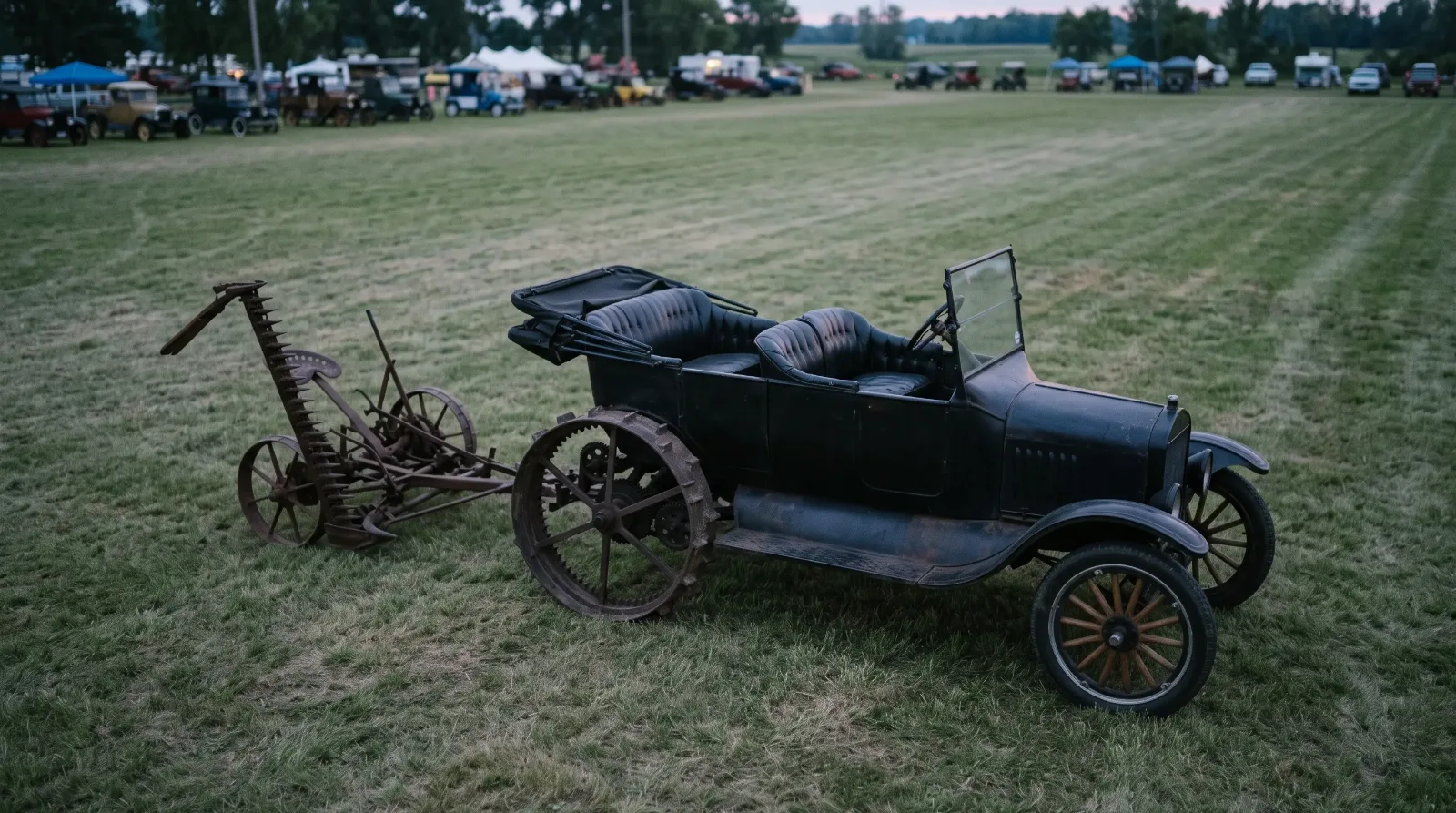
The basic problem is gearing. A Model T is geared to run down a road. A plow wants a slow, steady pull with a lot of torque at the drawbar. The kits fixed that by putting reduction gearing between the car's rear axle and a new set of drive wheels.
The Pullford kit is the clearest example because a museum has one. It was made by the Pullford Co. of Quincy, Illinois, which started building it in October 1916, sold for $135, and used gears to slow the speed coming off the T's rear axle. The surviving example is fitted to a 1923 Model T and dated 1923 to 1925. The owner took off the rear wheels and fenders, an eight-tooth pinion went on each hub, and a pair of lugged steel wheels on a special rear framework took the work, with the gear reduction turning them slow enough to pull an implement.
Most kits worked along the same lines: a heavier frame extension or brackets, a reduction drive, steel wheels with cleats, and a way to steer from the driver's seat as usual. The Pullford was meant to come off again: a Quad Cities history says it could be removed in about 10 minutes, so the car could go back to being a car on Sunday. That was the selling point. One purchase, two machines.
"A kit like the Pullford was cheap power for a farm that could not justify a real tractor. It also put tractor loads through a car drivetrain that was never designed to see them, and the ones that survived usually show it."
Robert Halloran
Ford had its own answer by then. Joseph Galamb, the engineer behind much of the Model T, worked on the Fordson tractor from 1915, and Fordson tractors were built at River Rouge from 1921. Ford also built purpose-made trucks, the one-ton TT and later the factory pickup, and you can read more here on those. A farmer who could afford a proper tractor or truck had less reason to load up the family car.
Why the kits faded
The kit boom peaked around 1917 and did not last. Knickerbocker went into receivership in 1920, and that tells you something about the trade. Ford was building its own tractor at scale, and a converted touring car was always a compromise: light, with a cooling system that hated slow, heavy work.
The kits had their moment in the war years, the same years that sent Model Ts to France as the ambulances of 1917. When that pressure eased and purpose-built machines came within reach, most farmers who could buy a tractor bought one. Belt work lasted longer, because a T with a pulley was still handy for odd jobs long after it stopped pulling a plow.
Finding and keeping a converted T today
Kit tractors turn up at swap meets, farm auctions and in the back of machine sheds. The question with any of them is the same: how much of the kit is really there, and how much of the car underneath is worth saving?
Here is the practical side. The Model T car parts are the easy part. Engines, transmissions, axles and body panels are still reproduced or found used, because so many Ts were built. The kit parts are the hard part. Nobody is reproducing gear housings for a company that went under in 1920, so a missing casting means fabricating one or hunting for years.
On economics, be honest with yourself. A complete, identified kit on a sound T is a display piece and a conversation starter at a show. A pile of rusty gears with no name on them is a project that will cost more in time than it ever returns. Either way, it is real farm history, and those are worth keeping.
Sources and notes
- Farm Collector: the tractor conversion boom
- The Henry Ford: Pullford farm tractor converted from a 1923 Model T
- Historical Society of the Quad Cities: tractor maker was careful to hedge its bet
- Gas Engine Magazine: Staude Mak-a-Tractor and the E-Z Power attachment
- Richmond Fed: farm cars, trucks and tractors around 1920
- Wikipedia: Ford Model T
Related Reading

Have a
Ford Model T
for Sale?
Reach thousands of serious classic car collectors across the US.
Sell It Here →
Selling a classic? Here's how: where to sell your classic car online
Are You a Classic Car Dealer?
List your full inventory and connect with targeted classic car buyers.
Join as a Dealer →
#ford model t
#farm history
#Rural America
#tractor conversion
#Pullford
#Staude Mak-a-Tractor
#belt power

About the author
Robert Halloran
Texas-based classic truck enthusiast with decades of experience buying, restoring, and writing about American pickups from the 1940s through the 1980s.
Related Listings - Ford Model T
Comments
Be the first to comment on this article.